Pregnancy and bodily alienation
The Lost DaughterPregnancy and bodily alienation name a central contradiction in Leda’s experience of motherhood: she wants to make reproduction an intentional, intelligible project, yet repeatedly encounters the body as a force that exceeds her plans. Her first pregnancy seems to confirm her capacity for control and imaginative transformation; her second breaks that confidence. The difference follows her into the work of raising Bianca and Marta, where tenderness and care coexist with fatigue, resentment, and a desire for a life beyond maternal demands.
Reproduction and the Body
Leda understands pregnancy through a tension between continuity and separation. A child is biologically part of the mother, but the developing life also moves away from her, becoming another person. In her reflection on Bianca and Marta, reproduction appears at once as an embodied process and as something shaped by social expectations. After Bianca’s birth, Leda planned a second child partly because those around her believed a child needed a sibling. She was twenty-three when Bianca was born and twenty-five when she planned to have Marta; the decision belonged not only to her private wishes but also to a shared belief about what a family should be.
That account does not make Leda’s pregnancies interchangeable. It instead emphasizes how differently she experiences the two. The first child’s arrival is later remembered as intensely joyful, while pregnancy with the second seems to turn her body into unfamiliar territory. The body that sustains life is also the body through which Leda feels separation, strain, and a loss of command. Her conflict is not a simple rejection of motherhood: it is a struggle over how much of herself reproduction asks her to give up, and whether she can shape that demand into a form she recognizes.
The First Pregnancy as a Project
Leda approaches her first pregnancy as something to observe, organize, and incorporate into a deliberate account of herself. In contrast to the women in her family, whose pregnancies she remembers as physically transforming them, she insists on being different and rebellious. She follows medical instructions rigorously and wants to experience the nine months with pleasure while monitoring and guiding the process. Rather than accept pregnancy as an uncontrolled interruption, she tries to make it part of the self-directed life she has pursued since adolescence.
Her imagined control extends to the unborn Bianca. Leda speaks to the child, plays music for her, and reads aloud the texts she is studying, translating them for her as an inventive exercise. In her imagination, Bianca is already a distinct, cultivated person, not merely an unknown presence within her body. This intellectual and artistic framing gives Leda a way to meet reproduction without surrendering her sense of authorship. Even the difficult labor is remembered as a test she prepared herself to endure, leaving her with a proud account of her own composure.
The birth appears to fulfill that account, though not in the way Leda could have planned: holding Bianca for a few seconds becomes the most intense pleasure of her life. The memory matters because it is both bodily and interpretive. Leda does not deny the physical event; she gives it meaning through a narrative of preparation, achievement, and joy. That successful transformation becomes the standard against which she later measures the second pregnancy.
Marta and the Failure of Control
Leda’s experience of pregnancy with Marta overturns the confidence associated with Bianca. She cannot turn the second pregnancy into an uplifting or intellectually ordered experience. Her body feels as if it has become unfamiliar to her, while the language she once used to make pregnancy meaningful no longer works. She describes the collapse not just as discomfort, but as the loss of her ability to reshape what is happening into a story of mastery.
The change also alters the memory of the first pregnancy. Leda had believed she could preserve its joy as proof that she could reconcile motherhood with an active, self-fashioned identity. When the second pregnancy defeats that expectation, she feels that the happy meaning she had attached to Bianca’s gestation and birth has been damaged as well. Pregnancy thus becomes a site of retrospective change: the later experience revises the earlier one, making it harder to treat the first birth as a stable, uncomplicated triumph.
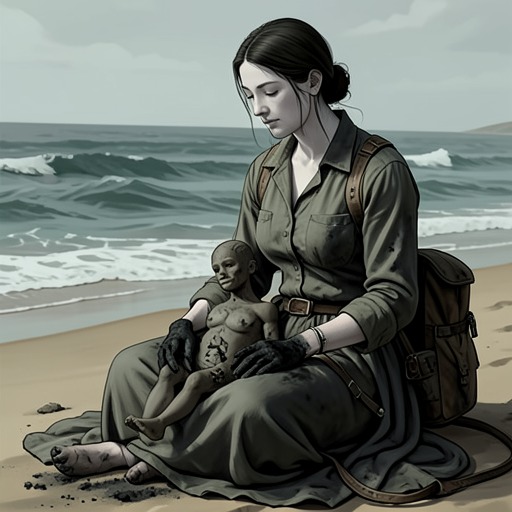
The contrast is sharpened when Leda, years later, discovers a beach worm inside Elena’s doll. As she tries to remove it, the doll’s apparent pregnancy prompts memories of her own. She associates the doll’s condition with her second pregnancy, not with the first, whose morning sickness had been mild and brief. The object does not simply remind her of childbirth; it draws out the bodily difference between two pregnancies that had seemed to belong to one continuous maternal story. A child’s game becomes the occasion for Leda to recognize how unevenly her body and her memories have carried motherhood.
Care, Work, and Maternal Ambivalence
The demands of motherhood continue after pregnancy, in the daily allocation of time and attention. When Bianca is small, Leda tries to participate in the child’s game by letting Bianca treat her as a doll. She is exhausted: Marta does not sleep well at night, while Bianca needs constant attention and resists day care. Leda tries to remain patient and to be a good mother, but the episode makes visible how care takes place alongside fatigue rather than outside it.
When Marta cries in another room, Leda gets up and leaves Bianca’s game. She describes the interruption as a kind of liberation and excuses herself by thinking that it is Marta, the second-born, who is pulling her away from the first child. Bianca cries as Leda goes. The scene holds together Leda’s need to respond to one child and the pain that her departure causes the other; neither the practical demand nor the emotional cost cancels the other out.
Leda’s maternal responsibilities also press against her ambitions. During her first years with the children, she feels unable to study and describes her body as drained of desire. Later, when she travels to an academic conference, she arranges food, visits, and backup childcare before leaving, even though Marta has a slight cold. After returning, she increases the time she spends at the university and tries to advance her work. These details show that professional life is not separate from motherhood: preparing for work and pursuing it require planning around care, while care can consume the time and energy she wants for intellectual life.
Kinship and the Doll as a Recurrent Image
Leda’s understanding of reproduction is also formed by family relationships and expectations. She fears that, during her separation from her daughters, they will be taken to her relatives in Naples and raised amid the habits and language she tried to leave behind. Gianni does take Bianca and Marta to Leda’s mother when work or travel overwhelms him, sometimes for months. Leda later regrets the arrangement, but does not return at the time. Her account therefore connects motherhood not only to pregnancy and individual bodily experience, but also to the extended family networks through which children are cared for and cultural inheritance continues.
At the beach, Leda observes Nina and Elena within a large Neapolitan family. She sees the relatives support the young mother and child, and notices Elena’s closeness to the pregnant Rosaria, who takes the child in her arms when Nina is overwhelmed. Leda’s view of this scene is shaped by her own history: she recognizes both the practical force of shared care and the family world she once fled. The encounter provides a contrast to her own isolated exhaustion, without making another family’s maternal life a simple solution to her conflict.
The doll links these strands. Elena treats it as a second daughter, and the adults around her respond to it as part of the child’s play. When Leda discovers what has been placed inside it, the doll becomes a prompt for remembering pregnancy, birth, and the unequal bodily experiences associated with Bianca and Marta. Her later description of herself as an unnatural mother, after Nina learns that Leda had kept the doll, further exposes the distance between the expected role of a mother and Leda’s own actions. Across these episodes, pregnancy and bodily alienation do not settle into a single verdict about whether Leda loves or rejects motherhood. They reveal the unsettled terms on which she has tried to inhabit it: through control, imagination, care, and the recurring discovery that her body and her life do not obey one coherent plan.