The doll as a surrogate child
The Lost DaughterThe doll as a surrogate child is both a prop for maternal play and a material link between different mother-daughter relationships. In Elena and Nina’s shared games it receives the care of a baby; in Leda’s hands it summons memories of her own childhood and of raising Bianca and Marta. When Leda takes and keeps it, the object exposes how readily affection, identification, resentment, and concealment can gather around the performance of motherhood.
A shared object of care
From a distance, Leda first notices the tenderness between Nina and Elena: Nina rubs lotion on her daughter, holds her close in the water, and shares laughter and touch with her. The doll joins this intimate routine as another recipient of care. Mother and child dress and undress it, pretend to apply lotion, bathe it in a green pail, dry it, and include it in their time on the beach. Their play makes the doll a baby under their shared protection, rather than merely a toy each uses alone.
The game takes on a more public, repetitive form when Elena carries a yellow watering can between the water’s edge and Nina’s lounge chair. She waters Nina and the doll in turn, returning to refill the can each time. Nina responds playfully, and mother and daughter speak for the doll, sometimes separately and sometimes in overlapping voices. To Leda, their shifting voices make the doll seem to have no stable identity of its own. She watches from a distance, increasingly unsettled by the performance, while recognizing that the game belongs to Nina and Elena, not to her. The episode establishes a tension that follows the doll: it can be a focus for loving cooperation, but an outside observer may see that same play as an unstable projection.
Leda’s memories of dolls and motherhood
After taking the doll, Leda finds it wet and heavier than expected in her bag. Handling it prompts a memory of Mina, the doll she had as a child. Leda recalls that her mother rarely accepted being treated as a doll in their games: she resisted having her hair combed or being washed and dressed. As an adult, Leda remembers the disappointment of that refusal and connects it to her effort to let Bianca care for her in play. When Bianca was small, Leda sometimes lay beneath the kitchen table and let her daughter pretend to nurse and tend to her, despite being exhausted by childcare and Marta’s disrupted sleep.
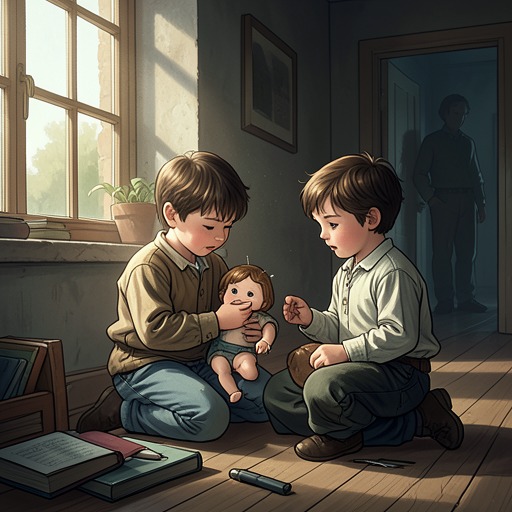
Leda later gave Mina to Bianca, imagining that the old doll would comfort her or invite the same tenderness Bianca had shown toward her. Bianca did not take to it, preferring a different doll. When Leda found her sitting on Mina and marking it with pens, Leda reclaimed the toy and threw it from the balcony. Bianca watched; Leda then picked her up and held her. The memory makes Mina more than a cherished possession: it records a moment when Leda’s attachment to an object from her own childhood collided with her daughter’s claim to it. That earlier rupture complicates Leda’s later response to Elena’s doll, without making the two incidents identical.
The doll also draws Leda into recollections of pregnancy and maternal exhaustion. She remembers experiencing pregnancy as a bodily process that belonged to her and yet seemed to move away from her, and recalls having another child soon after Bianca partly because she believed her first daughter needed a sibling. With Marta’s demands and her own depleted sense of self, Leda sometimes experienced being called away from Bianca as a release. Her memories of trying to mother Bianca therefore include care and play, but also strain, resentment, and a wish to escape. The doll gives those conflicting memories a concrete focus rather than resolving them into a single account of maternal love.
Taking and keeping the doll
Leda takes Elena’s doll without permission. When she returns home, she leaves it in the bottom of her bag, intending to make sure she does not forget it. She soon recognizes that the act has been unkind, though she cannot explain it as compassion or a deliberate attempt at repair. She considers buying clothes for the doll as a possible way to make amends to Elena, but the idea also draws her further into her own history with Mina and Bianca.
As Leda handles the doll, it becomes a substitute for company and a means of approaching the mother-daughter bond she has been watching. She holds it against herself and reenacts, in her own way, the tenderness she saw Elena offer it. At the same time, she understands that the doll has been part of Nina and Elena’s intimacy: it had helped them share a game and care for an imagined baby together. Leda’s private attachment thus develops alongside her awareness that keeping the object means withholding it from a child who misses it. Her actions do not settle into a simple explanation; she feels remorse and fear, yet decides that she does not want to return it.
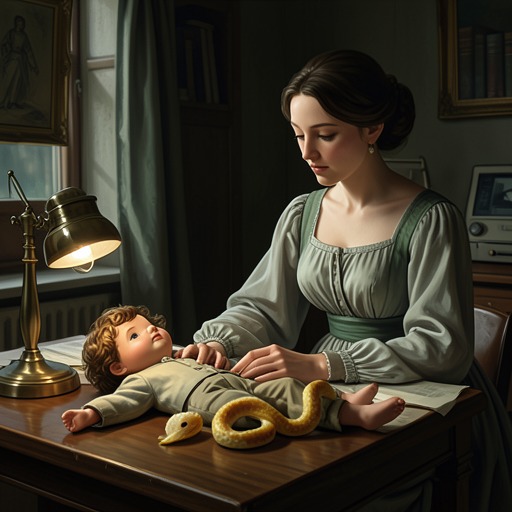
The doll’s role in play continues after Leda has taken it. Later, while cleaning it, she discovers a beach worm inside its body. Elena had put it there as part of a game about a doll becoming pregnant, echoing Rosaria’s pregnancy. The discovery joins children’s imaginative play to the adult experiences of pregnancy that Leda has been recalling. Leda carefully removes the worm with tweezers, an act of attention that contrasts with the secrecy of taking the doll and shows her responding to it as a vulnerable object requiring care.
Confession and significance
Leda eventually tells Nina that she has kept the doll. Nina understands the admission in light of the time Elena spent crying and the fact that Leda had watched their distress without intervening. She takes the doll back in a fierce gesture and ends her relationship with Leda. The recovery of the toy restores it to Nina and Elena, but does not undo the breach of trust that formed around its absence.
Across these episodes, the doll moves between being a toy, a baby in make-believe, a treasured remnant of Leda’s childhood, and a focus for her unresolved feelings about motherhood. Its significance comes from that movement rather than from any fixed meaning: it helps Nina and Elena enact closeness, recalls the limits and disappointments of Leda’s own early bond with her mother, and brings her memories of caring for Bianca and Marta into the present. By taking it, Leda crosses from observing another mother and child to interfering in their relationship. Her eventual confession makes the doll’s double function unmistakable: it has served as a surrogate child in play, and as the object through which Leda’s own attachment and estrangement become visible.