The fruit-peel snake
The Lost DaughterThe fruit-peel snake is a simple transformation of fruit peel into a continuous strip, but in the narrator’s memories it becomes a measure of intimacy between mothers and daughters. Bianca first treats the skill as one of her mother’s remarkable abilities; later, the request to make a snake accompanies the narrator’s departure from Bianca and Marta. Years afterward, she identifies the wish to perform that same small act in front of her daughters as the impulse that brought her to tears and marked her decision to return. The game thus links admiration, maternal care, separation, and the possibility of reunion without resolving their tensions into a sentimental picture of motherhood.
A Small Skill Made Significant
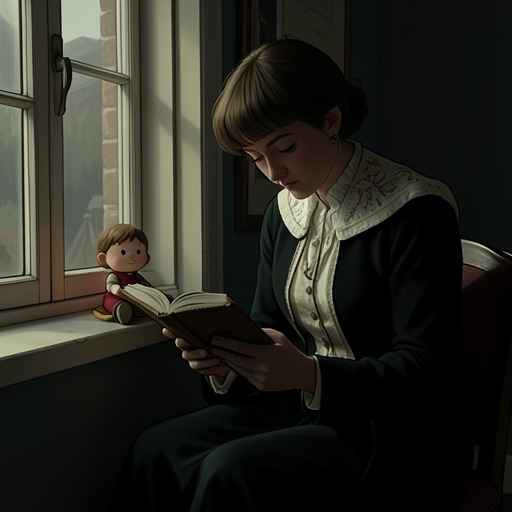
The snake begins with the narrator’s precise way of peeling fruit. Bianca notices that her mother takes care to guide the knife so the peel does not break. The narrator had not been conscious of this habit before Bianca pointed it out; her daughter’s attention makes an ordinary gesture legible as a skill. For Bianca, the unbroken peel is not merely a by-product of preparing fruit. It can be made into a snake, and the act becomes one of several abilities she imagines as almost magical in her mother.
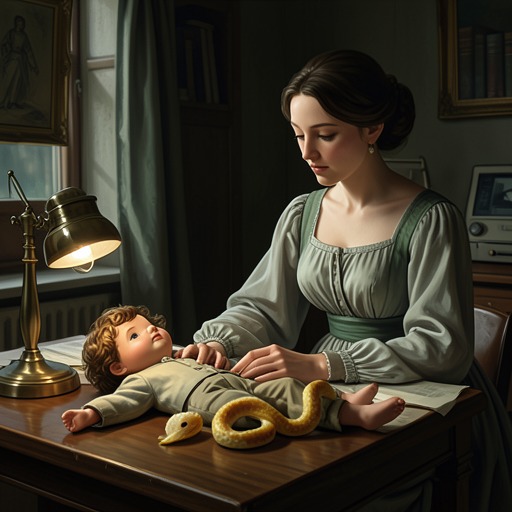
The child’s repeated request, “Make a snake, Mama,” gives the gesture a shared form. Bianca asks her mother to peel an apple, and the long strip of peel becomes an object of fascination. The narrator later recognizes a resemblance between the curled peel and the serpentines in a poem by Maria Guerra, a connection that confirms how the image can exceed its practical origin while remaining attached to a familiar household action. Bianca’s wonder also changes the narrator’s understanding of herself: only after her daughter admires the habit does she see it as a distinctive capability.
Admiration, Imitation, and Maternal Limits
Bianca’s attention is affectionate but not passive. The narrator recalls that her daughter tried to uncover how she performed the skills Bianca admired and to prove that she could perform them too. The fruit-peel snake therefore carries a small contest as well as a bond: the child wants to imitate her mother, to possess the skill for herself, and to be recognized as capable of it. The gesture is passed between them, but it does not pass without strain.
When Bianca is five, she cuts her finger while attempting to make a snake. The narrator becomes frightened and yells; she recalls feeling overwhelmed by the constant demands on her and unwilling to leave Bianca unattended for even a moment. She also delays kissing the wound, a gesture Bianca expects to ease the pain. In the narrator’s account, this hesitation is tied to a wish to teach that the knife is dangerous and that the mother, as the grown-up, is the one who should use it. The ordinary lesson about handling a knife is inseparable from a more difficult assertion of limits: the narrator feels that she has too little time for herself and that motherhood is pressing upon her as an obligation.
This episode complicates the apparent ease of the game. The snake is a sign of a mother’s competence in Bianca’s eyes, but trying to reproduce that competence exposes the child to risk and the mother to fear. The narrator’s refusal to comfort Bianca immediately is neither presented as a simple rejection of her daughter nor erased by the tenderness of the game. Instead, the scene preserves the opposing demands she experiences: to protect and soothe Bianca, to teach her, and to retain some space of her own.
The Snake at the Moment of Departure
The game returns at a decisive moment in the narrator’s account of leaving Bianca and Marta. After a two-month absence, she comes back to collect her books and notes, intending to leave for good. She brings dresses for the girls, who want help putting them on. Her husband asks her to try again and tells her that he loves her; she refuses, and after they quarrel she shuts herself in the kitchen. Bianca enters with Marta, takes an orange from the fruit tray, opens a drawer, and hands her mother a knife. The practical objects of the remembered game—fruit and knife—are now placed within a farewell scene.
Bianca asks for a snake for herself and Marta. The girls sit before their mother in their new dresses, waiting; Marta smiles encouragingly. The narrator begins peeling the orange. She recognizes that the children’s gazes are directed toward her, as if they hoped to draw her back into the role they knew. But she experiences the life outside the household as more compelling, and cannot reconcile that possibility with the domestic space in which the girls wait for her. She finishes peeling the orange and leaves. From then on, she neither sees nor hears her daughters for three years.
The act is significant because it does not turn the departure into a clean break from maternal attachment. The narrator does make the snake, answering the request, yet the gesture cannot keep her in the room. The same skill that once registered as a source of wonder and shared play becomes part of a scene in which the children’s expectation and the mother’s desire pull in opposite directions. The peel is completed; the relationship is not repaired by completing it.
The Snake and the Decision to Return
Later, when Nina asks how she decided to go back, the narrator answers that one morning she discovered that the only thing she wanted was to peel fruit and make a snake in front of her daughters, and then she began to cry. She does not offer the image as a full explanation of the years apart. When Nina says she does not understand, the narrator replies that she will tell her if they have time. The exchange leaves the memory partly open: the wish is clear, but its meaning cannot be reduced to a simple account of why she left or why she returned.
The remembered act now points toward a desire for an ordinary scene with Bianca and Marta: the mother making something they once asked her to make, with the daughters there to watch. Its force comes from the contrast with the earlier orange-peeling scene, when the same request was followed by the narrator’s departure and three years without contact. In the later recollection, the snake does not undo that absence. It gives form to a particular longing that surfaces after it, and to the narrator’s recognition that her desire to return is bound up with the daughters from whom she had separated.