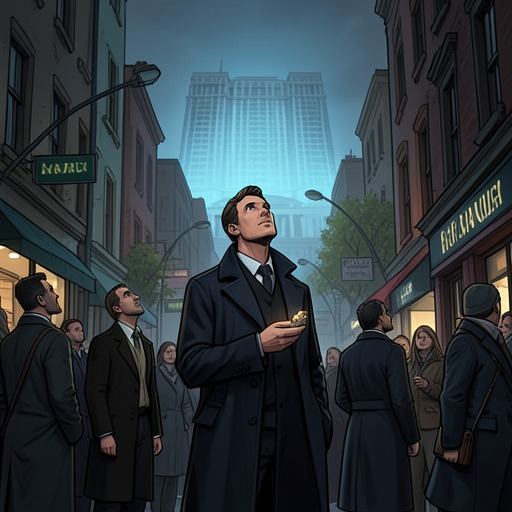
“A society with secrets”
The Lost SymbolThe expression “a society with secrets” is Robert Langdon’s compact distinction between Freemasonry as a visible organization and the knowledge it keeps from outsiders. It neither denies that Masons practice confidentiality nor treats secrecy, by itself, as proof of a conspiracy. As the novel moves from Langdon’s classroom explanations to the dangerous search for hidden wisdom, the phrase becomes a measure of how much he—and others—are prepared to believe about what is concealed.
Formulation and the Corporate Analogy
In a lecture, Langdon rejects the claim that Freemasonry is a secret society by pointing to its visible signs: Masons wear rings, tie clips, and pins; Masonic buildings are marked; and meeting times appear in newspapers. He then offers the alternative description, “a society with secrets.” The distinction turns on access to information, not on whether the organization itself is invisible.
To make that distinction concrete, Langdon compares Masonic confidentiality to a company’s protection of its recipe for Classic Coke. A person could approach corporate headquarters, but would not thereby gain access to the formula. Learning it would require joining the company, working there, earning trust, rising through its hierarchy, and accepting an obligation of secrecy. The analogy presents guarded knowledge as something acquired through membership and demonstrated trust, rather than as evidence that the organization has no public existence.
The phrase sits alongside another definition Langdon attributes to a Mason: “Masonry is a system of morality, veiled in allegory and illustrated by symbols.” Together, the formulations describe both the content and the method of the institution as Langdon presents it: moral teaching is communicated symbolically, while some knowledge remains restricted. The wording makes secrecy a feature of an organized relationship, with insiders, outsiders, degrees of access, and duties to preserve what has been entrusted.
Boundaries, Belief, and Public Misconceptions
Langdon also distinguishes Freemasonry from religion. In his account, it promises no salvation, prescribes no single theology, and does not seek converts; religious discussion is prohibited in Masonic lodges. At the same time, membership requires belief in a higher power. Masons use general terms such as Supreme Being or Great Architect of the Universe so members of different faiths can gather without being required to adopt one definition of the divine. The organization’s boundary, as Langdon describes it, is therefore not simply a wall between belief and unbelief: it is a shared requirement combined with room for different beliefs.
That account has limits. When a student challenges Langdon over women’s exclusion, he acknowledges that Freemasonry arose from traditionally male stone-masons’ guilds and that women’s participation is associated with Eastern Star, which he says has more than a million members. His defense of Masonry’s openness thus coexists with recognition that women are excluded from the organization he is describing. The episode complicates any simple equation of secrecy with either tolerance or universal access.
Langdon’s lecture sets this measured account against extravagant public suspicion. He recalls a student bringing him a street map of Washington, District of Columbia, on which selected streets supposedly formed satanic pentacles, Masonic symbols, and the head of Baphomet. Langdon answers that the same shapes could be drawn on a map of Detroit. His point is not that the city has no secrets: he tells the student that it does, but rejects the map’s shapes as proof. The contrast anticipates a central distinction in the expression: genuine concealment and imagined conspiracy can occupy the same cultural landscape without being the same thing.
From a General Principle to a Dangerous Secret
The plot gives Langdon reason to reconsider how far that distinction can be trusted. He initially treats the Masonic Pyramid as a myth, dismissing the idea that it is a hidden fortress for the Ancient Mysteries as a story built from familiar legendary elements. He explains that the pyramid symbolizes enlightenment, an ascent from the earthly toward a higher source of illumination, but does not accept that the symbol proves a real Washington pyramid or concealed treasure exists.
As events draw him into the search, symbols and protected knowledge become material problems rather than lecture subjects. The seven marks concealed on Peter Solomon’s palm change when Langdon turns the hand upside down, yielding a Roman numeral and the letters SBB. Later, Bellamy presents the pyramid not as a legend but as a map, with the capstone serving as the key to reading it. Langdon’s established distinction between public organization and hidden knowledge remains relevant, but his earlier confidence that the pyramid is merely fantasy is placed under pressure by objects whose meanings depend on careful interpretation and restricted information.
Bellamy sharpens the social cost of keeping a secret when he insists that Langdon has a duty to protect the pyramid even if doing so means sacrificing Peter. He invokes “circles within circles” to explain that not every Mason knows everything, and says Peter chose Langdon partly because he stood outside the brotherhood. In this instance, access is not only a privilege granted to an insider: an outsider is entrusted with the capstone precisely because he is beyond the organization’s internal circles. Secrecy creates trust and hierarchy, but it also forces a choice between protecting the knowledge and helping the people endangered by its protection.
Meaning and Narrative Function
The expression’s force comes from its refusal to collapse two different claims. Freemasonry may be publicly identifiable and still guard information; conversely, the existence of confidential practices does not establish every legend told about the Masons. Langdon’s classroom analogy and his dismissal of the street-map theory give readers a standard for separating organized secrecy from conspiratorial interpretation. His subsequent involvement with the pyramid tests that standard without erasing the difference between evidence and rumor.
By the time the search for the Ancient Mysteries becomes urgent, “a society with secrets” has widened beyond a description of Masonic customs. It names a structure in which knowledge is withheld, trust determines access, and protection carries consequences. The phrase is therefore both an explanation and a warning: secrecy need not mean that an organization is hidden, but a real secret can still place extraordinary pressure on those asked to keep it.