Adams Building
The Lost SymbolThe Adams Building serves as both an unexpected escape point and a temporary waystation in Robert Langdon and Katherine Solomon’s search for Peter Solomon. Its circulation rooms and basement connect the building to the United States Library of Congress’s hidden book-handling infrastructure; a conveyor carries the fugitives out of the library, while the building’s quieter interior gives them room to examine the clues they have carried with them. The route offers a momentary break from pursuit, not safety: the Central Intelligence Agency soon recognizes where the conveyor leads and redirects its agents there.
Circulation Rooms and the Hidden Route
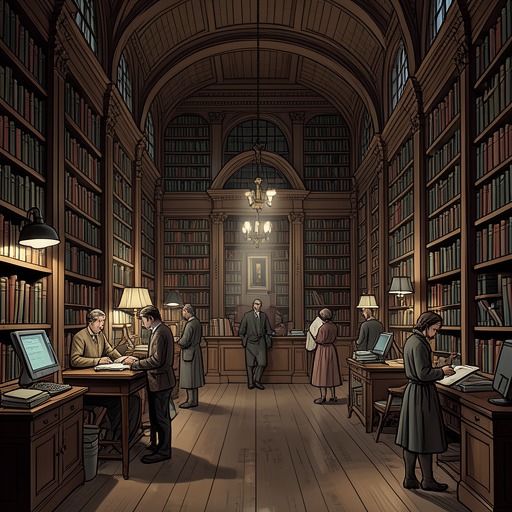
Langdon and Katherine emerge from a narrow opening on a moving conveyor belt into a circulation room in the Adams Building. A sign identifies it as Circulation Room 3. They have ridden through the book-conveyor system from the library, passing through a concealed opening rather than an ordinary public entrance. Langdon climbs off just before the belt turns and heads back into the building; Katherine retrieves his daybag, which contains the stone pyramid and its sealed capstone.
The exit gives the passage the quality of an abrupt return to open space after confinement. Langdon has travelled through a cramped, dark route, and his first response is to feel as though he has emerged from a subterranean birth canal. Katherine, whose eyes are red from crying, meets the moment with resolute silence. The circulation room is therefore not simply a point on a floor plan: it marks their physical arrival in a new building at the same time that they are carrying the consequences of Peter’s abduction into it.
The escape depends on a service system that the pursuers do not initially understand. At the library’s distribution hub, a Central Intelligence Agency field agent sees two heat signatures appear from a wall on a conveyor loop and then vanish into a narrow opening. The agent realizes that Langdon has escaped through the conveyor and that Katherine is with him. After consulting an employee reference schematic, the agent identifies the destination as the Adams Building, one block away. The discovery transforms an obscure piece of library infrastructure into a route the search teams can follow.
A Brief Refuge and a Clue in the Box
In the circulation room, Katherine sets the daybag on a cluttered desk and switches on a halogen clamp lamp. Under its light, she examines the granite pyramid and the wax-sealed cube bearing the impression of Peter’s Masonic ring. Langdon explains that Peter entrusted him with the package years earlier and insisted it not fall into the wrong hands. He also recounts Warren Bellamy’s warning not to open it, even though the capstone seems necessary to decipher the pyramid and may be their best chance of getting Peter back.
Katherine challenges the logic of preserving the secret at the cost of Peter’s life. The box’s warning and its immediate practical use pull in opposite directions: the capstone may protect a hidden meaning, but keeping it sealed obstructs the effort to rescue her brother. Their argument makes the desk and lamp a small, provisional workspace in which an inherited rule is weighed against an urgent obligation. Katherine studies the box closely and finds the carving of 1514 A.D. near a lower corner, a specific detail that turns their attention from the cipher toward a possible clue.
The building’s basement then becomes a place for rapid interpretation and movement. As Langdon and Katherine hurry through it, illuminated EXIT signs mark their route. They pass a locked door, which Langdon opens with Bellamy’s key card, and climb stairs into a large corridor. When they reach an alcove, Katherine uses a computer on a desk to access the internal library network’s Digital Collections. The Adams Building thus supplies not only a route away from the pursuers but also access to information that helps them pursue the puzzle without visiting a collection in person.
From 1514 to Dürer’s Magic Square
Langdon recognizes that the inscription should not be read as a date. In the symbol system he identifies, A.D. points to a person: Albrecht Dürer. The number 1514 directs them to Dürer’s work Melencolia I, completed in that year. Langdon explains that the date and artist are not an answer on their own; they point toward a particular image whose arrangement can be compared with the letter grid taken from the stone pyramid.
The next step depends on examining the magic square in Dürer’s engraving. Katherine checks its rows and columns and finds that they add to thirty-four. Langdon explains that the construction is more elaborate than that basic property: its quadrants, central four squares, and corner squares also add to the same number, while the bottom row places 15 and 14 together to mark the year of the work. He further connects the square’s appearance in European art to the movement of the Ancient Mysteries beyond Egyptian mystery schools and into European secret societies. At the Adams Building, these observations bring the Dürer reference into contact with the pyramid’s four-by-four grid, advancing the decipherment through a comparison of numerical and lettered patterns.
Pursuit and Narrative Significance
The building provides only a short interval in which the two fugitives can think. A CIA agent’s discovery at the conveyor hub prompts an immediate order to redirect the search to the Adams Building. Langdon and Katherine nevertheless make it out through a side door into the winter night before the pursuit closes around them. From the courtyard, they see activity at the Jefferson Building and recognize the danger of staying near the library. They run past the Folger Shakespeare Library, reach Third Street and East Capitol, and flag down a cab after Langdon spots it a block away.
Katherine directs the driver northwest, away from the Jefferson Building, while Langdon notices a black helicopter approaching low. The route through the Adams Building therefore links two kinds of suspense: the concealed mechanics of the conveyor make escape possible, while the agents’ ability to trace that same route keeps the fugitives exposed. Its narrative importance lies in this double function. The building is a circulation space in the literal sense, carrying people and books between facilities, and a temporary passage in the pursuit: a place where Langdon and Katherine can turn a physical escape into progress on the cipher, but cannot remain long enough to mistake access for safety.