Ancient Arabic Order of Nobles of the Mystic Shrine
The Lost SymbolThe Ancient Arabic Order of Nobles of the Mystic Shrine, commonly known as the Shriners, is a Masonic appendant body whose Washington headquarters becomes a decisive landmark in the novel’s chain of clues. The Almas Shrine Temple on Franklin Square is at once a public building and the location that the pyramid identifies obliquely as the place where the secret lies within the Order. Its significance comes not from an overt display of menace, but from the gap between its visible identity and the hidden meaning assigned to it by the searchers.
Identity and Masonic Context
The organization is identified as an appendant body of Freemasonry. That connection places it within the novel’s wider discussion of fraternal association, membership, and secrecy, without making it synonymous with all Masonic institutions. In a lecture, Robert Langdon challenges students’ assumption that Freemasonry is simply a secret society: its public signs, marked buildings, and advertised meeting times distinguish a society that keeps certain knowledge private from one whose existence is concealed. He describes Masonic membership as hierarchical and its deepest information as something shared only after a person has joined, established trust, and advanced within the organization.
Langdon also distinguishes Freemasonry from a religion. He says Masons make no promise of salvation, impose no single theology, and do not seek converts; religious discussion is prohibited in lodges, while belief in a higher power is a membership requirement. This general account supplies the social setting for the Shriners’ Masonic affiliation, but the novel does not provide a separate account of the organization’s internal rules or ceremonies. Its identity in the plot is established principally through its relationship to Freemasonry and the building associated with it.
The lecture also exposes the limits of claims about Masonic openness. Langdon says that the fraternity welcomes men across races, colors, and creeds, but a student points out that women are excluded from Freemasonry. Langdon acknowledges the historical male character of the organization and mentions Eastern Star as a women’s branch with more than a million members. The exchange makes clear that a rhetoric of religious and racial breadth does not mean universal access. The Shriners are discussed against this broader tension between fraternity, boundaries, and the public’s assumptions about secretive groups.
The Almas Shrine Temple
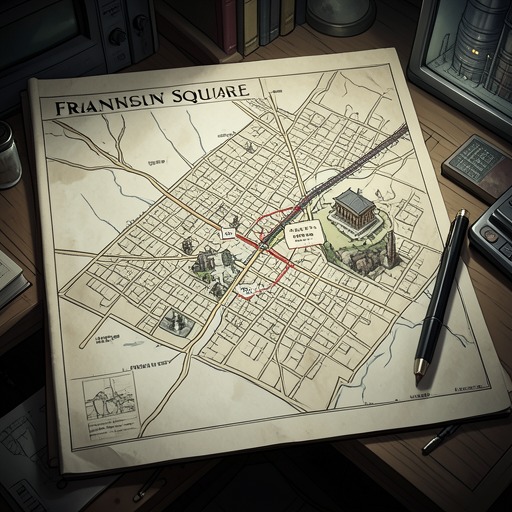
The organization’s Washington headquarters is the Almas Shrine Temple, on Franklin Square. A CIA field agent watching the square sees a building unlike its much larger neighbors: a Moorish-style facade of gleaming terra-cotta tile, patterned in multiple colors, with three large doors and two tiers of lancet windows. Its appearance makes it visually distinctive, but its place in the story depends on recognizing what the building is, not merely noticing its architecture.
The temple first enters the investigation through a mistaken understanding of the clue’s address. In a telephone conversation, Inoue Sato insists that Eight Franklin Square must exist, while Nola Kaye explains that One Franklin Square is the name of a building rather than its street address. Searching without the assumed street number, Nola finds a website describing an unusual Franklin Square building as a sacred mystical shrine designed for an ancient secret order. The discovery redirects attention from a nonexistent numbered address to an institution already standing in plain sight.
Sato then identifies the building as the Almas Shrine Temple and names the Ancient Arabic Order of Nobles of the Mystic Shrine as the group headquartered there. When the agent says he has never heard of the Order, Sato connects it to the Shriners. His skeptical response reflects the difference between the temple’s ornate, unfamiliar appearance and the more familiar public image of Shriners as men in red fezzes who march in parades and build hospitals for children. That contrast makes the headquarters an effective source of suspense: the building looks like a coded destination, while its recognizable fraternal identity resists the idea that it must be sinister.
The Order as a Clue
The temple’s plot function emerges when the pyramid is understood to direct its reader to a secret within the Order at Eight Franklin Square. The clue initially sends Robert Langdon and Katherine Solomon toward another destination, a refuge north of the Tiber. Katherine realizes that their interpretation is wrong and redirects the search to Freedom Plaza. Separately, Nola’s search for the Order on Franklin Square leads to the Almas Shrine Temple, giving Sato a plausible identification of the site before Langdon can reach it.
A field team watches the temple’s entrance because Sato recognizes the danger in the clue’s ambiguity: if the target identifies the Order on Franklin Square, he can bypass the expected meeting point and go directly to the relevant building. Later, while holding Langdon captive, Mal’akh says that he does not need the street number because only one building on the square could fit the clue. He identifies the Almas Shrine Temple by its full organizational name. Langdon recognizes the building and agrees that it fits the reference, although he sees no historical reason that its temple should sit above a secret staircase. The identification resolves the location of the clue, not the mystery of what the symbols ultimately mean.
Narrative Significance
The Shriners’ role depends on the novel’s recurring distinction between visible institutions and the secrets people imagine or seek within them. Their headquarters is not hidden: it occupies a prominent square, has a striking facade, and can be found through an ordinary web search. Yet the pyramid’s wording turns the temple into a cryptic destination, and the search for it draws attention to how an organization’s public identity can be overlaid with a private symbolic meaning.
The episode also complicates the equation of secrecy with conspiracy. Langdon’s classroom comparison presents secrecy as a feature of membership and restricted knowledge, while the discussion of the Shriners evokes a familiar charitable public image. Sato and the agents nevertheless treat the temple as strategically important because of its connection to the clue. The building’s importance therefore arises from the investigation’s interpretation of it, rather than from evidence that the organization itself is directing events. As a result, the Ancient Arabic Order of Nobles of the Mystic Shrine serves both as a real-world fraternal reference within the novel and as the crucial institutional name that helps turn a coded phrase into a place.