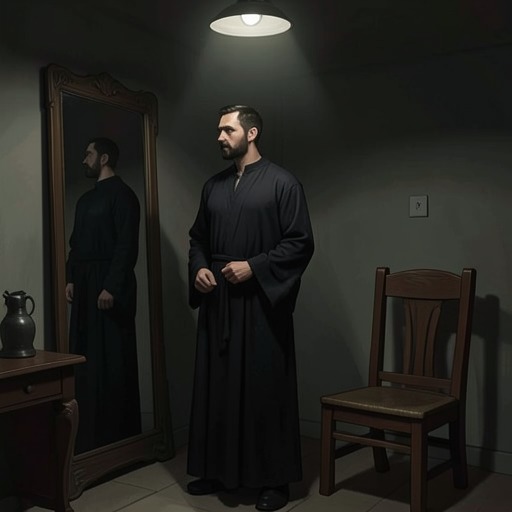
Castration
The Lost SymbolCastration is the self-imposed bodily sacrifice through which Mal’akh seeks to advance his imagined spiritual transformation. He treats the act not as an isolated physical change but as a break with the material world and a step toward immortality, making it a defining expression of his belief that sacrifice can confer power.
Meaning and Motive
In his preparations, Mal’akh regards his former submission to bodily needs as belonging to the past. He has undergone surgical castration, identified in the narrative as orchiectomy, and interprets it as a deliberate spiritual commitment. The narration notes that men undergo the procedure for varied reasons, including spiritual beliefs, but Mal’akh’s stated rationale is specific: he believes immortality requires a clean break with the material world of male and female. He frames the resulting condition as a unity beyond that division, rather than presenting it as a medical goal.
Sacrifice and Transformation
Mal’akh places castration within a larger theory of transformation through sacrifice. In his account, destruction is a precondition of creation, and relinquishing part of the body is meant to loosen the hold of ordinary material existence. The choice is therefore both personal and ritualized: he makes his body evidence of a commitment to the transformation he expects to complete.
This belief also shapes how he judges Peter Solomon. Mal’akh regards Peter’s loss of a hand as a comparatively small bodily sacrifice and anticipates that Peter will be made to give up far more. He connects this anticipated suffering to Peter’s past decision concerning his son, Zachary Solomon, whom Mal’akh believes Peter could have saved from Soganlik Prison. The contrast turns bodily loss into part of Mal’akh’s private moral accounting: his own sacrifice serves his promised ascent, while Peter’s is cast as punishment and payment.
Relation to the Masonic Initiation
The novel places Mal’akh’s personal transformation alongside a formal Masonic initiation. In the initiation footage, Robert Langdon recognizes Mal’akh preparing to enter the first degree, while the prologue presents an initiate taking an oath in the Temple Room at the House of the Temple. These rituals involve prescribed clothing, vows, and witnesses; castration, by contrast, is Mal’akh’s self-chosen bodily act. Their juxtaposition links his pursuit of a new identity to the book’s wider imagery of ritual passage without making the initiation itself the cause of the operation.
Narrative Significance
Castration clarifies the extremity of Mal’akh’s understanding of spiritual change: transformation, in his view, requires surrender rather than preservation of the body. It also establishes the principle through which he interprets Peter’s captivity and planned fate, converting physical sacrifice into a claimed route to power. The belief reveals the logic Mal’akh uses to justify his actions, but the narrative presents that logic as his conviction, not as an established spiritual truth.