Colin Galloway
The Lost SymbolColin Galloway is the blind, elderly dean of Washington National Cathedral and a crucial guide to the Masonic Pyramid. Though physically frail and dependent on touch to examine the object, he understands that Langdon and Katherine have only begun to decipher it: its map points to a real location, and its secrets may depend on a transformation they do not yet know how to bring about.
Identity and Presence
Galloway is introduced first through a nighttime encounter in a walled garden west of Embassy Row. A young man finds him seated beneath a blanket in the Carderock gazebo known as Shadow House, a tiny, hunched figure whose years have bent him and whose eyesight is gone. The visitor brings word that Warren Bellamy called in haste and left a message, along with a question requiring an immediate answer. Whatever Bellamy asked, its effect is unmistakable: Galloway throws off his blanket and struggles to his feet, asking to be helped inside at once.
At Washington National Cathedral, where he serves as dean, Galloway’s blindness is again made concrete. He wears priest’s robes, and his eyes are opaque with cataracts. Later, he guides Robert Langdon and Katherine through the dark cathedral and its administrative annex with the practiced certainty of someone who knows the route by heart. His frailty does not prevent him from receiving them, assessing their choices, or speaking with force when he thinks they have misunderstood the task before them.
Sanctuary and the Pyramid
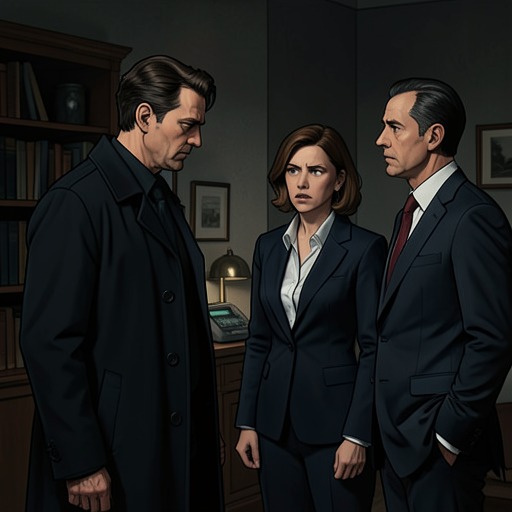
Langdon and Katherine arrive at the cathedral seeking sanctuary after being directed there. Galloway opens the door before they can knock and says he has been expecting them. In his office, he listens as Langdon explains their search and examines the pyramid and capstone himself, running his hands over the engraved face, smooth base, truncated top, and small inscriptions. Because he cannot rely on sight, touch becomes his way of testing the objects and considering their arrangement.
Galloway also aligns the capstone atop the pyramid by touch, then reverently passes his palms over the assembled object. He examines the cube-shaped box as well, probing its interior and exterior. The sequence shows both his careful attention to the artifacts and his recognition that their relation matters: the pyramid, capstone, and box are not simply isolated curiosities. Yet his inspection ends not with reassurance but with a challenge to Langdon and Katherine about why they have come and what they have accomplished.
A Map with Further Layers
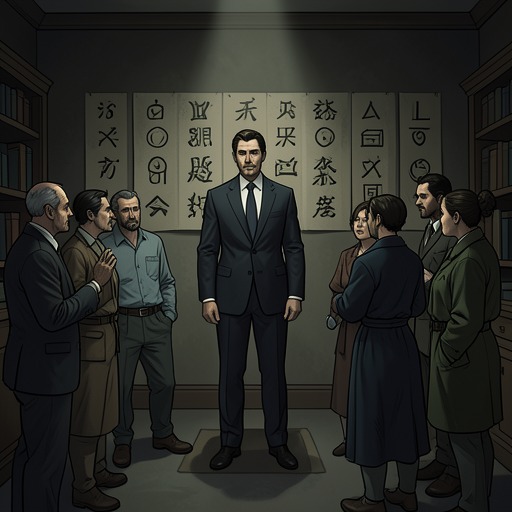
Galloway confronts Langdon with the fact that he opened a package that Warren Bellamy and Peter Solomon had told him to leave sealed. He acknowledges Katherine’s explanation that they were trying to help her brother, but insists that opening it has not answered the captor’s demand for a location. In his view, the phrase already deciphered, Jeova Sanctus Unus, is not enough to solve the problem.
His correction is more sweeping: the Masonic Pyramid is a real map pointing to a real place, and Langdon has not deciphered it fully. Galloway describes the map as having multiple layers of meaning, like the Ancient Mysteries, with its true secret still veiled. The objects’ current appearance, he argues, does not exhaust what they can disclose. He invokes the legend that the pyramid can change its physical form and reveal its secret to someone worthy, comparing the possibility to the stone from which King Arthur drew Excalibur. Langdon doubts that such a literal transformation is possible; Galloway answers by challenging the assumption that phenomena beyond present understanding must be impossible, recalling how people once mocked the idea of a spherical Earth held in place by an invisible force.
Narrative Role
Galloway’s authority rests on a contrast between apparent limitation and interpretive confidence. He is blind, aged, and physically unsteady, yet he can navigate the cathedral, examine the pyramid through touch, and identify the gap between Langdon’s partial decoding and the map’s intended meaning. His blindness shapes the scene’s handling of knowledge: the artifacts are read through texture and position, while their deeper significance remains hidden from characters who can see them.
As a host, Galloway offers the fugitives a place of sanctuary; as an interpreter, he refuses to let that refuge become a stopping point. His warning that the pyramid has not been fully deciphered shifts the mystery from reading an inscription to understanding a changing object and locating its real destination. The evidence establishes his claim and his challenge, while leaving the promised transformation and the pyramid’s remaining secret unresolved.