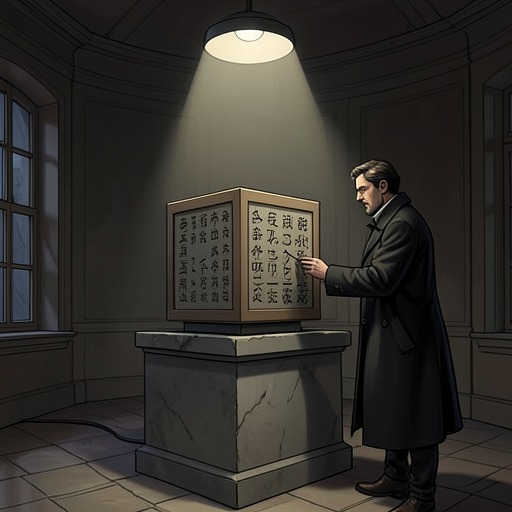
Deciphering the Masonic Pyramid
The Lost SymbolDeciphering the Masonic Pyramid is the sequence in which Robert Langdon and Katherine Solomon turn a sealed stone package, an engraved cipher, and a Renaissance artwork into a layered code. Its decisive result is Jeova Sanctus Unus, a Latin phrase meaning one true God; its immediate complication is that this answer does not give Mal’akh the location he wants. The puzzle therefore advances by discovery and frustration together: each solved layer offers a new way to read the objects, but not yet a plain route to Peter Solomon.
Causes and Stakes
Peter had entrusted Langdon with a cube-shaped package sealed with wax bearing Peter’s Masonic ring. Langdon understood that the package mattered to the stone pyramid: Peter had said it could help create order from chaos and warned that it must not fall into the wrong hands. Warren Bellamy reinforced that warning, telling Langdon to conceal the pyramid and not open the package. He had explained the capstone as the key, or legend, to a map that might disclose the hiding place of ancient wisdom. The pyramid was thus presented as more than an inscription: it was an artifact whose parts had been separated and whose meaning depended on how they were reunited and read.
The warning collided with the purpose of the night’s pursuit. Langdon told Katherine that her brother’s captor had promised Peter would be returned alive if the pyramid were deciphered. Katherine, already grieving her nephew Zachary and her mother, refused to let the family’s remaining secret take precedence over Peter’s life. She reasoned that if the capstone was necessary to read the pyramid, opening it was the only available path to saving her brother. When Langdon hesitated because of Bellamy’s instruction, Katherine pulled the twine and broke the brittle wax seal. Her decision made the puzzle an immediate moral choice: preserving a guarded inheritance, or using it in an attempt to rescue Peter.
The Sealed Package and Its Inscription
Inside the faded paper was a small gray stone box, polished like a granite cube and marked with no visible hinge or latch. Its apparent solidity concealed a hollow interior, as an X-ray had indicated. Katherine found a narrow slit along the top edge and carefully raised the lid. Within lay a gold capstone, still bright after more than a century enclosed in the stone box. Its small inscription seemed to promise a key, but its six words initially disappointed both investigators: The secret hides within The Order.
The wording appeared at first to offer little beyond the premise they already knew. Langdon considered whether order referred simply to rearranging the pyramid’s letters, but that reading seemed too obvious. The capitalization of The Order suggested a reference to the Masonic Order, yet this, too, gave them no practical instruction. The capstone’s message was therefore both a clue and a refusal of easy interpretation: it pointed toward the Masons while leaving the method of reading the pyramid unresolved. Katherine’s question about the promised power to see order in chaos sharpened Langdon’s sense that he had not yet understood what the package was asking them to do.
A small marking on the gray box provided the next turn. Katherine noticed what looked like the date 1514 A.D. carved near one corner and proposed that it might point to a building or cornerstone from that year. Langdon recognized instead that the marking was a signature-like symbol: A.D. did not mean Anno Domini, or a date designation, but referred to a person. The person was Albrecht Dürer. The apparent date was not directing them toward a building completed in 1514; it was directing them to a particular work by the German artist, completed in that year.
Dürer’s Work as a Reading Key
Langdon connected the box’s marking to Dürer’s Melencolia I, which he described as a work concerned with humanity’s struggle to comprehend the Ancient Mysteries. Katherine knew the engraving was held at the National Gallery of Art in Washington, but the gallery was closed. Rather than attempt to visit it, she used the library’s digital collections, searching the fine-prints catalog for Dürer. The screen displayed the work’s identifying details and a high-resolution image, allowing them to inspect its composition where they were.
The engraving gathers an array of objects around a brooding, winged figure: measuring scales, an hourglass, tools, geometric forms, a ladder, and other instruments of human thought and labor. Langdon read the figure as human genius surrounded by the resources of intellect yet unable to reach enlightenment. For the puzzle, however, the crucial object was not the central figure but a small numbered square carved into the building behind it, beneath a bell. Katherine located the square after Langdon directed her attention to the numbers. It contained 1514, linking the artwork back to the marking on the stone box and giving the apparent date a second, confirming role.
The square was a magic square, a mathematical arrangement in which rows, columns, and diagonals share a common total. Katherine checked several lines and found that each added to thirty-four. Langdon explained that Dürer had extended the pattern beyond the ordinary rows, columns, and diagonals: the four quadrants, the central four cells, and even the four corners also produced thirty-four. The placement of 15 and 14 together in the bottom row further associated the square with the year of the engraving. In the novel’s chain of clues, the numerical arrangement was not decorative background. It supplied a second grid that could be applied to the letters already obtained from the pyramid.
Reordering the Pyramid’s Cipher
The pyramid’s initial inscription had been rendered through a Masonic substitution cipher. Langdon had explained that the method used four grids, two plain and two dotted, with letters assigned to distinctive enclosed shapes. Matching each engraved shape to the corresponding enclosure yielded letters, but the result was not yet an intelligible message. The capstone had supplied the instruction to seek order; Dürer’s four-by-four square now supplied a sequence for imposing it.
Langdon hesitated before proceeding, mindful that Peter had expressly urged him not to reveal the pyramid’s secret. Katherine insisted that she would decipher it herself if he would not. He then superimposed the numbered pattern from Dürer’s square on the pyramid’s letter grid, assigned a number to each letter according to its position, and built a new grid using the order specified by the magic square. The result initially looked like gibberish. On closer inspection, Langdon recognized that it was Latin, and Katherine read the phrase Jeova Sanctus Unus. She knew its sense as one true God, a Latin rendering associated with the Hebrew God’s many names.
The reading solved the arrangement of the letters without solving the practical problem. Katherine could not see how one true God would identify a location, and Langdon likewise recognized that the decrypted phrase did not answer Mal’akh’s demand for a place. Their disappointment exposed a distinction between decoding and understanding: they had followed a consistent method and obtained a meaningful phrase, but its meaning might be figurative rather than geographical. Langdon began to question whether the pyramid’s map should be understood literally, while Katherine objected that her family had guarded it for generations and that the authorities had treated the matter as a national-security concern. The correct reading, they suspected, was still incomplete.
Significance and Continuing Uncertainty
The sequence binds physical objects to acts of interpretation. The sealed cube hides the capstone; the capstone refers to The Order; the marking on the cube points to Dürer; and the magic square supplies a rearrangement that makes the pyramid’s letters readable. None of these elements works alone. A date-like mark becomes a person’s initials, a detail within an artwork becomes a cipher key, and a grid of numbers becomes an ordering device. The puzzle’s progress depends on revising an initial reading whenever the next object changes the terms of the problem.
The first decipherment also preserves the danger of misreading. Langdon and Katherine produce a coherent Latin phrase, yet their result seems to fail the immediate test imposed by the kidnapping: it does not name a place where Peter can be found. The gap between a sound method and an apparently insufficient answer keeps the pyramid’s promise unresolved. What they have established is that its message is structured, that its parts were meant to be read together, and that apparent disorder can conceal a deliberate arrangement. What the phrase ultimately points toward remains unsettled at this stage.