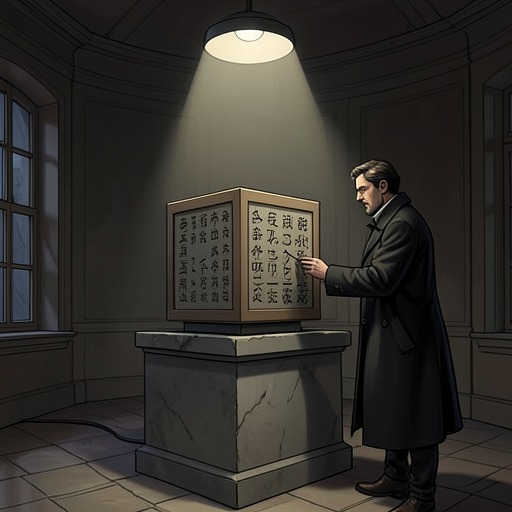
Decoding “Jeova Sanctus Unus” as a Reference to Newton
The Lost SymbolDecoding Jeova Sanctus Unus as a Reference to Newton is the breakthrough in which Robert Langdon recognizes the pyramid’s inscription as an anagram of Isaac Newton’s Latin name. A phrase that had seemed connected to alchemy proves to identify an alchemist: the solution links the pyramid’s cipher to Newton’s scientific, Rosicrucian, and Masonic world, and gives Katherine Solomon a new way to think about the pyramid’s transformation.
Clues Converge
The recognition comes after Langdon and Katherine have already established that the pyramid’s first inscription can be read through a cipher associated with Dürer’s Four-by-Four Magic Square. Their examination of the square makes its structure concrete: its rows, columns, and diagonals total thirty-four, while the arrangement of fifteen and fourteen in the bottom row points to 1514. That earlier decoding has made the pyramid’s symbols legible, but the phrase they uncover still needs interpretation.
Langdon has been trying to recall what Peter Solomon told him about Jeova Sanctus Unus and alchemy. The connection returns while Dean Colin Galloway explains the historical relationship between Freemasonry and Rosicrucianism. His account of a founder using a pseudonym supplies the missing conceptual link: the phrase may not name an abstract doctrine or process, but conceal the name of a person.
The Anagram Identified
Langdon realizes that Jeova Sanctus Unus is a pseudonym and that its relevance lies less in alchemy itself than in an alchemist. Dean Colin Galloway has already mentioned both a famous scientist and the idea of a pseudonym, and he confirms that he suspected the answer from the combination of the inscription, the Dürer square, and the Rose Cross discovered in the stone box.
The scientist is identified by several connected facts. He was an alchemist, belonged to the Royal Society, was associated with the Rosicrucian Order, and signed some of his most secretive scientific papers with the phrase. Dean Colin Galloway explains that its sixteen letters can be rearranged to spell the scientist’s name in Latin. Langdon writes the rearrangement as Isaacus Neutonuus; because Latin uses I where the phrase has J and U where it has V, the letter substitutions complete the match. Katherine recognizes the name as Isaac Newton.
From Name to Next Clue
The solution changes the pyramid from a puzzle that merely yields a name into a clue about how to proceed. Newton’s presence joins the episode’s recurring strands—pyramids, hidden knowledge, science, and mystery—and gives Katherine a practical inference: the pyramid may be transformed through a basic scientific, specifically Newtonian, process. Her realization follows directly from the identity hidden in the inscription, although the precise procedure is not yet established in this exchange.
The scene also shows how the decoding depends on multiple kinds of knowledge rather than on substitution alone. The Dürer square provides the earlier cipher framework; the Rose Cross connects the object to Rosicrucian and Masonic traditions; and the pseudonym’s Latin letter pattern identifies Newton. Each clue narrows the interpretation until the phrase is no longer an obscure motto but a specific name with consequences for the investigation.