District of Columbia
The Lost SymbolThe District of Columbia gives the novel a landscape where civic monuments, Masonic history, and stories of hidden knowledge overlap. Its carefully arranged streets and prominent buildings appear to invite symbolic interpretation, but the narrative repeatedly sets that atmosphere against Robert Langdon’s insistence on distinguishing evidence from myth. The city is not merely a backdrop: its architecture and subterranean spaces shape the clues and the characters’ understanding of what may be concealed there.
Monumental City and Arrival
From the air, Langdon sees the 555-foot Washington Monument rising above a network of streets and monuments whose geometry radiates outward. The obelisk’s form evokes an ancient Egyptian model, and its scale makes the capital appear, even at a distance, to possess an almost mystical force. Crossing the Potomac, Langdon passes the Jefferson Memorial, often likened to the Pantheon, and the Lincoln Memorial, whose rigid lines recall the Parthenon. The city’s classical and Egyptian references make the built environment feel like an argument about the origins and meanings of American civic life.
The landscape also contrasts with the circumstances of the capital’s founding. Langdon reflects that the nation’s founders chose Foggy Bottom, a riverside marsh, as the place to establish their planned society. The juxtaposition between wet ground and an orderly monumental plan gives the city’s geometry an origin in a setting that was far from naturally grand. On the day of Langdon’s visit, traffic and construction around the National Mall delay his journey to the Capitol; security restrictions keep his car a quarter mile away, and he has to hurry through the rain to reach the underground visitor entrance.
The Capitol and Its Subterranean Spaces
The United States Capitol concentrates the city’s historical and architectural layers. Its dome contains nine million pounds of ironwork, while the Statue of Freedom stands nearly three hundred feet above the roof. Langdon also knows the building through its less formal stories: accounts of ghosts in its corridors and basement, and unusual historical details that sit alongside its public role as the seat of government. These accumulated legends contribute to the impression that the Capitol contains more than its official rooms reveal.
The Capitol Visitor Center offers a different experience of underground space. Its glass ceiling and spacious, light-colored interior ease Langdon’s anxiety about enclosed places, despite a childhood accident that left him with a severe aversion to them. The contrast matters: beneath the Capitol, the visitor center is open and welcoming, while the building’s older substructure is associated with narrow passageways and a hidden chamber. The city’s below-ground spaces thus range from public infrastructure to places that sustain mystery.
Masonic History and the Problem of Interpretation
The District of Columbia’s Masonic associations are presented as history and as a source of speculation. Langdon notes that George Washington, Benjamin Franklin, and Pierre L’Enfant were Master Masons, and that Washington laid the Capitol’s cornerstone in a Masonic ritual. He also describes how the city’s founders incorporated Masonic symbolism, architecture, and art into the capital. Those facts help explain why the city attracts claims that its street plan encodes concealed designs.
Langdon rejects one student’s attempt to read satanic and Masonic figures into a map of the city. If enough intersecting lines are drawn, he explains, comparable shapes can be found on a map of Detroit; an apparent pattern alone does not establish a conspiracy. He makes a related distinction when teaching that the word occult means hidden or obscured, rather than inherently evil. The city does have secrets, he tells his students, but they are not proved by arbitrary lines on a street map. This tension between genuine history and unsupported inference becomes central to how the District of Columbia is read throughout the novel.
Legendary Portals and Hidden Knowledge
When Langdon explains the legend of a Masonic Pyramid, he initially treats it as a fictional construction rooted in the Great Seal of the United States and familiar stories about secret fraternities. In the legend, the Freemasons become the last custodians of the Ancient Mysteries after other groups disappear amid religious persecution. They bring this knowledge from Europe to America and conceal it in a fortress shaped as a pyramid, topped with solid gold and intended to safeguard wisdom until humanity can use it. The pyramid’s promised contents remain unspecified, and the knowledge is said to be encoded for only the most enlightened to understand.
Langdon calls the story an archetypal hybrid: a mixture of recurring mythic elements rather than reliable history. Yet the legend’s association of a pyramid with a portal and hidden knowledge acquires renewed relevance when the investigation concerns a secret location in the capital. The gap between Langdon’s dismissal of the pyramid as fantasy and the possibility that the city holds real, concealed secrets gives the setting its narrative force. A 1991 CIA document, locked in the agency director’s safe, refers cryptically to an ancient portal, an unknown underground location, and something buried somewhere; its unresolved language echoes the novel’s larger uncertainty about what the city’s symbols can actually prove.
A City of Institutions and Concealment
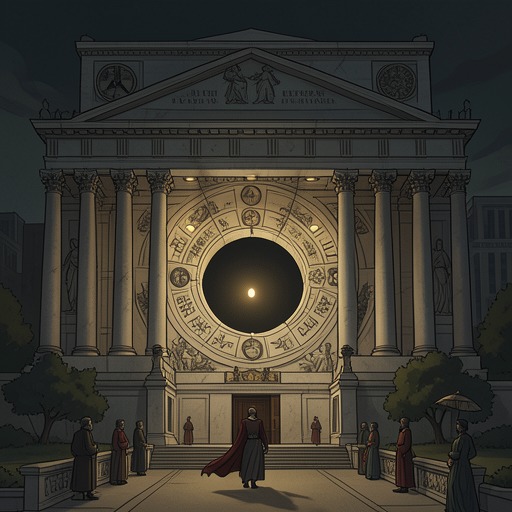
The District of Columbia’s Masonic landscape extends beyond the Capitol. The House of the Temple, at 1733 Sixteenth Street NW and only blocks from the White House, is described as a replica of the pre-Christian temple of King Mausolus. Two seventeen-ton sphinxes guard its entrance, and its interior contains ritual chambers, halls, vaults, libraries, and a hollow wall holding human remains. The Temple Room, where a Masonic initiation takes place, concentrates the secrecy and ritual that Langdon’s earlier explanations have treated as subjects of legend.
The city also places less familiar institutions beside ordinary urban landmarks. At Franklin Square, agents identify the Almas Shrine Temple as the headquarters of the Ancient Arabic Order of Nobles of the Mystic Shrine, an appendant body of the Masons more commonly known as the Shriners. Its ornate, mosque-like facade initially appears ominous to an agent unfamiliar with the group, while its association with the Shriners’ public philanthropy complicates that impression. Across its monuments, meeting places, government buildings, and underground rooms, the capital makes secrecy visible without settling whether any particular hidden meaning is true.