Freemason's Cipher
The Lost SymbolFreemason's Cipher is a geometric substitution system in which the shapes enclosing letters become the signs that stand for them. In The Lost Symbol, its simplicity is both a practical feature and a narrative misdirection: Robert Langdon can decode the sixteen-character inscription on the stone pyramid in under a minute, yet the resulting letters initially offer no intelligible message. The cipher therefore proves easy to break but not easy to understand, serving as the first readable layer of a puzzle whose key lies in how its output is used next.
Definition and Mechanism
Freemason's Cipher was used for private communication among early Masonic brothers. Its method replaces each letter with the distinctive shape of the enclosure containing that letter in a set of grids. Langdon describes a common key consisting of four grids: two plain and two dotted, with the alphabet arranged through them in order. A symbol can thus be matched to its enclosure, and the letter inside that enclosure recovered. The procedure is substitution, not a mysterious language requiring specialist knowledge.
The system's weakness is also its defining characteristic. It had long since been abandoned for private communication because it was too easy to break; Langdon notes that many students in his advanced symbology seminar could solve it in about five minutes, while he could do so in less than sixty seconds. That ease makes the cipher an unlikely safeguard for a secret of world-historical importance. The contrast between an elementary code and the grave claims surrounding the pyramid becomes one of the puzzle's first warnings: deciphering the visible inscription is not the same as understanding the artifact.
The Pyramid Inscription and Its First Reading
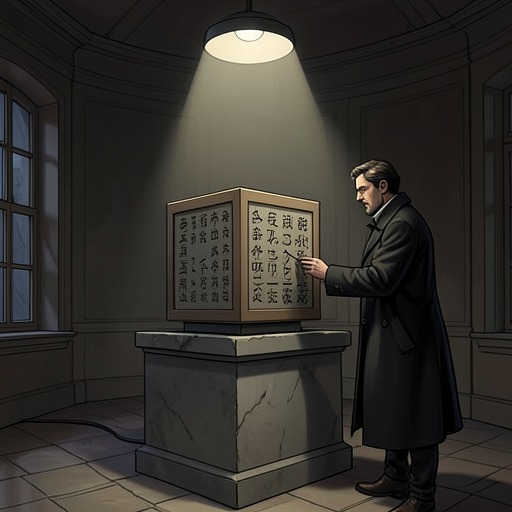
The cipher enters the central mystery when Inoue Sato shows Langdon a newly exposed face of the stone pyramid bearing sixteen engraved characters. She assumes he can read them because he was brought to Washington to decipher the inscription. Langdon recognizes the symbols as a seventeenth-century encrypted cipher language and knows how to break it, although he objects that the pyramid is Peter Solomon's private property. Sato insists that the code may be connected to national security and presses him for its meaning.
Later, with Warren Bellamy beside him in the United States Library of Congress, Langdon identifies the inscription specifically as Freemason's Cipher. Bellamy's claim that the pyramid is a map, and that its golden capstone is the map's legend, gives the decoding a larger purpose: the two pieces are said to point toward the hiding place of ancient wisdom. Langdon remains doubtful. The cipher is so familiar and vulnerable that the idea of it guarding a unique, powerful secret seems paradoxical; he even compares the security implied by Sato's concern to protecting nuclear launch codes with a novelty decoder ring.
Langdon writes out the four-grid key and begins matching the engraved shapes to their enclosures. The first character resembles a down arrow or chalice and resolves to S; the next, a dotted square open on its right side, gives O; the third, a plain square, gives E. He continues through the inscription until he has transcribed the whole grid. The work is rapid and methodical, but its result is not a clear instruction or an obvious location. The letters appear to form a random grid, leaving Langdon without the revelation he expected—or that Bellamy's explanation seemed to promise.
A First Layer in a Larger Code
The apparent failure is crucial to the cipher's role. At the Central Intelligence Agency, Nola Kaye independently confirms that the inscription is Freemason's Cipher and reports that its cleartext is a meaningless grid of random letters. She considers whether another layer of encryption might be present and notes that a grid-based matrix could be tested with methods such as Vigenère, grilles, or trellises, although she cannot promise a solution. The intelligence analysis reaches the same impasse as Langdon's hand decryption: the substitution is solved, but the output remains unreadable.
The novel later makes that grid's arrangement matter. In a conversation about Dürer's magic square, Langdon explains that the famous four-by-four arrangement in Melencolia I is more than a grid whose rows, columns, and diagonals total thirty-four: its quadrants, central four cells, and corner cells also produce that sum. He sets the numbered square beside the lettered grid from the pyramid, establishing a visual and procedural connection between them. This does not make the first substitution cipher itself more difficult; instead, it suggests that the solved letters may need to be organized according to another system.
That distinction leads to the final layer. When Mal'akh studies the pyramid's base, he recalls Langdon's desperate explanation that the clue points to an order-eight magic square, not to an address. The square is the one associated with Benjamin Franklin, whose arrangement of the numbers one through sixty-four is used to define a new order for the sixty-four symbols on the pyramid's base. The first cipher thus functions as a clue to the method of reading the later grid: substitution exposes letters, while the magic square supplies an ordering principle. The book links the two stages without treating them as the same operation.
Secrecy, Access, and Narrative Significance
The cipher's simplicity also sharpens the novel's distinction between secrecy and obscurity. In an earlier lecture, Langdon explains that Freemasonry is better understood as a society with secrets than as a secret society: its members and buildings are publicly visible, while access to some information depends on trust, hierarchy, and time within the organization. Freemason's Cipher embodies that distinction in miniature. Its signs are not impenetrable, and knowledge of the key is not enough to guarantee understanding; the real obstacle is knowing what to do with the readable result and how it fits into a wider body of clues.
For Langdon, the inscription turns an abstract claim into a practical test. He can recognize the historical cipher, explain its mechanics, and translate every character, but those competencies alone do not unlock the pyramid. The gap between legibility and meaning keeps the investigation moving: the first code yields a grid, the grid invites comparison with magic-square structures, and the later order-eight clue explains how symbols can be rearranged. Freemason's Cipher matters not as a formidable encryption device but as the accessible first step in a layered puzzle—one whose apparent ease conceals the more consequential problem of interpretation.