Hidden Spiral Staircase
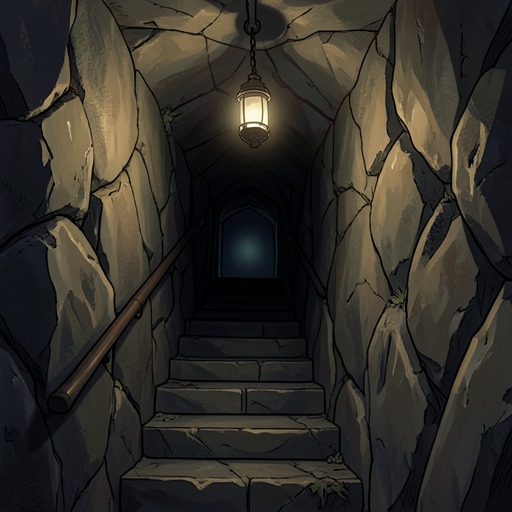
The Lost SymbolThe Hidden Spiral Staircase is a concealed route said to descend hundreds of feet beneath the earth to the resting place of ancient wisdom. In the novel, it is not a verified structure but a guarded Masonic claim: an entrance hidden beneath an enormous stone, whose location is supposedly encoded by the Masonic Pyramid. Its uncertain existence gives the puzzle a physical destination while forcing Robert Langdon and Warren Bellamy to weigh evidence against inherited belief and duty.
The Staircase as a Masonic Claim
Bellamy tells Langdon that, according to what he has heard over the years, the Masonic Pyramid leads to the entrance of a spiral staircase descending many hundreds of feet. Ancient wisdom, he says, is allegedly buried at the bottom. The proposed entrance is covered by an enormous stone, an image Langdon recognizes from accounts of the tomb of Jesus. The resemblance makes the story legible as a familiar burial motif, but it does not confirm that the passage exists.
Bellamy is careful about the limits of his knowledge. He has never seen the staircase personally; a few older Masons swear that it exists, and he has tried to contact one of them for guidance. The distinction matters: the staircase is supported by testimony passed through Masonic circles, not by direct observation from either man. The story’s promise is concrete—an underground descent and something buried below—while its evidence remains indirect.
What the Pyramid Is Said to Reveal
Bellamy presents the Masonic Pyramid as a map rather than a mere symbol. In his explanation, the Gold Capstone serves as its legend: the key that teaches its reader how to interpret the map and find the hiding place of the lost wisdom. The staircase is thus the proposed link between an inscribed object and a real underground location. Without that route, the pyramid’s claim to be a map would remain an abstract mystery; with it, the cipher appears to point toward a place that can in principle be reached.
The first stage of Langdon’s reading uses the Masonic cipher engraved on the pyramid. He applies the familiar key of four grids, two plain and two dotted, in which each letter occupies a distinctive enclosure. That elementary substitution produces a message that does not immediately function as a location. The staircase story therefore remains suspended between a partially decoded artifact and a destination that the characters have not found.
Later, the puzzle points toward another kind of code: an eight-by-eight magic square. While trapped in the breathable-liquid chamber, Langdon tells Mal’akh that the phrase refers not to an address but to an order-eight square associated with Benjamin Franklin. The sixty-four symbols on the pyramid’s base must be rearranged according to the numbers in Franklin’s square. This revelation makes the pyramid’s promised route dependent on a layered process of interpretation, but it does not, by itself, establish that the staircase has been located or entered.
Secrecy, Custody, and Trust
The staircase’s reported existence also shapes the conflict over who should possess the pyramid and its capstone. Bellamy argues that Peter Solomon entrusted the capstone to Langdon because Langdon stood outside the Masonic brotherhood, making the hiding place harder for those with unworthy motives to penetrate. Bellamy insists that guarding the secret may take precedence even over rescuing Peter. Langdon resists that logic, objecting that a supposed buried treasure cannot justify abandoning people in danger.
That disagreement gives the staircase more than a practical role in the plot. It is the object of a secrecy system in which access is controlled through trust, hierarchy, and partial knowledge. Bellamy distinguishes the Masons’ obligation to protect the alleged secret from his own lack of firsthand proof. His conviction is not based on having descended the stairs; it rests on testimony and an inherited duty. The novel thus keeps the boundary between evidence and faith visible even as the urgency of the chase presses the characters to act as if the route might be real.
A Promised Destination, Not a Confirmed Discovery
When Bellamy is later captured in the Library of Congress, he draws comfort from believing that Langdon and Katherine Solomon are carrying the pyramid toward safety. He has reached the man he contacted and expects that person to offer sanctuary. Bellamy believes the contact knows a great deal about the pyramid and the staircase, but this remains his understanding of what the man can provide, not an account of anyone finding the entrance.
The contact’s message to Langdon confirms the distinction between a clue and a discovery. Speaking without names, the old man assures Langdon that the map points to a real location and offers sanctuary and answers. He gives a riddle identifying his own refuge through its position north of the Tiber and its sacred stones; he does not claim that Langdon has reached the Hidden Spiral Staircase. The passage therefore ends this strand with the staircase still beyond direct verification. It functions as the physical promise behind the Masonic Pyramid—a buried destination that turns secrecy into a map-reading problem, while leaving the crucial question of what actually lies below unresolved in these scenes.