Isaac Newton
The Lost SymbolIsaac Newton never appears in person, but his name and ideas become a crucial key to the mystery of the Masonic Pyramid. Presented as both a major scientist and an alchemist associated with Rosicrucian thought, he links the puzzle’s coded inscription to a physical process: the pyramid can be tested, not merely interpreted, through the temperature scale he devised.
Identity and Hidden Signature
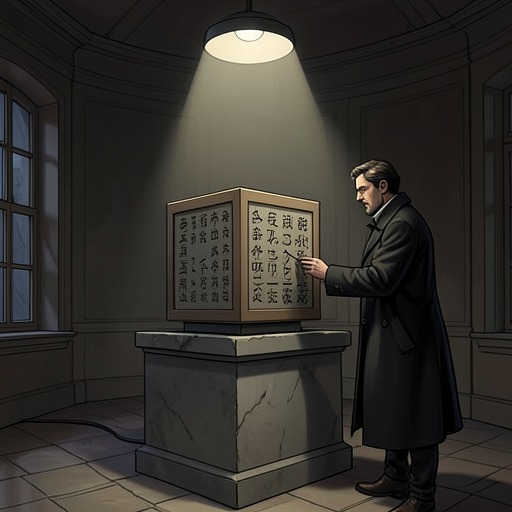
Newton first enters the investigation through the phrase Jeova Sanctus Unus, engraved on the pyramid and understood by Robert Langdon as a pseudonym rather than a statement about alchemy in the abstract. The clue emerges while Langdon, Katherine Solomon, and Colin Galloway discuss the Rosicrucian Order. Galloway recognizes that the inscription, its decoding through Dürer’s magic square, and the pyramid’s transformation into the Rose Cross point toward the same historical figure.
The phrase means One True God, but its importance also lies in its letters. Treating J as interchangeable with I and V as interchangeable with U in Latin, Langdon rearranges its sixteen letters into Isaacus Neutonuus. Katherine recognizes the name as Isaac Newton. The solution recasts the inscription as a deliberately disguised signature: the pyramid’s cipher does not simply identify a subject but directs its interpreters toward the person whose work can help them proceed.
The novel associates Newton with several intersecting traditions. Langdon describes him as an alchemist, a member of the Royal Society, and a Rosicrucian; Galloway adds that Newton’s personal papers included a heavily annotated copy of the Rosicrucian manifestos. Newton’s scientific standing therefore does not separate him from the secret wisdom the characters seek. In the story’s account, those identities overlap, making him a plausible guide to a puzzle that joins learned science with mystical symbolism.
A Guidepost in the Pyramid’s Clues
Newton’s name follows a chain of material and textual clues rather than arriving as a detached historical reference. The Rose Cross discussion revives Langdon’s memory of the cryptic phrase; the anagram identifies Newton; and that recognition prompts Katherine to see that the pyramid’s transformation may be achieved through a basic scientific process. Langdon recalls a similar moment of recognition at Newton’s pyramid-shaped tomb in Westminster Abbey. The echo makes Newton’s name feel like a recurring guidepost in the search for concealed knowledge, while keeping the immediate solution grounded in the objects and inscriptions before the characters.
That chain also changes how the pyramid is understood. Initially, its inscription appears to demand symbolic interpretation. Once Newton is identified, Katherine treats the name as a practical instruction: his science offers a way to test what the artifact will reveal. The clue thus moves from language to action, carrying the investigation out of abstract decipherment and toward an experiment.
The Newton Scale and the Thirty-Third Degree
The experiment depends on Newton’s temperature scale. Katherine explains that Newton based it on natural phenomena, set the temperature of melting ice at the zeroth degree, and assigned boiling water a temperature of thirty-three degrees. Peter Solomon had told her that Newton chose thirty-three because he regarded it as especially significant. In the novel, this numerical choice links Newton’s scientific method to the mystical traditions surrounding the pyramid.
The phrase “All is revealed at the thirty-third degree” has already admitted more than one reading. The characters first take degree to mean Masonic rank; rotating Peter’s ring by thirty-three degrees then reveals the Rose Cross and establishes the angular sense of the word. Katherine proposes a third meaning: temperature. On Newton’s scale, boiling water reaches the promised thirty-third degree, so the phrase becomes a direction for heating the pyramid rather than a reference to rank or rotation alone.
Katherine places the granite pyramid and its gold capstone in a strainer and lowers them into boiling water. The process is presented as a scientific test informed by Newton’s scale, not as supernatural intervention. The surrounding explanation of thermal markers supplies a material mechanism: different substances become incandescent at different temperatures. Newton’s role is therefore both interpretive and practical—the numerical clue leads to a controlled change in temperature, and that change can make the artifact disclose information through the properties of its materials.
Narrative and Thematic Significance
Newton’s significance rests on the tension the novel draws between scientific inquiry and mystical inheritance. He is invoked as a scientist, alchemist, numerologist, and Rosicrucian, without treating those descriptions as mutually exclusive. His coded name gives Langdon and Katherine a historical identity to pursue; his temperature scale turns that recognition into an experiment; and the special status of thirty-three binds the experiment back to the pyramid’s Masonic language.
The sequence also makes Newton a model for reading the novel’s clues. A phrase that appears devotional conceals an anagram; a word associated with Masonic rank also names an angle and a temperature; a stone-and-gold artifact responds to an ordinary scientific process. Each apparent change of subject is instead another layer of the same puzzle. Newton matters because his presence joins those layers, allowing the characters to move from deciphering the pyramid’s message to testing what the pyramid can do.