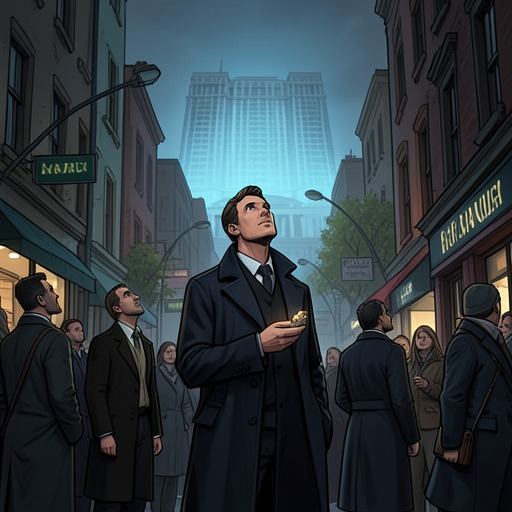
Keep the Masonic Pyramid and capstone apart
The Lost SymbolKeep the Masonic Pyramid and capstone apart is a rule for protecting a divided artifact: its stone pyramid and Masonic Pyramid’s Golden Capstone are not to be assembled. In the account given by Warren Bellamy, separation is not merely a precaution against theft but a duty, maintained across generations because the reunited pieces disclose how to read a map to the Ancient Mysteries. The rule turns custody itself into a form of guardianship: keeping the components apart limits who can reach the knowledge they encode.
The Rule and the Cipher
Bellamy explains that the pyramid is a map, and that the capstone serves as its legend: the key needed to interpret it. Robert Langdon first sees a simple Masonic cipher engraved on the pyramid, but its decoded letters do not make sense by themselves. The capstone, Bellamy suspects, carries an inscription that provides the next step. The parts are therefore a segmented cipher, a code broken into pieces whose information becomes legible only when the pieces are brought together. Bellamy invokes the ancient practice of dividing an inscribed tablet and storing its fragments separately: the security lies not in making the text impossible to decipher, but in preventing any one holder from possessing the complete key.
The distinction matters because the pyramid’s first decipherment produces only a grid of letters, not an answer. Langdon regards the grand claims about a hidden treasure with skepticism, while Bellamy insists that the letters conceal another layer. Later, the puzzle’s reliance on ordered numerical grids makes the layered design more concrete. Langdon and Katherine Solomon examine Albrecht Dürer’s four-by-four magic square, whose rows, columns, diagonals, and other groups of numbers share a total, as a clue to the method behind the pyramid’s letter grid. In a subsequent stage, the order-eight magic square associated with Benjamin Franklin supplies a way to rearrange the pyramid’s sixty-four base symbols. The separation rule thus protects access to a process: each layer depends on recognizing how one set of signs directs the reading of another.
Custodianship and Inheritance
The rule is bound to trust as much as to the artifact. Peter Solomon and Bellamy have long kept the pyramid and capstone apart. After a confrontation with Peter’s son Zachary, Bellamy worries that Zachary might reveal what he has seen and recommends taking precautions, including finding a new custodian for the capstone. Peter refuses to alter the arrangement. He believes Zachary does not understand the pyramid’s significance, and maintains that he will keep the pyramid in his vault while Bellamy continues to hold the capstone.
Six years later, on Christmas Day, an intruder claiming to have killed Zachary breaks into the Solomon estate seeking the pyramid. The attack costs Isabel Solomon her life, while the intruder leaves with the pyramid. In the aftermath, Peter tells Bellamy that he should have listened to his warning. Bellamy brings the capstone, still wrapped in faded brown paper, tied with twine, and sealed with Peter’s ring. The two components are now closer than they should be, making the danger of their reunion newly immediate. Peter asks Bellamy to find someone else to watch over the capstone, without telling him that person’s identity. He then accepts Bellamy’s suggestion to hide the pyramid in the Capitol Subbasement, a location Bellamy considers exceptionally secure and symbolically apt as the heart of the nation.
The Rule Under Pressure
Peter chooses Robert Langdon, an outsider to the Masons, to guard the capstone. Bellamy later interprets that choice as deliberate: the pyramid had been targeted before, including by people who entered the brotherhood with unworthy motives, so entrusting one component to someone outside it offered a different kind of protection. Peter tells Langdon that powerful people want the package and that it would be dangerous in the wrong hands. When Inoue Sato questions Langdon, he conceals the package in his daybag and worries that a trip to the CIA would lead to a search. His deception is a direct consequence of the custody rule: protecting the object requires withholding its existence from those who might seize it.
Bellamy’s understanding of the duty becomes most severe when he and Langdon are in danger. He insists that their responsibility to safeguard both pieces outweighs Langdon’s wish to find out what has happened to Katherine or Peter. He urges Langdon to help hide the pyramid and capstone far apart, describing preservation as a burden larger than any one person’s immediate concerns. His position makes the rule’s cost plain: secrecy can demand that a guardian place the artifact’s protection above urgent personal loyalties. The narrative also exposes the strain in that demand. The pieces have repeatedly come close together, and protecting them depends on fallible people making decisions under pressure.
Separation, Reunion, and Consequence
The rule is a safeguard, not a permanent solution to the puzzle. Once the pyramid and capstone are reunited, the capstone’s inscription helps reveal how to interpret the pyramid’s successive codes. That process ultimately reaches the base, where Langdon identifies the need for an order-eight magic square and connects the clue to Benjamin Franklin. Mal’akh, holding the pyramid, applies the same direction to the grid of sixty-four symbols. The reunion therefore gives the seeker access to the next cipher layer—the very access that the rule was designed to withhold until the pieces could be read by someone capable of understanding them.
This tension prevents the rule from being only a mechanical instruction about where to store two objects. Separation preserves the secret, but it also delays its interpretation; assembly opens the code, but exposes the knowledge to whoever controls the completed artifact. Peter and Bellamy treat divided custody as a duty inherited and renewed in response to specific dangers. Langdon’s later work with the clues shows the other side of that duty: secrecy can protect knowledge without making it intelligible, while the act of joining the pieces changes both the puzzle and the stakes. The rule’s central question is consequently not whether the pyramid can be assembled, but who may bring its fragments together and what that person will do with what they reveal.