Main Reading Room
The Lost SymbolThe Main Reading Room is the central chamber of the United States Library of Congress and, in the novel, an unexpected refuge where Robert Langdon and Warren Bellamy examine the Masonic Pyramid. Its scale and ceremonial order make it seem an improbable place to hide, yet Bellamy chooses it for a practical reason: he wants to hear anyone entering the building. At one of the room’s reading desks, the two men begin to interpret the pyramid’s cipher and the capstone that Bellamy identifies as its key.
Setting and Architecture
The room lies at the heart of the library’s cruciform floor plan. Bellamy leads Langdon through the building’s east corridor to a pair of double doors at the chamber’s center; their position gives the room an almost altar-like prominence. The approach passes through a broad marble-and-stucco hall lined with eight pairs of statues depicting Minerva, then into a grander space whose stained-glass skylights sit beneath beams decorated with aluminum leaf. Nearby display cases hold the Giant Bible of Mainz and a vellum copy of the Gutenberg Bible, while the vaulted ceiling bears a six-panel painting titled The Evolution of the Book.
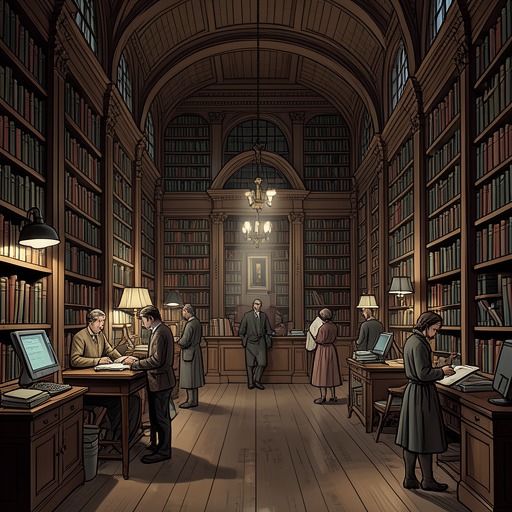
Beyond the doors, the Main Reading Room rises as a 160-foot octagon. Tennessee, Siena, and Algerian marble distinguish its eight sides, and light from eight directions leaves no shadows, lending the interior an even, almost self-illuminating appearance. A central collar and arabesque coffers lead the eye upward to the dome; sixteen bronze portrait statues look down from the surrounding balustrade. Below them, an arcade forms a lower balcony, while three concentric circles of burnished-wood desks radiate from a massive octagonal circulation desk. The room’s design makes reading feel like a public, monumental activity rather than a solitary one.
An Unlikely Refuge
The room’s grandeur initially makes Langdon question Bellamy’s choice. Its open, central position seems less like concealment than hiding in plain sight, and signs asking for silence add an ironic note to a conversation between men who have entered the library while fleeing danger. Bellamy nevertheless unlocks the doors and turns on the lights. He leaves the double doors propped open, explaining that he wants warning if anyone comes into the building. He expects that they would eventually be found wherever they hid, but insists that Langdon will be glad of his choice if they are cornered there. He does not explain further before turning their attention to the object in Langdon’s bag.
At a reading desk, Bellamy asks to inspect the pyramid. Langdon avoids placing its polished surface directly against rough granite by setting his entire bag on the desk and opening it. Bellamy adjusts the reading lamp and runs his fingers over the engraving. The practical intimacy of this gesture contrasts with the scale of the chamber around them: the immense room becomes, briefly, a worktable for studying a small stone object.
The Pyramid and Its Cipher
Langdon recognizes the sixteen engraved symbols as the Freemason’s Cipher, an old system for private communication among Masonic brothers. Its method is simple enough that many students in Langdon’s senior symbology seminar could break it in about five minutes; he estimates that he could do so in less than a minute. That ease makes the circumstances harder to understand. Langdon doubts that such a readily deciphered code could itself justify the CIA’s claim that the pyramid presents a national-security concern.
Bellamy offers a different way to understand the object. A map requires a legend, or key, that explains how to read it; he argues that the capstone supplies that key for the Masonic Pyramid. The pyramid, in his account, is not merely a decorated stone but a map that points toward the hiding place of lost ancient wisdom. The capstone’s significance therefore lies not simply in its material or its symbolism, but in how it makes the larger object legible.
Langdon agrees to test the cipher, though deciphering it feels like a small breach of Peter Solomon’s trust. He writes out the standard key: four grids, two plain and two dotted, with the alphabet placed in sequence. Each letter occupies an enclosure, and the enclosure’s shape becomes the symbol used to represent it. Matching the pyramid’s shapes to those in the grids, he begins translating the inscription. The first three symbols yield S, O, and E; he continues through the grid until he has completed the translation, but the evidence at the scene does not disclose the full result. Bellamy’s suggestion that the Ancient Mysteries are reserved for the truly enlightened leaves Langdon unsure whether his work has brought them closer to an answer.
A Starting Point for Further Decoding
The Main Reading Room is important not because the puzzle ends there, but because the scene establishes how the novel’s symbols invite successive acts of interpretation. A code that initially looks like a set of isolated shapes is approached through a consistent system of enclosures; Bellamy’s account then enlarges the cipher’s function by treating the capstone as a reading key for a map. The change is from asking what the symbols spell to asking what kind of object the pyramid is and what route its instructions might open.
Later stages of the investigation extend this attention to grids and numerical arrangements. Langdon and Katherine Solomon examine Dürer’s magic square, whose rows, columns, diagonals, quadrants, central squares, and corner squares each sum to thirty-four; the pairing of 15 and 14 in its bottom row also encodes the year of Dürer’s achievement. The pyramid’s final cipher, in turn, depends on an order-eight magic square associated with Benjamin Franklin and the rearrangement of sixty-four symbols. Those later developments occur beyond the room itself, but they give added weight to the first deciphering session: in the Main Reading Room, a cipher that seems almost childishly easy begins the larger movement from visible marks to hidden order.