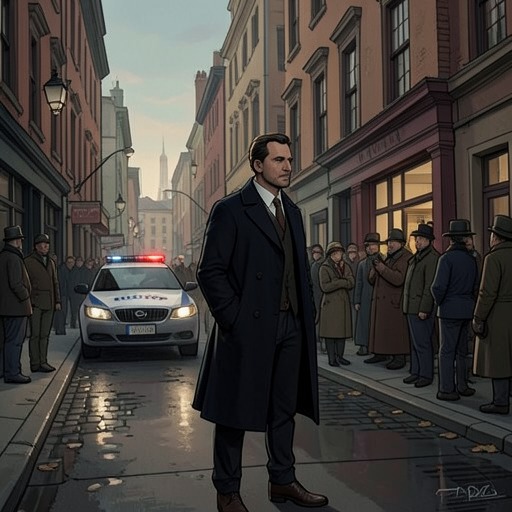
Mal’akh Disguises Himself and Escapes the Capitol
The Lost SymbolMal’akh’s escape from the United States Capitol is both a practical evasion and a staged performance: he leaves Peter Solomon’s severed hand in the Capitol Rotunda, lets the discovery trigger a police response, and uses that response to conceal his change of identity. The episode ends with him outside the building, composed and headed for a waiting limousine, confident that the invitation meant for Robert Langdon has been delivered.
The Planted Object and the Alarm
The escape begins under the eyes of the Capitol’s security system. From the basement surveillance center, Capitol police chief Trent Anderson watches a camera feed of a nearly deserted Rotunda. The man who draws his attention is bald, dressed in an army-surplus jacket, carrying an injured arm in a sling, and walking with a limp while talking on a cell phone. These conspicuous details make him easy to follow on camera, but they also form the appearance Mal’akh will soon discard.
At the precise center of the Rotunda, the man stops, ends the call, and kneels as if to tie his shoe. Instead, he takes an object from the sling and sets it upright on the floor. The object is about eight inches tall. Once he has left it, he limps briskly toward the east exit. A nearby child notices the object and approaches; then the child stops and screams. The alarm is thus created not by a confrontation with the police, but by a startling discovery placed in the path of an unsuspecting visitor.
Anderson recognizes what the object appears to be and immediately orders officers to find and detain the bald man with the sling. He leaves the surveillance center and runs upstairs, reasoning that the suspect’s route from the east portico should take him through the east-west corridor. The planted hand has already changed the building’s atmosphere: officers seal the Rotunda and try to move distressed tourists away, while the security response shifts from watching a screen to pursuing a suspect through public corridors.
A Pursuit Redirected
In the corridor, Anderson questions a blond tourist in a blue blazer who is reading a guidebook beneath a mosaic ceiling. The man says he saw the bald suspect run toward a staircase at the far eastern end. Anderson accepts the apparent lead, radios that the suspect is heading for the southeast exit, and runs toward it with his sidearm drawn. The tourist’s hesitation and nervous glance toward the east help make his answer seem like a report from a bystander rather than part of a disguise.
The apparent witness is Mal’akh. The pursuit has been directed toward the route he wants Anderson to take, while Mal’akh reaches a quiet exit on the east side of the Capitol and steps into the damp night air. The contrast is deliberate: inside, the chief is moving urgently and broadcasting instructions; outside, the escaping man can pause to savor the evening. The surveillance image and the eyewitness account have both supplied police with a suspect, but neither has kept pace with the transformation occurring out of their sight.
The Transformation
Only about a minute earlier, Mal’akh had been moving through the Capitol in the surplus coat and sling. In a darkened alcove, he removes the coat, revealing the blue blazer beneath it, then takes a blond wig from a pocket and puts it on. He straightens his posture, exchanges the limp for an elegant gait, and carries a slim Washington guidebook as he calmly leaves the alcove. Rather than merely changing clothes, he replaces the physical signs that made the camera image recognizable: baldness, slouched posture, apparent injury, and hurried movement give way to blond hair, an upright stance, and the bearing of a tourist.
That change explains why Anderson’s pursuit can continue in the wrong direction after Mal’akh has left. The security response is organized around a description that was accurate when given but has become obsolete. Mal’akh has used the building’s ordinary spaces—the Rotunda, corridor, alcove, and east exit—as stages in a sequence that separates the visible suspect from the person who escapes. His transformation is not an interruption to the plan; it is the means by which the plan succeeds.
The Invitation and Its Purpose
Outside, Mal’akh’s body becomes part of the scene’s emphasis on transformation. He stands to his full six-foot-three height, throws back his shoulders, and breathes deeply. He feels the wings of the tattooed phoenix on his chest opening wide and regards the disguise as a gift. The image joins the practical change of appearance to the larger transformation he believes is nearing completion, without altering the immediate fact of his escape: he has passed beyond the Capitol’s pursuit and is walking toward his waiting limousine.
Mal’akh also understands the escape as the delivery of an invitation. He has moved through the Capitol while observing its ancient etiquettes, and considers the invitation delivered; if Langdon has not yet understood his part in the evening, Mal’akh expects that he soon will. The hand’s placement therefore has a double consequence. It provokes an emergency that draws the security chief away from the exit Mal’akh uses, and it leaves a signal within the Rotunda that draws Langdon toward the unfolding mystery. The episode converts a police chase into a controlled transition: Mal’akh leaves the building unseen as the consequences of his action begin to gather inside it.