Mal’akh Learns the True Lost Word as He Dies
The Lost SymbolMal’akh Learns the True Lost Word as He Dies is the turning point in which Mal’akh’s promised moment of glory collapses into a painful recognition: the symbol he believed completed his work was not the Lost Word. In the Temple Room, Peter Solomon corrects him and offers an intimate final truth—he was loved. The scene then shifts from Mal’akh’s certainty about supernatural reward to his frightened, uncertain experience of dying.
The failed expectation
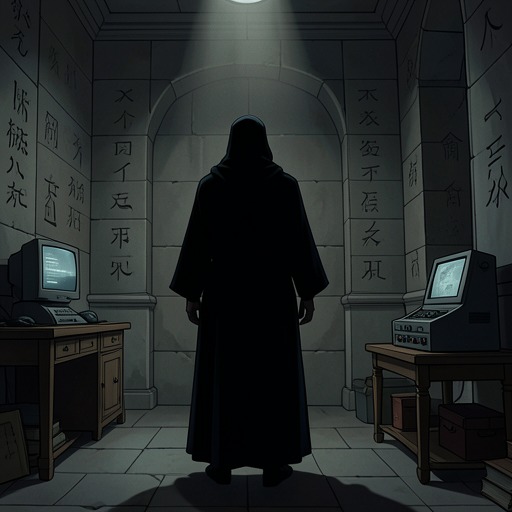
The scene opens after Mal’akh’s plan has gone wrong. He registers darkness and pain, cannot see, and senses people moving around him. Among the voices he recognizes Robert Langdon, repeatedly assuring Peter Solomon that Katherine Solomon is alive and safe. Mal’akh instead believes Katherine must be dead, an assumption that reveals how little he can know of events around him at this point. The reassurance belongs to the people in the room; his understanding remains trapped within his own failing perception.
He hears that the helicopter has moved away and that the Temple Room has become abruptly calm. Even without sight, he interprets the change through an image of the earth’s rhythms becoming disturbed by a gathering storm. His attention soon turns to urgent voices discussing the laptop and video file. He believes the recording is already spreading throughout the world and will damage the brotherhood. The contrast is stark: while others deal with the immediate consequences of the crisis, Mal’akh continues to imagine himself as the agent of a world-changing design, certain that he has done great deeds and will be welcomed as a king.
Peter’s correction
Peter approaches Mal’akh and speaks close to him, identifying what Mal’akh has written on his scalp as not the Lost Word. The correction overturns the meaning Mal’akh has attached to his final act. He had understood the Word as an ancient language, and Peter had taught him to think of that language as the language of symbols. Within that framework, the circumpunct—a circle with a dot at its center—appeared to him to gather many traditions into one image: the sun, alchemical gold, the Philosopher’s Stone, the Rose Cross, Creation, and the all-seeing eye above the unfinished pyramid.
Mal’akh recalls that the Masonic Pyramid’s grid seemed to point directly toward the circumpunct. That apparent confirmation made Peter’s earlier teaching seem true and persuaded Mal’akh that the symbol was the answer. He had inscribed it believing that his masterpiece and offering were complete. Peter now reveals that he lied: he says Mal’akh would not have believed or understood the true Lost Word if it had been disclosed earlier. The deception is therefore presented as a choice forced by Mal’akh’s inability to accept the truth, not as evidence that the symbol was meaningless. Peter says the Word is known to all but recognized by few. Its significance lies in recognition, not in discovering an obscure term.
A final exchange between father and son
The correction reaches Mal’akh at the moment he can no longer act on it. His confident interpretation—that the symbol would secure his reward—gives way to confusion about what Peter has told him. Peter’s next words are personal rather than explanatory: he tells Mal’akh that his work remains incomplete, then asks him to know that he was loved. Peter places a hand on his head, the same area where Mal’akh has marked the symbol. The gesture connects the false conclusion of Mal’akh’s ritual with a truth he had not expected to receive from his father.
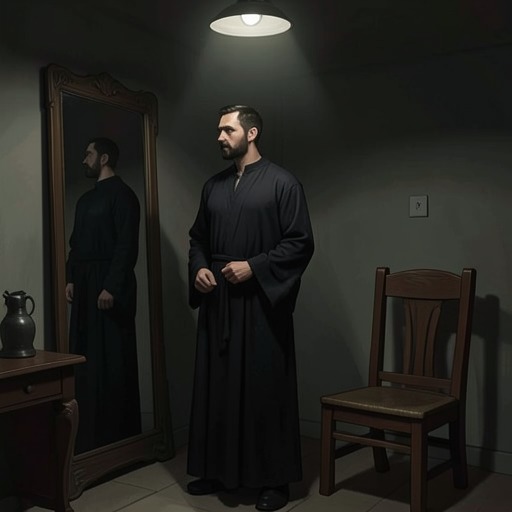
Mal’akh experiences that touch as a catalyst for a transformation within his physical self. His worldly pain seems to disappear, and his perception separates from his body: he describes looking down at himself while Peter kneels behind him, holding his head. The scene does not confirm Mal’akh’s earlier expectation of a divine welcome. Instead, his disembodied awareness remains angry and confused. He believes Peter is refusing to fulfill the role Mal’akh expects of him, including the demand that Peter direct his own pain and anger against his son. Peter does not comply. He gently closes Mal’akh’s eyes, and Mal’akh feels the connection to his earthly body release.
The reversal of the promised reception
Once the tether releases, the narration follows Mal’akh into an increasingly unfamiliar state. A veil obscures the world; time accelerates; he descends into a barren darkness and senses a growing force around him. At first, he interprets this as the grand reception he expected. The interpretation does not last. The force becomes threatening, and instead of joy he feels boundless fear. The final image is not triumph or welcome but a darkness that takes him in as he screams.
This ending reverses Mal’akh’s own account of what his sacrifice would accomplish. He had anticipated reward and transformation; at the threshold of death, he encounters uncertainty and terror instead. Peter’s revelation supplies the scene’s central correction, while his final declaration of love complicates the revenge Mal’akh still expects from him. The event closes Mal’akh’s pursuit of the Lost Word not with mastery over its meaning, but with a distinction between possessing a symbol and recognizing what it signifies.