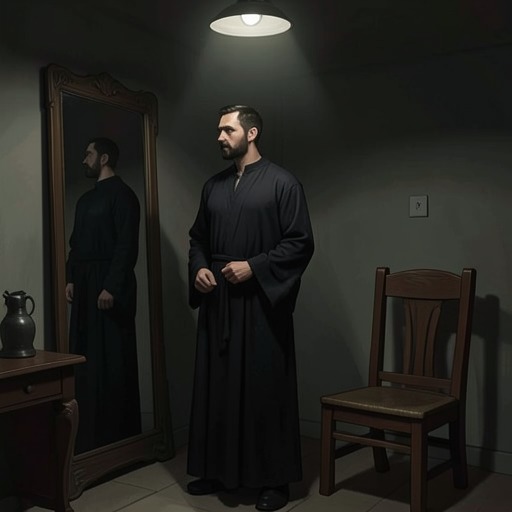
Mal’akh's physical and spiritual transformation
The Lost SymbolMal’akh’s physical and spiritual transformation is a deliberate passage through successive identities, from a prison escapee using stolen wealth to a self-fashioned figure who believes his body can be remade into a sacred instrument. His changing name, altered physique, tattoos, and ritual practices are not separate details but parts of a single project: to turn survival into a chosen destiny and to make an imagined spiritual apotheosis visible on the body.
From Inmate 37 to Andros Dareios
After arranging Zachary Solomon’s death and escaping prison, Inmate 37 takes the murdered man’s fortune and begins again under the Greek name Andros Dareios. The name itself joins the qualities he wants to claim: warrior and wealthy. On Syros Island, he leaves the drug world behind, settles into an affluent community, reads, exercises, and develops a new relation to his body. The reinvention is practical as well as symbolic: the money buys him new identities and passports, while his changed habits help him construct a life that conceals his past.
Andros’s physical change becomes a discipline. He begins lifting weights, then uses steroids and black-market growth hormones alongside sustained training. His body grows taller and more muscular, and he becomes conscious of the attention it attracts. The same substances alter his voice, which he comes to regard as part of his mysterious persona. The transformation is therefore neither purely inward nor simply cosmetic: he deliberately remakes his appearance and manner, then uses the resulting impression to keep his history obscure.
A chosen mythology and a new name
Andros’s reading and ritual practice gradually supply a story for the body he has built. He studies mystical texts, medieval poetry, and early philosophy, and interprets the opposition between order and chaos as a natural principle rather than a moral boundary. Reading John Milton’s Paradise Lost gives this search a figure: the fallen angel Moloch. He learns that the name, rendered in an ancient tongue, becomes Mal’akh, and adopts it as his own. The name marks a shift from a hidden past to an identity he treats as destiny.
That change of identity is joined to a design. After deciding that his transformation requires a sacrifice greater than the animals used in his earlier rituals, Mal’akh spends three days making a life-size sketch of the person he intends to become. He takes the drawing to a tattoo parlor, converting an inward conception into a bodily plan. The sequence matters: first he finds a myth that gives his ambition a shape, then he drafts that shape at full scale, and finally he begins to inscribe it onto himself.
The body as ritual work
The novel presents Mal’akh’s body as something he repeatedly prepares, interprets, and alters. In a later purification ritual, he removes his body hair, applies Abramelin oil, and ends with a cold shower that recalls the icy river associated with the beginning of his transformation. He reads his own anatomy through sacred symbols: his legs become the pillars Boaz and Jachin, while his hips and abdomen figure as mystical archways. The Phoenix tattoo across his chest and the sigils on his face make the body resemble a surface on which his chosen mythology has been written.
His most consequential bodily sacrifice is castration, which he understands as giving up sexual potency in exchange for spiritual power. He imagines the removal of gender and sexual temptation as a step beyond ordinary human limitation. This is his belief about the act, not proof that the transformation has achieved what he claims; the account instead shows how completely he has made physical alteration serve his theology. In his scheme, bodily change must precede spiritual change, and the self he seeks to shed is described as a mortal covering.
The bare patch at the top of his head gives this project an unfinished focal point. Mal’akh associates it with the fontanel, the place open at birth, and treats it as a symbolic portal between inner and outer worlds. He expects the hidden treasure sought through Robert Langdon to fill this void and enable his final transformation. Until then, his altered body remains both evidence of his progress and a sign that the process, by his own account, is incomplete.
Ritual identity and the unfinished transformation
Mal’akh’s transformation also takes place through borrowed ritual forms. At the House of the Temple, a thirty-four-year-old initiate kneels with wine in a human skull and prepares to take a final oath before an assembly of Masonic brothers. The initiate’s language and dress evoke ritual death and rebirth: he recalls the earlier degrees, the blindfold, the ceremonial dagger, and the threatened punishments for revealing the mysteries. The scene casts entry into the brotherhood as a threshold between an old identity and a new one, while the initiate privately understands the ceremony as an opportunity to gain power through knowledge he intends to use for his own purpose.
The later recording of a first-degree Masonic initiation confirms that the tall, muscular initiate wearing a blond hairpiece is Mal’akh. In the footage, Peter Solomon leads the ritual at Potomac Lodge No. 5, and the familiar ceremonial actions become evidence of Mal’akh’s concealed participation in Freemasonry. The ritual’s public meaning is brotherhood and obligation; for Mal’akh, it is entangled with secrecy, disguise, and access to the Ancient Mysteries. His performance of an initiate’s role thus extends his bodily self-fashioning into a social identity, one that lets him move within a tradition whose secrets he hopes to command.
When Mal’akh leaves the Capitol Rotunda, he has again used disguise: he puts on a blond wig, stands to his full six-foot-three height, and carries a Washington guidebook as he heads toward his waiting limousine. The Phoenix tattoo across his chest seems, in his private interpretation, to open with the promise of the night’s final stage. Yet the transformation is still conditional on the treasure he seeks and the knowledge it may disclose. The narrative’s central contrast is between the ceremony of rebirth he repeatedly performs and the unfinished state he cannot overcome by appearance or ritual alone.