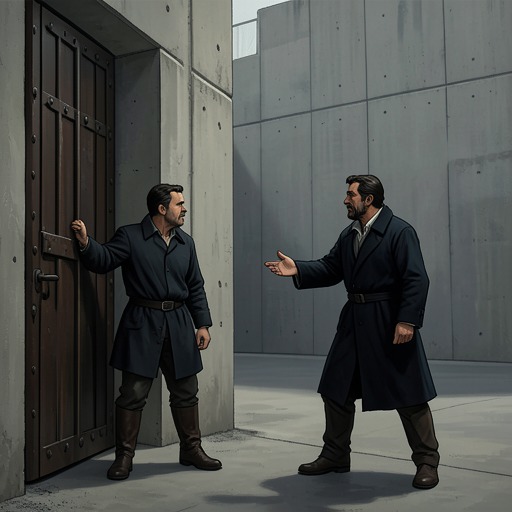
Mal’akh’s Kalorama Heights mansion
The Lost SymbolMal’akh’s Kalorama Heights mansion is a deceptive setting: from the road it appears to be a silent, gated estate, while beneath its ordinary cellar lies a concealed suite used for Mal’akh’s private practices. The house becomes important when Katherine Solomon identifies its address as a possible place where Peter Solomon is being held, and a security guard’s nighttime inspection inadvertently reveals the secret space within.
Setting and Role in the Search
The mansion stands behind a gated driveway in Kalorama Heights. When a security guard arrives in response to an urgent call concerning the property, she finds a house that seems quiet and unoccupied: there is no alarm sounding, no answer at the intercom or front door, and no movement visible from outside. After checking the perimeter, she initially reports no sign of trouble. The contrast between that unremarkable exterior and the hidden activity below ground makes the house a setting where appearances actively conceal the situation inside.
Katherine Solomon has directed the emergency dispatcher to check the address associated with Dr. Abaddon because she believes Peter may be held there. She has already learned that Dr. Abaddon’s true identity is Mal’akh, the man who killed her mother and nephew and has now captured her brother. As she drives toward the Library of Congress, Katherine sees the explosion at her laboratory and understands that Mal’akh has also come after her. The mansion is therefore more than an address on a call sheet: it links the hunt for Peter to the danger surrounding Katherine and her research.
The Concealed Basement
The visible cellar resembles an ordinary household basement, with a boiler, fuse box, woodpile, and miscellaneous storage. That familiar arrangement masks a larger underground area walled off from the accessible portion. Mal’akh’s private workspace consists of several small rooms, each assigned a particular purpose, and its only entrance is a steep ramp concealed behind a doorway accessible from the living room. The route makes the rooms difficult to discover through an ordinary visit to the house.
At the end of the corridor is the chamber Mal’akh calls his sanctum sanctorum. It is a twelve-foot square, with a stone table at its center and a seven-by-seven surface. Above the table hangs a calibrated light whose colors change according to a six-hour cycle tied to the Table of Planetary Hours. At the time described, the chamber is lit in a soft purple hue. The measurements, patterned furnishings, and timed illumination show how the hidden rooms have been organized around Mal’akh’s ritual system, rather than serving as incidental basement storage.
The scene also establishes a contrast between domestic space and secret use. From the cellar’s ordinary fixtures to the concealed ramp and specialized chambers, the house contains two different environments: one that can be inspected without revealing anything, and another reserved for Mal’akh’s clandestine work. The boundary between them is controlled by architecture—a hidden doorway, a blocked-off area, and rooms set apart from the household basement.
The Security Guard’s Discovery
The guard’s visit follows a routine procedure. After finding no obvious sign of intrusion, she walks around the house and notices a small bluish light at a low basement transom. Most of the window has been blacked out from the inside; a tiny place where the paint has peeled allows light to escape. When the loose paint falls away, she can see into the basement and discovers Mal’akh’s hidden work area. Before she can report what she has seen, Mal’akh attacks her with a Taser and incapacitates her.
The discovery turns the property’s concealment into a source of suspense. The guard does not enter by knowing a secret route or solving a clue; she spots a small defect in the covering over a window while completing an ordinary perimeter check. The narrow opening provides only a brief view, but it is enough to expose the concealed interior. Mal’akh subsequently repairs the paint on the window, restoring the barrier that had almost given the space away.
Mal’akh’s Preparations and the House’s Function
After dealing with the guard, Mal’akh leaves the basement through its hidden doorway and emerges into the living room. He pauses there to admire a painting of the Three Graces and to take in the familiar surroundings. He expects that after this night he will not return to the house, which gives the domestic rooms the character of a place he is preparing to leave behind rather than a secure refuge for the future.
At 10:02 p.m., Mal’akh checks his disposable phone and finds that Robert Langdon has not called. He believes Langdon has less than two hours. He then goes upstairs to an Italian-marble bathroom, turns on the steam shower, drinks water to settle his hunger, and begins a cleansing ritual. He has fasted for two days and regards his changed body as part of his preparation for what he expects to become by dawn. In the basement, meanwhile, he has arranged ritual materials, including a costly ancient knife purchased on the black market, for later use.
The mansion thus gathers together the ordinary and the ceremonial without making them the same space. Its living room, bathroom, cellar, and hidden chamber form a route through which Mal’akh moves from familiar home surroundings toward his planned ritual. The concealed basement gives physical form to the secrecy surrounding his work; the guard’s glimpse briefly breaks that secrecy, while Mal’akh’s repair of the window attempts to reestablish it. In the wider pursuit, the address draws attention to where Peter might be held, but the house’s most revealing role is as the private setting for Mal’akh’s preparations and concealed practices.