Mal’akh’s bodily transformation
The Lost SymbolMal’akh’s bodily transformation is a sustained attempt to make the body itself an instrument and emblem of change. His tattoos do not serve merely as decoration: he treats their creation as an act of sacrifice, self-mastery, and symbolic construction, shaping his appearance toward an image he intends to complete through the events in Washington. The novel sets that private project beside Masonic initiation, where ritual clothing, oaths, and witnesses also mark a passage into a new identity, but where Mal’akh’s bodily transformation remains his own calculated design.
A Deliberate Project of Change
Mal’akh understands tattooing as a way of altering more than appearance. The account places his practice within a long history of people marking their bodies as a means of transformation, and presents physical change as an assertion of control over the self. For Mal’akh, that principle becomes an organizing purpose: he regards the pain and labor involved in tattooing as a partial sacrifice through which he can emerge changed. His conviction that he is making himself into a work of art gives the process a ritual character, though its intended result is personal power rather than membership in a community.
The preparation is methodical. At his mansion, Mal’akh works on his shaved head with tattooing equipment and maintains a regimen that includes two days of fasting, drinking only water. The fasting connects bodily discipline to the future event he anticipates; it is not an incidental detail of his routine but part of his preparation. His self-fashioning thus involves both what he adds to his body and what he temporarily withholds from it.
The Body as a Symbolic Design
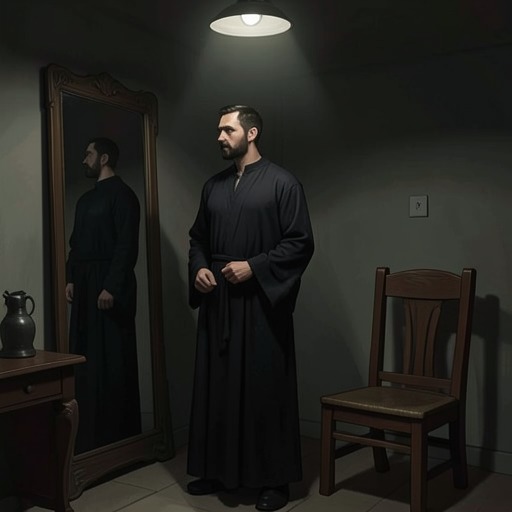
In front of a large mirror, Mal’akh surveys the accumulated tattoos as a deliberately composed image. His feet bear the scales and talons of a hawk; his legs are rendered as pillars, with one spiraling and the other vertically marked, evoking Boaz and Jachin. Above them, his torso is arranged into an architectural scheme, with a decorated archway and a double-headed phoenix across his chest. Ancient symbols and sigils continue over his shoulders, neck, face, and shaved scalp. The body reads as a coordinated design rather than a collection of unrelated marks: animal, architectural, and esoteric imagery are joined into what Mal’akh regards as an evolving icon.
That design is not yet complete. A small circle of untouched skin remains at the crown of his head, set apart as the final space to be filled. Mal’akh treats this reserved patch as essential to the finished work, although he does not yet possess what he needs to complete it. The unmarked area gives his transformation an explicitly unfinished state: the image he admires in the mirror is already elaborate, yet its anticipated completion depends on an outcome still ahead.
Concealment, Disguise, and Public Appearance
Mal’akh does not present his tattooed appearance openly in every situation. Before leaving for the Capitol, he covers the marks on his face, scalp, and neck with concealer, then puts on clothing selected for his plans. The contrast between his private self-image and his public appearance is part of the transformation’s operation. The tattoos make his body legible to himself as a symbolic artifact; concealing them lets him move through the world without revealing that design.
His escape from the Capitol extends this controlled change of appearance. He sheds an army-surplus coat in a dark alcove, puts on a blond wig, stands upright, and emerges in a blue blazer carrying a Washington guidebook. The shift from the apparently injured, bald figure to a composed tourist depends on posture and clothing as well as disguise. It shows transformation functioning tactically: appearance can be altered to redirect suspicion, while Mal’akh maintains a larger sense of himself as undergoing a more consequential change. The temporary disguise is not the final transformation he seeks, but it enables him to leave and continue his plan.
Ritual Context and Narrative Significance
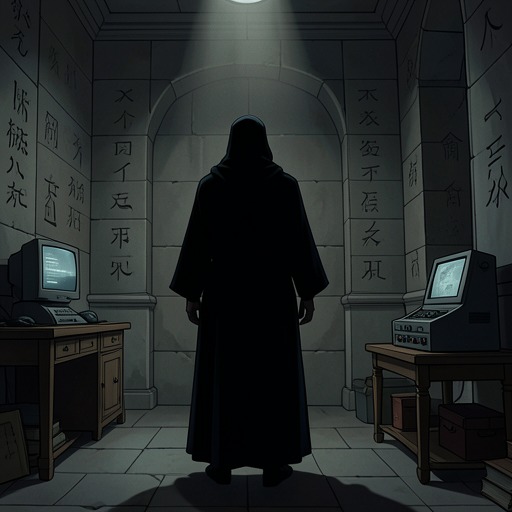
The novel places Mal’akh’s bodily project alongside Masonic initiation. In the prologue, an initiate prepares to take a final oath in the Temple Room of the House of the Temple, surrounded by brothers in ceremonial regalia. Later, a recording shown to Robert Langdon reveals Mal’akh in the first-degree initiation setting at Potomac Lodge No. 5, with his tattoos concealed beneath makeup. These scenes distinguish two kinds of change: the lodge’s passage is conducted through prescribed ritual, an oath, and the presence of a brotherhood; Mal’akh’s transformation is a private construction that borrows symbolic forms while concealing its purpose from those around him.
His new status as a thirty-third-degree Mason does not give him access to the brotherhood’s deepest secret. He has ascended to its highest degree, yet he knows that trust is limited and that further disclosure may never come. His tattoos and ritual participation therefore do not simply certify belonging. They accompany an independent search for the hidden knowledge he expects will complete his project. The body becomes a visible record of his chosen transformation, while concealment and disguise keep its meaning unavailable to most observers. In that contrast between an unfinished private image and carefully managed public appearances, the novel makes bodily transformation both a personal ambition and a practical instrument of Mal’akh’s plan.