Mal’akh’s hydrogen attack on Katherine Solomon’s laboratory
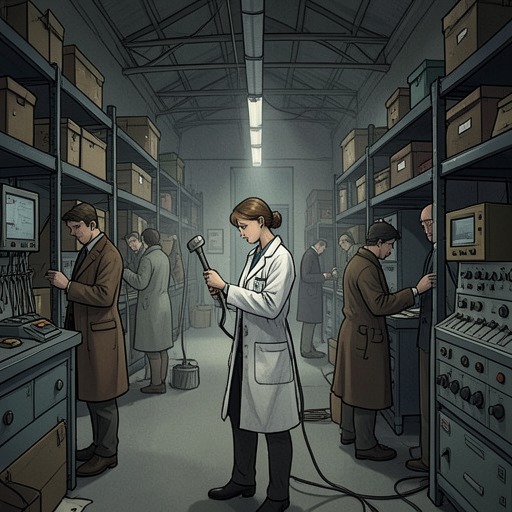
The Lost SymbolMal’akh’s hydrogen attack on Katherine Solomon’s laboratory converts an access problem into a destructive chain reaction. Unable to retrieve the holographic research data through the locked data-room door, he uses a reserve cylinder of liquid hydrogen and a trail of Bunsen-burner oil to set the laboratory ablaze. The explosion destroys the security of The Cube, exposes the danger facing Katherine’s work, and gives Katherine a sudden, unmistakable sign that the attack has reached her laboratory.
Motive and the Target
The attack is aimed not simply at Katherine Solomon but at the research preserved in her laboratory. Mal’akh has learned that her experiments address ancient questions about prayer, life after death, and the existence of the soul. He regards the findings as scientifically conclusive and potentially capable of changing human consciousness. In his view, that prospect makes the research dangerous: if its results become public, people may begin to find their way without the guidance he intends to control. Destroying the stored data is therefore his last task before his planned transformation, an attempt to prevent knowledge he considers threatening from reaching the wider world.
The immediate obstacle is the data-storage room’s security. Mal’akh uses Trish Dunne’s key card at its entrance, but the panel remains dark; the card he took from Katherine Solomon’s lab coat activates it. He still does not know Katherine’s PIN, and Trish’s PIN fails. The three-inch-thick Plexiglas door cannot be broken through by force, even with an ax, and Mal’akh cannot reach the two holographic storage units behind it. His attack begins where conventional access ends: with the narrow gap between the bottom of the door and its jamb.
The Hydrogen and Oil Trap
Mal’akh has prepared for the possibility that he will be unable to enter the room. In the power-supply room, he finds a rack of metal cylinders marked with the letters LH, the number 2, and a combustible-material symbol. One cylinder is connected to the laboratory’s hydrogen fuel cell; he leaves that one in place and rolls a reserve cylinder on a dolly across the lab to the data-room door.
He lays the cylinder on its side and threads its flexible rubber tube through the opening beneath the Plexiglas. Once he releases the valve, liquid hydrogen begins draining into the storage room. The puddle spreads across the floor and around the pedestals supporting the holographic units. Because the hydrogen remains liquid only while cold, it begins boiling as it warms, producing flammable gas within the enclosed room. The breach in the door is small, but it is enough to carry the material toward the very equipment Mal’akh means to destroy.
He then fetches a Pyrex jug of Bunsen-burner fuel: a viscous oil that is itself noncombustible but can carry flame. He pours it over the hydrogen cylinder and tubing, directs more beneath the door, and backs away from the storage room while laying an unbroken stream across the laboratory floor. The method depends on connecting two spaces that the security door was meant to separate. The data room receives the hydrogen; the oil trail carries the eventual ignition back toward it.
The Guard and the Fire
The explosion is set in motion when a perimeter patrolman responds to a report that the keypad to Pod 5 has been sabotaged and its specimen-bay door opened. At the bay, the guard finds the door ajar and shines his flashlight into the darkness without stepping fully inside. Mal’akh seizes his wrist, pulls him into the blackness, and knocks him down with a blow to the sternum. The guard sees a can of Bunsen-burner fuel on the floor, then the flame of a lighter in Mal’akh’s hand.
Mal’akh touches the lighter to the floor. A narrow strip of fire races away through the pod while he slips out through the open bay door. The patrolman recognizes the direction of the flame: it runs toward a massive cinder-block structure he knows as The Cube, the enclosure housing Katherine Solomon’s laboratory. The oil has extended the threat beyond the data-room threshold and along the path Mal’akh has made through the facility. Before the guard can reach help, air sucks through the pod; the hydrogen fireball erupts upward, tears off the roof of Pod 5, and throws titanium mesh, electronic equipment, and droplets of melted silicon into the night.
Katherine’s Recognition and the Aftermath
Katherine Solomon is already driving north after escaping the laboratory compound. From a pay phone at a gas station, she has called emergency services and asked for officers to investigate the attack at the Smithsonian Museum Support Center and to check the Kalorama Heights mansion where she believes her brother may be held. She has also tried, unsuccessfully, to obtain Robert Langdon’s unlisted cell-phone number. With no direct way to reach him, she heads toward the United States Library of Congress, where he said he was going.
In the rearview mirror, Katherine first mistakes the distant flash for fireworks. Then the light intensifies into an orange fireball rising above the trees, accompanied by dark smoke. The sight makes her understand that the blast has come from the direction of the laboratory. Its meaning is sharpened by what she has just learned: the man who killed her mother and nephew has captured her brother and come to kill her, and his interest in her laboratory is bound up with the mystery of a pyramid. The attack thus links the destruction of her research to the larger pursuit already unfolding around her family and the pyramid.
The fire is both Mal’akh’s practical solution to a locked door and the violent culmination of his effort to suppress knowledge he fears will reach the public. Yet its consequences exceed the destruction he seeks: the explosion makes the assault visible from the road, confirms to Katherine that the laboratory is under attack, and turns her flight toward the United States Library of Congress into a response to an unmistakable emergency.