Masonic House of the Temple
The Lost SymbolThe Masonic House of the Temple is a monumental Masonic headquarters in Washington, District of Columbia, and a pivotal setting where initiation, secrecy, and the pursuit of hidden knowledge converge. Its maze of ritual chambers gives physical form to the layered world of Freemasonry; at its center, the enormous Temple Room becomes both the setting of Mal’akh’s initiation and the destination of his later search for the Lost Word.
Setting and Architecture
Located at 1733 Sixteenth Street NW, the Masonic House of the Temple stands only a few blocks from the White House. The novel describes it as a replica of the pre-Christian temple of King Mausolus, the original mausoleum. Two seventeen-ton sphinxes guard its bronze entrance doors, while inside, ritual chambers, halls, sealed vaults, and libraries form an ornate labyrinth. The building also contains a hollow wall holding the remains of two people. Its reputation for concealment is therefore grounded in its physical arrangement: rooms open onto other rooms, while vaults and hidden spaces suggest that what is visible is not the whole of the building.
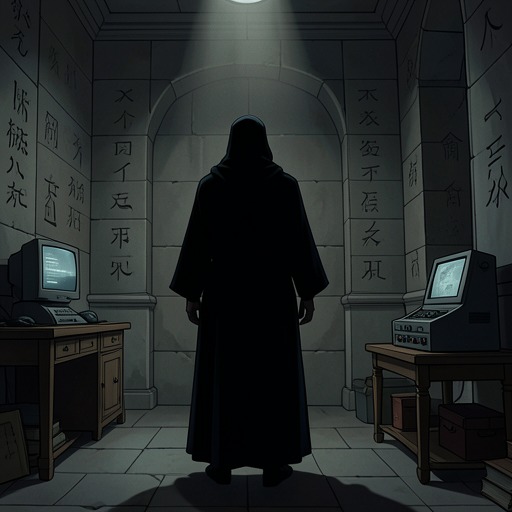
The Temple Room is the structure’s most imposing interior. A perfect square, it rises one hundred feet to a ceiling supported by massive green-granite columns. Dark Russian walnut seats, faced with hand-tooled pigskin, encircle the chamber in a tiered gallery. A thirty-three-foot throne dominates the western wall, opposite a concealed pipe organ. The walls carry an array of Egyptian, Hebraic, astronomical, and alchemical symbols, among others. At the center stands an altar carved from a solid block of polished Belgian black marble; above it, an oculus admits moonlight. These exacting proportions and accumulated symbols make the room feel less like an ordinary meeting place than a carefully composed ritual environment.
The Temple Room and Initiation
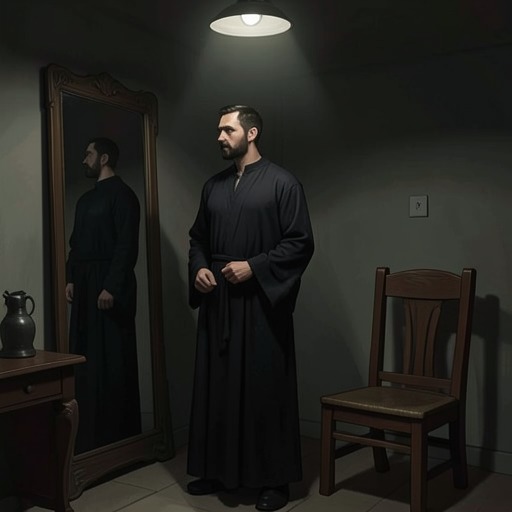
The novel first presents the Temple Room at 8:33 p.m., during the final stage of an initiation. A thirty-four-year-old initiate kneels before the assembled brothers, who wear Masonic regalia, while the ceremony’s presiding master directs him to complete his journey and take his oath. The initiate drinks wine from a human skull, following a ritual framed around the possibility of symbolic death and entry into a new status. His initiation is not his first encounter with the brotherhood: the narrative recalls an earlier ceremony in which he was blindfolded and asked to declare that he had freely chosen to become a candidate.
The room’s architecture intensifies the ceremony without explaining away its secrecy. Candles provide most of the light, supplemented by the moonbeam falling through the oculus; the central altar and surrounding gallery place the initiate within the attention of the gathered brothers. He believes that something unprecedented is happening and that the ceremony will give him great power. The reader later learns that the initiate is Mal’akh, whose participation in this Masonic rite is part of a larger plan. The Temple Room thus begins as a place of communal recognition but also marks Mal’akh’s entry into an institution whose knowledge he intends to exploit.
Masonic Authority and Hidden Knowledge
The building is associated with the highest levels of Scottish Rite Freemasonry. Peter Solomon heads the Supreme Council Thirty-third Degree, the governing body of the Scottish Rite in America, and has authority within the House of the Temple. Robert Langdon explains that the thirty-third degree is an honor attained by invitation rather than simply by completing each preceding degree. The number is made visible in the building’s later role: its thirty-three exterior columns are each thirty-three feet tall, turning a number associated with Masonic rank into a feature of the structure itself.
The novel also distinguishes the public presence of Freemasonry from its restricted knowledge. In a lecture, Langdon argues that Masons are not a secret society so much as a society with secrets: their buildings and symbols may be visible, while deeper information is shared only within the organization’s hierarchy. The House of the Temple embodies this difference. It is a recognizable headquarters, but its secluded chambers, access controls, and ritual use create boundaries between those admitted to its inner spaces and those kept outside them. The building’s mystery is therefore not presented only as an architectural puzzle; it is connected to who may enter, who may know, and who has been entrusted with the institution’s obligations.
Heredom and the Return to the Temple Room
The House of the Temple is also known among its Masonic brethren as Heredom, a name associated with an imaginary mountain in Scotland. When Langdon deciphers a clue as pointing to Heredom, he identifies the Washington building rather than a distant mountain. Mal’akh independently reaches the same destination: the message he extracts from the Masonic Pyramid directs him to the space beneath the House of the Temple, where he believes the Lost Word is hidden. The place name that might sound legendary thus becomes an actionable address in the city.
Mal’akh enters through the rear entrance, using an access code he received after his initiation to the thirty-third degree. Peter, whom Mal’akh has brought there in a wheelchair, recognizes the purpose of the journey and resists cooperating. Mal’akh uses the threat to Katherine to press him forward, making the building’s initiation-derived access serve a coercive purpose. For Mal’akh, returning to the Temple Room completes a circle: it is where the Masons admitted him, and now he means to uncover what he believes their most sublime secret conceals.
The Building’s Role in the Plot
The House of the Temple gathers several of the novel’s central tensions into a single site. Its architecture promises hidden rooms and concealed knowledge; its institutional hierarchy provides Mal’akh with both an entrance code and an understanding of Masonic signs; and its Temple Room links an earlier initiation to his later attempt to reach the Lost Word. The building is not merely a backdrop for ritual. Its controlled passages and layered spaces make secrecy spatial, while the public scale of its architecture stands in contrast to the private knowledge its members are charged with guarding.
When Langdon and the agents learn that Mal’akh is headed there, Warren Bellamy explains that the front doors are sealed from within and that the rear entrance is the practical way in. The route from that entrance passes through the Hall of Regalia, the Hall of Honor, a middle landing, the Atrium, and the Grand Stair before reaching the Temple Room. Bellamy warns that the building is a maze; an old, noisy elevator would open directly in view of the chamber, so a quiet approach requires navigating the interior on foot. Langdon’s knowledge of the layout makes him useful to the operation, while the building itself becomes an obstacle with a precise geography. The novel’s final approach to the House of the Temple consequently transforms a place of initiation and guarded learning into a contested space where Mal’akh seeks the secret he believes will complete his transformation.