Masonic Secrecy Obligations
The Lost SymbolMasonic Secrecy Obligations govern who may learn Freemasonry’s private teachings and what initiated members may disclose. In the novel, secrecy is not presented simply as evidence of a hidden conspiracy: it is an organized practice of trust, restricted access, and responsibility. Its force becomes clearest when Robert Langdon’s refusal to join the Masons keeps him free to teach openly, while Peter Solomon and Warren Bellamy treat the protection of an ancient secret as a duty that may outweigh even a brother’s life.
A Society with Secrets
Robert Langdon distinguishes a secret society from a society with secrets. Masonic rings, tie clips, pins, identifiable buildings, and publicly announced meeting times make the organization visible; what remains restricted is the knowledge shared within it. He illustrates the distinction through the example of a corporation whose existence is public but whose most valuable information is available only to trusted members who have spent time within its hierarchy. Entry and advancement, rather than concealment of the organization itself, regulate access.
The model is not an assertion that every rumor about Freemasonry is true. Langdon repeatedly challenges students who interpret Washington’s street plan as proof of a sinister Masonic design, explaining that arbitrary lines can produce suggestive shapes on other city maps as well. The distinction matters to the rule: secrecy can create a genuine boundary around information, but outsiders may also turn that boundary into imagined evidence of a vast hidden plot.
Membership, Trust, and Limits
Langdon describes Freemasonry as a hierarchical fraternity that takes secrecy seriously. In his classroom account, the deepest information might be shared only with members who have demonstrated trustworthiness and risen to a sufficiently high level, after which they would be sworn to secrecy. The obligation therefore depends on controlled disclosure: not everyone inside necessarily knows everything, and membership alone does not guarantee access to every secret.
The novel sets this structure beside Freemasonry’s distinction from organized religion. Langdon explains that Masons do not promise salvation, prescribe a specific theology, or seek to convert nonmembers; religious discussion is prohibited in Masonic lodges. At the same time, belief in a higher power is a requirement for membership, expressed in general terms such as the Great Architect of the Universe so that members of different faiths can meet without adopting a single religious identity. These rules define what the fraternity asks of its members while also limiting what its shared spiritual language can mean.
Langdon’s classroom discussion also exposes a boundary within the membership rules: Freemasonry is traditionally a men’s organization, while Eastern Star is described as a women’s branch with more than a million members. The exchange complicates Langdon’s broader characterization of the fraternity as open across races, colors, and creeds. Secrecy is one form of membership boundary, but the novel also makes visible who is excluded from the organization itself.
Langdon’s Refusal and Solomon’s Trust
Langdon respects Masonic philosophy and symbolism but decides not to be initiated. His reason is practical and ethical: vows of secrecy would prevent him from discussing Freemasonry freely with his students. The choice gives the obligation a cost before it becomes part of the later crisis. He can study and teach about Masonic symbols precisely because he has not accepted the restrictions that membership would place on his speech.
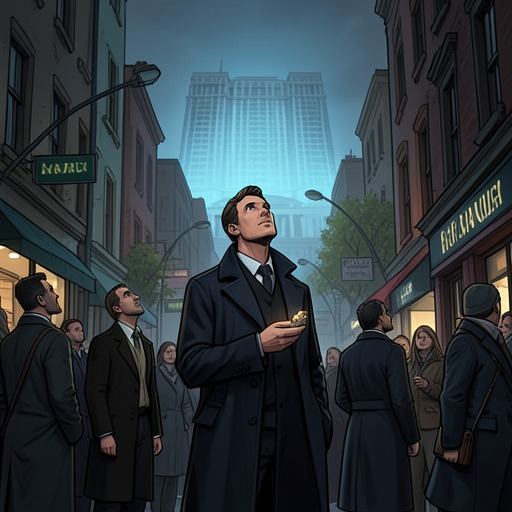
Peter Solomon nevertheless entrusts him with a small sealed package inherited through the Solomon family. Peter asks Langdon to keep it safe and tell no one, explaining that he believes it contains a powerful talisman and could be dangerous in the wrong hands. He chooses a trusted friend outside the brotherhood rather than a Masonic colleague, because he suspects the package will be safer beyond the organization. Langdon’s outsider status thus becomes useful: Peter trusts him to guard the object without making him a participant in the fraternity’s vows.
The Ancient Mysteries and the Burden of Secrecy
The obligation reaches its sternest form in Bellamy’s insistence that Langdon protect the Masonic Pyramid and its secret even if doing so means sacrificing Peter. Bellamy says that a Mason’s duty to protect a fellow Mason has an exception: the great secret guarded for all humanity. He argues that the pyramid has been targeted by people who infiltrated the brotherhood for unworthy reasons, and that Peter’s decision to place the capstone outside the organization was therefore deliberate protection, not a rejection of Masonic loyalty. Langdon resists the demand, doubting that ordinary Masons would consider a stone pyramid or a hidden staircase more important than a brother’s life. Bellamy’s answer—that there are circles within circles—makes the unequal distribution of knowledge central to the conflict.
The historical lineage of the rule is associated with the transmission of concealed wisdom. Langdon recalls accounts in which knowledge from the Mystery Schools of early Egypt passed underground, resurfaced in Renaissance Europe, and was entrusted to an elite group of scientists associated with the Royal Society of London and the Invisible College. Among the figures connected to that history are Isaac Newton, Francis Bacon, Robert Boyle, and Benjamin Franklin. Langdon remains skeptical of claims that this secret wisdom caused their scientific breakthroughs, but the discovery of Newton’s private papers in 1936 revealed his intense interest in alchemy and mystical knowledge. A letter from Newton to Robert Boyle urged silence about what they had learned, warning that its communication could cause immense harm. The novel leaves the meaning of that warning debated, preserving the gap between historical evidence of secrecy and speculation about what the secret contained.