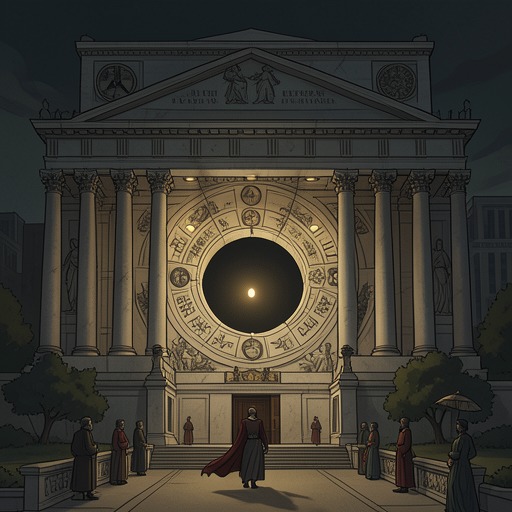
National Mall
The Lost SymbolThe National Mall is the novel’s great public axis: a landscape of monuments that Langdon reads not as a collection of isolated memorials but as a connected pattern of American history, sacred symbolism, and human achievement. From the Washington Monument at its center, the Mall’s geometry becomes a way to orient the story’s final revelations and to reconsider the relationship between divine language and human creation.
Setting and Symbolic Geography
The Mall is described through its radiating lines and landmark sequence. From the Washington Monument, Langdon imagines its four arms extending toward the cardinal points, making the obelisk a crossroads in the national landscape. The view gives physical form to the novel’s recurring interest in hidden order: the monuments occupy recognizable public space, yet their arrangement invites Langdon to read that space as a symbolic design.
The Mall also belongs to the founders’ imagined new Rome. Langdon recalls that Washington’s early planners gave the city classical associations, while the Potomac carried the name-memory of Rome’s Tiber. In this historical frame, the capital’s public architecture joins classical, Egyptian, and American references rather than belonging to a single religious tradition.
Monuments and Connected Meanings
The Washington Monument dominates the Mall’s visual and symbolic geography. From its upper chamber, Langdon looks north toward the White House and the line of Sixteenth Street leading toward the House of the Temple. Looking west, he follows the reflecting pool to the Lincoln Memorial, whose Greek-inspired architecture recalls the Parthenon and Athena. Southward, the Jefferson Memorial’s cupola evokes the Pantheon, once home to Rome’s gods. Each direction links a national landmark to an older architectural or mythological reference.
The Mall’s monuments also frame a larger argument about human making. From the Capitol Dome, Katherine and Langdon look over museums and memorials that preserve inventions, art, science, and the work of thinkers. Langdon sees this public landscape as a record of humanity’s expanding ability to build and transform the world. The monuments are therefore not only tributes to the past; in his interpretation, they testify to capacities once imagined as divine.
The Mall in the Final Revelation
At the Washington Monument, Langdon connects the pyramid’s final cipher to the tiny inscription Laus Deo on the aluminum peak. The phrase, meaning praise God, becomes visible in the story through the first sunlight striking the monument at dawn. From the Capitol Dome, Katherine and Langdon watch that light glint across the Mall and illuminate the tip. The distant monument turns a learned solution into a witnessed event: the code’s meaning is written on the city’s skyline, yet easily missed in ordinary sight.
The Mall’s central plaza beneath the monument also matters to Langdon’s final understanding. He recalls the buried Bible in the Washington Monument Cornerstone and the circumpunct embedded in the circular plaza, then recognizes a related geometry in the stone box Peter entrusted to him. The Mall thus gathers the novel’s central pattern of concealment and disclosure: a buried text, a symbol at a crossroads, and a public monument whose message emerges with the dawn. Its narrative significance lies in making the city itself legible as a designed landscape, where civic memory and sacred imagery meet in plain view.