Peter Refuses to Kill Zachary
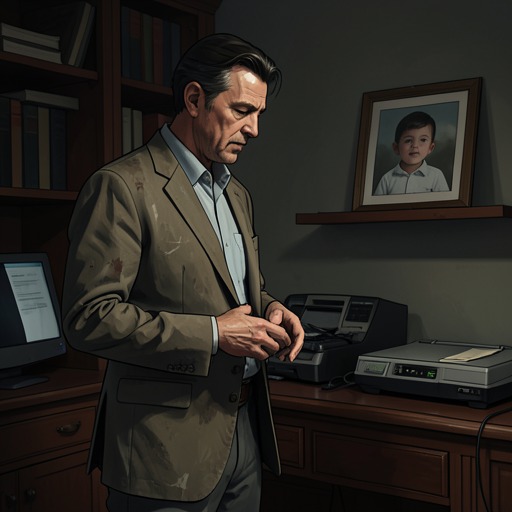
The Lost SymbolPeter Refuses to Kill Zachary is the confrontation in which Peter Solomon is pressed to kill his son, now known as Mal’akh, and does not complete the act. The crisis binds a father’s grief and guilt to an immediate threat against Katherine Solomon and the Masonic brotherhood. Peter raises the Akedah Knife, but the attempted sacrifice is disrupted before it can reach Mal’akh: Robert Langdon rushes into the Temple Room, and the helicopter overhead sends the chamber into turmoil.
The ultimatum
The choice is staged around competing emergencies. Mal’akh directs Peter’s attention to a laptop and cellular modem, where the transmission of a message is nearly complete. He insists that Peter can still save Katherine and protect the brotherhood by killing him, while warning that delay will make Peter responsible for the consequences. The threatened outcomes include Katherine’s death and the public release of a Masonic video. The demand makes the knife a test not only of Peter’s willingness to act, but of whether he will accept Mal’akh’s account of what duty requires.
Mal’akh presents the proposed killing as something Peter has already been driven toward. He invokes Peter’s earlier choices, including the moment when his son had to choose between wealth and wisdom, and accuses him of having pushed Zachary away. He also points to Peter’s past attempts to kill him and his abandonment in prison. In this retelling, the father is not simply asked to stop a present danger: he is told that earlier failures have produced the present crisis, and that only another act of violence can repair them.
The accusation presses on a conflict Peter cannot resolve by treating Mal’akh as a stranger. He knows the man before him is the son he once loved, yet confronts him as the person responsible for immense harm and as a continuing threat. Peter’s thought that Zachary had died long ago offers no secure escape from that recognition; he does not believe the separation it proposes. His inability to make the past emotionally distant is central to the hesitation that precedes the raised knife.
At the altar
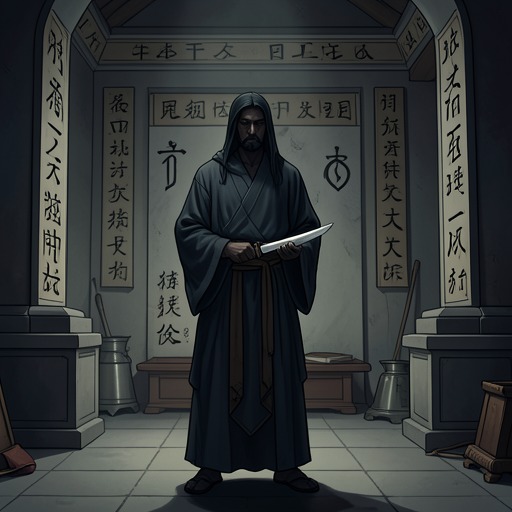
Mal’akh draws Peter toward an altar and lies down on a prepared white shroud, presenting himself as willing to die. The scene gives the demanded act the form of a ritual: the altar, the shroud, the knife, and the room’s oculus frame a killing Mal’akh interprets as transformation. He urges Peter to release him from his body and invokes both God and Peter’s own wishes. Peter, in contrast, remains caught between the plea to save Katherine and the recognition that the person he would have to kill is his son.
The laptop and modem remain visible across the room, keeping the threatened transmission in view as Peter approaches. Mal’akh repeatedly links the decision to the dangers beyond the altar: Katherine is in peril, the brotherhood is threatened, and the video may become public. He intensifies the pressure by naming the people and institutions Peter fears losing. The device’s progress indicator turns the ultimatum into a countdown, but it does not make the moral choice easier or remove Peter’s responsibility for it.
Peter finally stands over Mal’akh with the knife raised. His visible anguish and hesitation give way to a cry of grief as he brings the blade down. The scene therefore does not show Peter calmly accepting Mal’akh’s reasoning or treating the killing as an uncomplicated rescue. Rather, the gesture comes at the breaking point of an imposed choice, after Mal’akh has used their father-son history to make Peter feel accountable for every threatened consequence.
The interrupted strike
Langdon and Turner Simkins reach the doors as Peter’s cry comes from inside. Langdon opens them and sees a black-robed, shaved-headed figure at the altar, holding the blade above the outstretched body. He moves at once to stop the strike, crossing the room and colliding with the figure. In the brief confusion, Langdon expects to find Peter on the altar; instead, he recognizes the tattooed man there as Mal’akh and understands that the person he has tackled is Peter.
The interruption coincides with the arrival of a helicopter above the Temple Room. Searchlights pass through the glass overhead, and the aircraft’s approach fills the room with vibration. The blade is driven into the stone altar rather than into Mal’akh’s body, and it breaks. This is the decisive physical outcome of the confrontation: Peter has not killed his son, but the evidence shows the strike being diverted amid Langdon’s tackle and the helicopter’s arrival, not a clear, deliberate withdrawal by Peter.
The transmission, meanwhile, reaches completion. The laptop displays that the message has been sent before its screen goes black. The rescue of Mal’akh from the knife therefore does not itself resolve the danger Peter was trying to avert. The same moment that prevents the killing also leaves the threat of exposure unresolved, preserving the force of Mal’akh’s ultimatum even as its immediate demand fails.
Consequences and significance
The helicopter’s pilot struggles to keep the aircraft clear of the Temple Room’s glass oculus. Its downward force is deflected by the pyramid beneath it, and a strut strikes the glass. The oculus breaks, sending shards into the chamber. Mal’akh, who had expected the ritual to bring about a transformation, initially interprets the light and upheaval as confirmation; then he experiences pain. The event thus overturns the meaning he has assigned to the scene: the supposed sacred culmination becomes a physical emergency.
Peter’s refusal is consequential even though the moment does not present it as a composed declaration. The blade does not kill Mal’akh, and the father is not made to enact the son’s demand. Yet the interruption does not erase Peter’s grief, the accusation that their history led to this choice, or the danger to Katherine and the Masonic brotherhood. By bringing Langdon into the room at the instant of the strike, the narrative turns a private, coercive confrontation into a collision among family history, urgent rescue, ritual spectacle, and events beyond either man’s control.