Peter Solomon Entrusts Robert Langdon with the Sealed Package
The Lost SymbolPeter Solomon Entrusts Robert Langdon with the Sealed Package is the quiet handoff that sets the novel’s central chain of riddles in motion: Peter places a small, unopened inheritance in Robert Langdon’s care, and Langdon’s promise to protect it eventually brings the key to the Masonic Pyramid into the unfolding crisis in Washington. The scene is remembered from years earlier, but its consequences arrive in the present when Peter asks for the package back.
The Request and the Package
Peter visits Langdon before dawn at Harvard University, appearing unexpectedly in a deserted classroom. Their reunion is warm and teasing: Peter jokes about being on enemy territory as a Yale alumnus, while Langdon jokes about Peter’s age and recalls the trouble caused when he once looked after Peter’s enormous dog, Hercules. The banter establishes an easy friendship, but Peter has come on serious business and only has a few minutes.
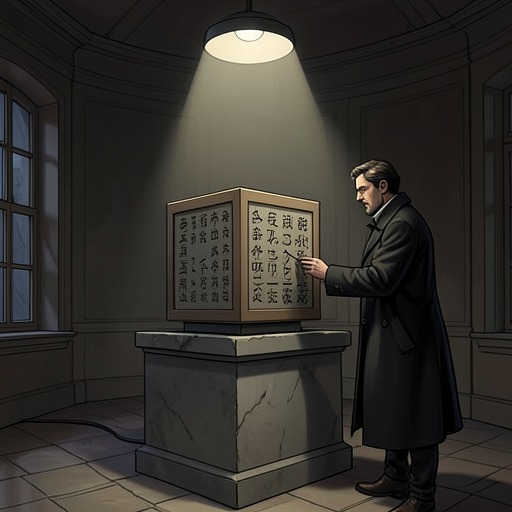
He asks Langdon to look after something valuable that he inherited and no longer feels comfortable keeping at home or in his office. Langdon suggests a bank safe-deposit box, but Peter would rather avoid paperwork and bank employees. He wants a trusted friend, and specifically someone he knows can keep a secret. From his pocket he produces a package about three inches square, wrapped in faded brown paper and tied with twine. Its weight suggests stone or metal; a wax seal, carefully secured on one side, bears a double-headed Phoenix and the number 33, a traditional emblem of the highest degree of Freemasonry.
The package’s modest size contrasts with the history Peter attaches to it. The seal was not made by Peter: he explains that his great-grandfather wrapped the package almost a century earlier. The family’s Masonic ring, which bears the same emblem, had passed from great-grandfather to grandfather, father, and finally Peter. No one had opened the package. When Langdon asks why, Peter answers that it is not time. The sealed wrapping thus carries not just an object but an inherited delay: a family’s decision to preserve something whose purpose remains undisclosed.
Trust Outside the Brotherhood
Peter asks Langdon not to open the package, to store it safely, and to tell no one that Peter gave it to him. Langdon wonders whether the elaborate secrecy is a playful attempt to make him curious about Freemasonry. Peter dismisses the idea: the Masons do not recruit, and Langdon has already said he would prefer not to join. Langdon respects Masonic philosophy and symbolism, but the order’s secrecy obligations would prevent him from discussing Freemasonry with his students. His refusal to become a member makes him useful to Peter in a different way: he is a trusted outsider.
Peter says that his own instinct is that the package will be safer outside the brotherhood. He also warns Langdon not to underestimate it: according to what his father told him, it contains something of substantial power, a kind of Talisman. Langdon responds with academic skepticism, associating talismans with obsolete beliefs in luck, protection from evil spirits, and ritual magic. Peter does not ask him to accept the claim on faith. Instead, he acknowledges Langdon’s skepticism as both a scholarly strength and a limitation, and asks him simply to trust the warning.
Peter describes the supposed power as the ability to bring Order from chaos, a central Masonic axiom. He insists that the object would be dangerous in the wrong hands and that he has reason to believe powerful people want to steal it. The exchange establishes the stakes without revealing what is inside: Peter knows more than he will say, while Langdon receives responsibility without explanation. The sealed package becomes an object of suspense precisely because the handoff withholds its contents and its intended moment of use.
Safekeeping, Delay, and Recall
After Peter leaves, Langdon sits alone at his kitchen table with the package, trying to imagine what it contains. He ultimately attributes Peter’s warning to eccentricity, locks the parcel in the wall safe in his library, and forgets about it. The contrast between Peter’s grave insistence and Langdon’s eventual forgetfulness makes the later summons decisive: a request framed as an old favor turns an apparently dormant secret into an immediate obligation.
Years later, while arranging Langdon’s trip to Washington, Peter’s assistant remembers one more instruction. He reads Peter’s note asking Langdon to bring the small sealed package given to him many years before. Langdon recognizes the request at once and agrees. Before leaving home, he retrieves the parcel from the back of the safe and puts it in his shoulder bag. By the time he is inside the United States Capitol, he believes he has failed Peter badly, though he does not yet know how the package’s presence will connect to the danger surrounding his friend.
That return also gives the original choice a new meaning. Langdon had accepted the package as a favor between friends, not as a participant in a secret society or as someone convinced of its alleged powers. But the very qualities that made him a suitable guardian—discretion, distance from the Masonic brotherhood, and a habit of examining symbols—make him central to what follows. The handoff has moved from a private act of safekeeping to a secret carried into the Capitol.
The Package Becomes a Key
In the present-day investigation, Langdon keeps the package hidden even as the authorities question him about the seven symbols tattooed on Peter’s hand. When Inoue Sato probes his sudden unease, he fears that her involvement may concern the object Peter warned could be stolen. Rather than disclose the package, Langdon improvises an explanation about the symbols to buy time. His secrecy is not abstract: it changes what he says during an active investigation and leaves him trying to protect both the object and his promise to Peter.
The tattoo becomes legible when Langdon turns the base supporting Peter’s hand upside down. From that angle, the marks can be read as the Roman numeral thirteen and the letters SBB, leading to the hidden chamber designation SBB XIII. The episode echoes the earlier entrustment: Peter’s secrets are approached not by taking their first appearance at face value, but by preserving what is hidden and changing the angle from which it is read.
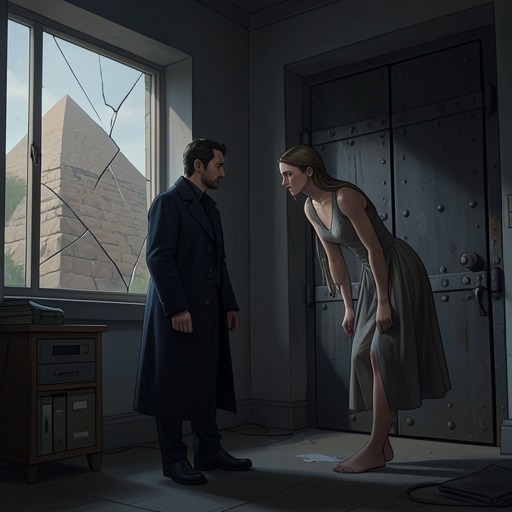
The package’s significance becomes clearer when Warren Bellamy explains that the Masonic Pyramid is a map and that the Gold Capstone is its legend, the key for reading it. Langdon deciphers the pyramid’s Masonic cipher using a grid-based substitution key, then works with Katherine Solomon to recognize how the cipher’s four-by-four layout connects with the magic square in Albrecht Dürer’s Melencolia I. Later, Mal’akh learns from Langdon’s desperate explanation that the pyramid’s base must be reorganized using an order-eight magic square associated with Benjamin Franklin. The package Peter entrusted to Langdon is therefore not merely a valuable relic: its capstone helps make the pyramid’s coded directions readable and drives the pursuit of the lost wisdom. The old classroom promise—to keep an unopened package safe until its time—has become the practical condition for unlocking the mystery.