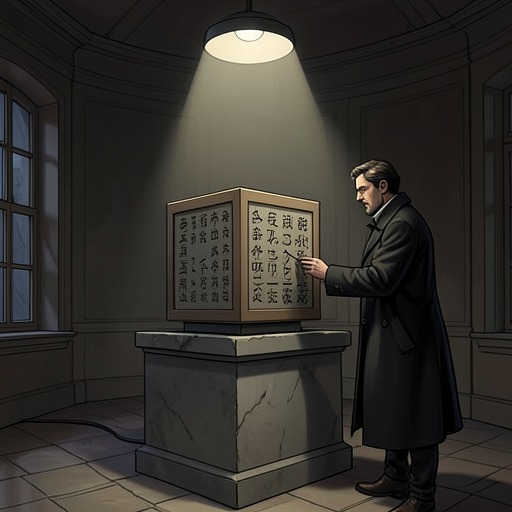
Peter Solomon and Robert Langdon
The Lost SymbolPeter Solomon and Robert Langdon’s relationship is defined by an act of confidence: Peter entrusts Langdon with a sealed package containing the capstone to a mysterious stone pyramid, trusting him to safeguard it even though he is not a Mason. The trust is tested when Langdon must decide whether to preserve the secret or use the package to help save Peter, who has been captured and is in danger.
A Trust Placed Outside the Brotherhood
Peter’s choice reaches back years before the events in Washington. He entrusted Langdon with a small, cube-shaped package and warned him that powerful people wanted to steal it and that it would be dangerous in the wrong hands. Its wax seal bears the imprint of Peter’s Masonic ring; as Langdon understands Peter to have explained, the ring had been used to seal the package more than a century earlier. The old seal gives the gift the character of a guarded inheritance, while Peter’s decision to place it with Langdon makes the professor personally responsible for protecting it.
The package’s contents are linked to the stone pyramid that Peter’s captor wants decoded. Peter had described the entrusted object as a means of creating order out of chaos, but Langdon does not yet know precisely what the capstone signifies or how it fits the pyramid. The uncertainty is part of the burden Peter has left him: Langdon receives a serious responsibility without a complete explanation, and must work out what the trust requires as events unfold.
Warren Bellamy later supplies a reason Peter chose an outsider. In Bellamy’s account, the pyramid and capstone have been kept apart for generations, and Peter’s decision to place the capstone beyond the Masonic brotherhood was a deliberate safeguard. Langdon is not a Mason and, Bellamy suspects, that is precisely why Peter selected him. Langdon’s distance from the organization makes him a less obvious target for anyone searching within it, but it also leaves him without the insider’s certainty about the secret he is being asked to protect.
The Clues Langdon Must Interpret
Langdon’s work on the clues gives practical force to Peter’s trust. When he examines Peter’s open hand, he sees seven small symbols concealed beneath the fingers. At first, their mixture seems to invite several readings: some marks resemble numerals, while others suggest runic writing. Langdon questions the assumption that the symbols belong to multiple systems and turns the hand’s wooden base upside down. From that changed orientation, the marks can be read consistently as Roman characters, including XIII, followed by SBB. The clue does not simply yield to his expertise; it requires him to reconsider how it is being viewed.
Bellamy then explains that the pyramid is a map and that its capstone functions as the map’s legend, the key needed to read it. Langdon deciphers the pyramid’s Masonic cipher using a grid of plain and dotted enclosures in which each shape stands for a letter. The resulting letters do not immediately make sense. Bellamy’s account suggests why: the pyramid and capstone form a segmented cipher, like a message divided into pieces that must be brought together before it can be understood. The separation Peter maintained is therefore both a security measure and an obstacle to interpretation.
That distinction makes Langdon’s role more complicated than simply keeping Peter’s package hidden. He must interpret the evidence well enough to understand what the object protects, while avoiding handing the combined secret to the person threatening Peter. Later, when Langdon is trapped in a chamber filling with liquid, he identifies the final clue as requiring an order-eight magic square associated with Benjamin Franklin. His deduction shows how far the search has moved from the sealed package Peter entrusted to him: Langdon’s ability to follow the cipher’s successive layers is now part of the struggle over the secret’s use.
A Conflict Between Secrecy and Peter’s Life
Bellamy presents the duty attached to the capstone in stark terms. He tells Langdon that Peter entrusted it to him because Peter believed he would keep it secret, and argues that protecting the secret must take precedence even if Peter dies. Bellamy’s reasoning turns their shared concern for Peter into a moral conflict: fidelity to Peter’s wishes, as Bellamy understands them, may require refusing the captor’s demand, while Langdon’s immediate purpose is to get Peter back.
Langdon resists the proposed choice. He challenges Bellamy’s claim that a Mason must protect the brotherhood’s secret above a fellow Mason and doubts both the alleged underground staircase and the power attributed to the hidden wisdom. His skepticism does not make him indifferent to the task. Rather, it distinguishes his loyalty from belief in the legend: he can doubt the pyramid’s promised treasure and still take seriously Peter’s confidence in him.
Bellamy also points out that Langdon is not a Mason or a member of any inner circle, asking why Peter would involve him if the pyramid revealed the ultimate Masonic secret. The answer Bellamy offers is the same strategic logic behind storing the capstone outside the brotherhood: an outsider could help protect it from people who had infiltrated the Masons with unworthy motives. Peter’s trust thus carries both personal and practical meaning. He relies on Langdon as a friend and scholar, but also as someone positioned beyond the institution whose secret is at stake.
What Langdon Reveals to Katherine
During the escape through the United States Library of Congress’s book conveyor, Langdon tells Katherine Solomon what Peter had entrusted to him and why he brought the package to Washington. He also tells her that Peter’s hand has been found in the Capitol Rotunda and explains the demand that he decipher the pyramid in exchange for Peter’s return. The account makes the consequences of Peter’s confidence explicit to Katherine: the object Langdon has guarded is now connected to the danger facing her brother and to the losses her family has already suffered.
Langdon describes Bellamy’s insistence that the capstone remain unopened, even at the cost of Peter’s life. Katherine rejects that priority. She argues that deciphering the pyramid is the only available path to getting Peter back and that the secrets should no longer be protected at the expense of her family. She breaks the package’s brittle wax seal. The decision does not erase Peter’s trust in Langdon; it exposes the question the trust has left unresolved—whether safeguarding the secret still serves Peter when the person who entrusted it is the one being used to enforce its secrecy.
The Relationship’s Narrative Significance
Peter and Langdon’s bond is conveyed less through their shared presence than through an object passed from one man to the other. The sealed cube carries Peter’s confidence across years and into a crisis in which Langdon must interpret its meaning without knowing everything Peter knew. Its seal signifies concealment, while the successive codes demand acts of attention and reinterpretation. The relationship therefore develops through the work Peter’s trust sets in motion: Langdon studies the hand, deciphers the pyramid’s first grid, and pursues the later ordering clue rather than treating the package as an unexplained token.
Their connection also establishes a contrast between institutional loyalty and personal trust. Bellamy frames the Masonic obligation as protection of a secret for all humanity; Peter’s action entrusts that obligation to someone outside the brotherhood. Langdon’s skepticism and resistance to abandoning Peter keep the relationship from becoming mere obedience. He takes Peter’s confidence seriously while questioning the claims made in its name, making the central test not whether he accepts the legend, but how he honors the man who trusted him.