SMSC Pod Five
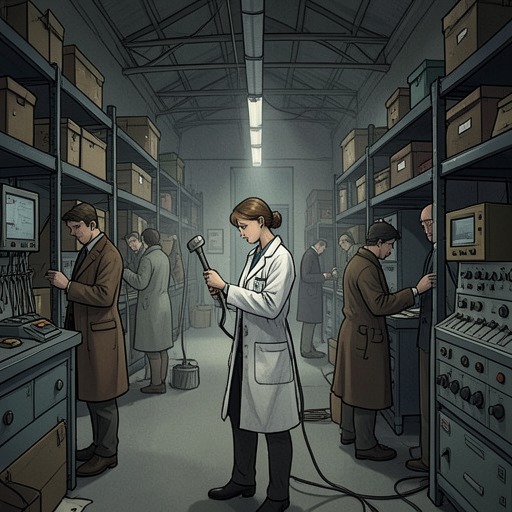
The Lost SymbolSMSC Pod Five is the remote laboratory at the Smithsonian Museum Support Center whose defining feature is a vast, lightless interior. A carpet runner makes the dark space navigable under ordinary conditions; during Mal’akh’s attack, the pod’s wall, movable specimen bay, and exterior security lights become Katherine Solomon’s means of survival. Its transformation from controlled workplace into a disorienting trap makes the location central to the danger surrounding Katherine and Trish Dunne.
Setting and Approach
The pod lies beyond the familiar corridors of the Smithsonian Museum Support Center. Visitors reach it by following a route known as The Street to a metal door marked for the pod. Once the door closes, the faint light from the corridor disappears, leaving a black interior so extensive that a first-time visitor can feel lost even when standing on the prescribed path. The space’s scale is conveyed less through a view than through the difficulty of crossing it: there is no visible destination, and the visitor must rely on bodily sensation and guidance.
A narrow carpet runner laid straight across the rough cement floor provides that guidance. Katherine explains to Trish that she can follow the runner with her feet, using its texture to detect when she drifts off course. The method turns an ordinary strip of carpet into a navigational instrument: in a room where sight offers nothing, the soles of the feet become the principal means of orientation. The runner also has a warning track near the exit, a change in texture that signals the approaching door. Trish recognizes it as the marker named by Peter Solomon, an avid baseball fan.
The door itself is operated with a key card inserted into a raised slot that must be found by touch. Entering or leaving therefore requires familiarity with a small sequence of tactile landmarks. In routine use, this makes the otherwise forbidding crossing manageable. During the attack, the same dependence on touch makes the pod’s darkness consequential: a person can lose direction, and even a familiar route can become uncertain when pursued.
Laboratory and Routine Use
The pod is associated with Katherine’s laboratory, a secluded work area that visitors reach by crossing the black interior. Trish first made the crossing about a year before the crisis, after accepting Katherine’s job offer and signing a nondisclosure agreement. Katherine led her into the darkness and demonstrated the carpet route. Trish was frightened when the pod door shut behind them, but she learned to correct her course by feeling when her foot left the runner. Katherine explained that when one sensory input is unavailable, the others can rapidly grow more sensitive; Trish’s feet became her guide through the space.
That earlier visit establishes the pod as both an unusual workplace and a place governed by practiced procedures. Trish later crosses in the opposite direction to collect Katherine’s guest, Dr. Abaddon, whom Peter Solomon reportedly trusted. The crossing is familiar enough that she can anticipate the warning track and reach the exit, but the setting still imposes its own conditions: she must keep to the runner, use her card by touch, and move through the darkness without a visual sense of the room around her.
The laboratory’s work also connects the pod to the mysterious file Katherine is studying. In a control room, she isolates phrases concerning a secret underground location in Washington, an ancient portal, a dangerous pyramid, and an engraved Symbolon. She believes the document may concern the same legend her brother has apparently shared with Dr. Abaddon. After studying the fragments, she switches off the plasma wall, which consumes the liquid hydrogen reserves of the fuel cell, and prepares to welcome her guest. The contrast between the high-energy display and the pitch-black route outside underscores how much of the site depends on tightly managed systems and controlled access.
Intrusion and Disorientation
The guest’s arrival turns the pod’s routines into evidence of danger. A security guard reviewing camera footage tells Katherine that Trish entered Wet Pod with the visitor but that he emerged alone. The visitor’s sleeves are wet up to the elbows, and he is carrying what appears to be a key card. He then proceeds toward Pod Five. Katherine is already running blindly across the carpet when the guard realizes that the footage is recorded rather than live: the visitor has entered the pod about ninety seconds earlier, using Trish’s card.
Katherine stops in the darkness and understands that the intruder is inside with her. She closes her phone to extinguish its light and tries to remain still. The smell of ethanol reaches her from a presence only a few feet away. When a toe cracks against the cement, the sound gives her position away; the attacker catches her lab coat, but she slips out of it and flees without knowing which direction leads out. The carpet that had once offered reassurance no longer provides a safe route, because she is moving in panic and the pursuer is close.
Katherine briefly uses the phone’s glow to mislead Mal’akh, setting it on a waist-high metal strut. He rushes toward the apparent light and collides with a wall and steel beam while she escapes along the pod’s sidewall, feeling its regularly spaced metal studs. When the studs break off at a smooth panel, she identifies it by touch as the specimen bay: a giant movable wall designed to transport oversized specimens. The pod’s large-scale equipment, ordinarily part of laboratory operations, becomes an escape route only after Katherine recognizes its function in the dark.
The Specimen Bay and Escape
Katherine finds the bay’s handle and tries to pull the panel open, but it does not move. Searching the surface, she discovers a security rod inserted into a hole in the cement floor. She lifts the rod free, returns to the handle, and heaves again. This time the panel shifts far enough to admit a narrow shaft of moonlight. With Mal’akh only a few feet away, she squeezes sideways through the opening as his tattooed arm reaches after her.
Outside, the loose stones around the building cut into her stockinged feet as she runs along the pale exterior wall. The darkness now helps rather than hinders her: after the pod’s complete blackness, her eyes are dilated enough for her to see outside. She hears Mal’akh force the heavy bay door open and pursue her. Rather than continue toward the corner, she cuts across the lawn and closes her eyes, anticipating the motion-activated security lights. When they blaze on, their intense brightness hurts Mal’akh’s dark-adapted eyes and causes him to stumble on the stones. Katherine then opens her eyes, corrects her course, reaches her Volvo, and starts the engine.
Narrative Significance
SMSC Pod Five is built around a stark opposition between blindness and orientation. The carpet, warning track, key-card slot, and wall studs are ordinary fixtures that become legible through touch; the specimen bay is a hidden possibility revealed by Katherine’s memory of how such facilities work. The attack reverses the meaning of the pod’s controlled darkness: the environment that once taught Trish to trust her senses becomes a place where a pursuer can approach unseen, while the procedures and structures of the laboratory offer Katherine only partial, hard-won ways out. The escape turns the pod’s architecture against the danger it had enclosed, and the lights outside complete that reversal by making darkness itself an advantage.