Sacred making
The Lost SymbolSacred making is the idea that sacrifice can make a person sacred and bring about transformation. In The Lost Symbol, it becomes the governing belief behind Andros’s evolution into Mal’akh: a self-directed ritual program in which study, bodily change, symbolic design, and the use of blood are treated as steps toward a new identity. The novel presents this as Mal’akh’s conviction, not as proof that ritual grants supernatural power.
Meaning and Claimed Origins
Andros understands sacred making as an ancient rite by which people offered something precious in order to seek favor from divine powers and make themselves holy. He draws a line between religious traditions separated by time and place: early Hebrew offerings at the Temple, Mayan rites at Chichén Itzá, and the Christian account of Jesus offering his body on the cross. In his reading, these are varied expressions of one principle: sacrifice is the means by which a human being crosses from the ordinary into the sacred.
The term itself becomes part of Andros’s system. He parses it as sacra, meaning sacred, and face, meaning make. That compact interpretation gives the concept a practical emphasis: holiness is not simply inherited or bestowed but made through deliberate action. The idea is powerful to him because it promises a method—a sequence that can be studied and performed—rather than an unknowable gift.
Andros’s understanding comes from his reading of mystical texts and his encounter with Aleister Crowley’s writings. He concludes that ritual words can serve as keys and that sacrifice can open access to a source of power beyond ordinary human understanding. The narrative shows how he assembles these ideas into a private doctrine. It does not establish that the forces he imagines are real; instead, it traces how his certainty grows and shapes what he does.
Andros’s Adoption of the Art
Andros’s search begins with a desire to hide the scars of his past. After a tattoo artist gives him a pamphlet on tattooing, he studies the subject intensively, finding dozens of books at the New York Public Library and then seeking more esoteric works through rare-book dealers. His reading broadens from tattoo practice into symbolism, mythology, mysticism, and ritual magic. Sacred making gives this scattered study a direction: he begins to see transformation as something he can pursue through disciplined practice.
Crowley’s writings sharpen that ambition. Andros takes from them the idea that a person must first become sacred, and he interprets blood sacrifice as an abandoned but still potent technology. His first experiments involve small animals; afterward, he experiences renewed energy and dreams of a phoenix. He reads these experiences as signs that the process is working. The phoenix matters as an image of rebirth, but the text presents its significance through Andros’s interpretation rather than as independent confirmation of supernatural change.
His studies also alter how he judges the world. He comes to regard decay and disorder as fundamental forces, and he divides people into those who create and those who destroy. Reading John Milton’s Paradise Lost gives this worldview a figure onto which he can project his aspirations: the fallen angel Moloch. Andros learns that the name, in the ancient tongue described by the novel, becomes Mal’akh, and adopts that name as the identity toward which he believes he is transforming. Sacred making thus supplies more than a ritual method; it provides a story in which he can cast himself as a chosen being.
Ritual Method and Material Form
Mal’akh treats the Art of Ritual Magic as a precise discipline, comparable in its demands to modern science. He believes its effects depend on correct formulas, specific ingredients, and exact timing, and he recognizes that an unskilled practitioner could be harmed by a backlash. This language of procedure makes his occult practice feel less like spontaneous fantasy than a system he has researched, organized, and rehearsed. The comparison describes his outlook; it does not validate the efficacy he claims for the Art.
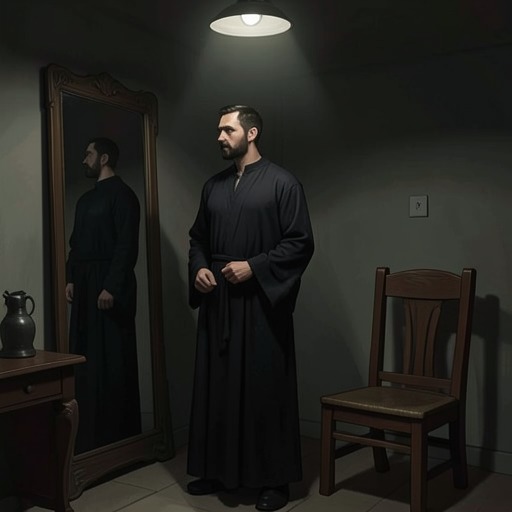
For the final stage of his intended transformation, Mal’akh prepares a private ritual chamber according to numerical and astrological correspondences. He arranges the space around a square stone table, uses lighting keyed to a cycle of planetary hours, and sets out purified water, ritual materials, and a silk robe. The knife he reserves for the ceremony cost $1.6 million on the antiquities black market. These precise objects and measurements turn sacred making into a designed environment: the chamber, its timing, and its implements all serve the identity Mal’akh is trying to construct.
The preparation of his intended tattoo ink makes that design especially concrete. Mal’akh uses Peter Solomon’s blood, a lambskin sheet, a crow-feather quill, candles, and a brass bowl. On the sheet he traces an open hand and adds five symbols: a crown, a star, a sun, a lantern, and a key. Each carries a meaning within his planned transformation, from kingship and destiny to illumination, limited human understanding, and the missing knowledge he hopes to obtain. He burns the sheet and mixes its ashes into the blood, producing the ink he plans to use to complete the tattooing on his head. Sacred making joins the symbolic and the material: the marks express his imagined status, while their ingredients and preparation make the ritual a tangible sequence of acts.
Relation to Initiation and the Novel’s Theme of Transformation
The novel places Mal’akh’s private practice alongside the formal initiation of a Masonic brotherhood. In the opening ceremony at the House of the Temple, an initiate follows a prescribed path, wears ritual clothing, takes an oath, and is witnessed by a community. The skull and wine evoke mortality, while the oath binds the initiate to the group’s secrets. This is not the same rite as Mal’akh’s sacrificial project: one is presented as an initiation into a brotherhood, the other as an individual’s attempt to remake himself through a private Art. Their contrast shows two different uses of ritual structure—belonging through a shared obligation and self-fashioning through a claimed sacrifice.
The novel also gives transformation a meaning beyond Mal’akh’s project. Robert Langdon explains that apotheosis—the transformation of a human into a god—is a central theme in the imagery of the Capitol Rotunda. At the story’s close, looking across the National Mall with Katherine Solomon, he considers monuments and inventions as evidence of humanity’s capacity to create and change its world. That perspective offers a counterpoint to Mal’akh’s solitary pursuit of sacred status: human transformation can be read not as the magical elevation of one man, but as a collective history of human making. Sacred making therefore sits within the novel’s larger question of what it means to become more than one was, while its most extreme expression remains tied to Mal’akh’s dangerous, self-authored mythology.