Smithsonian Institution
The Lost SymbolThe Smithsonian Institution serves as more than a prestigious backdrop in the novel: its public museums, largely unseen collections, and research facilities make it a place where knowledge is displayed, stored, and pursued beyond ordinary public view. As its secretary, Peter Solomon links that institutional world to both a high-profile Washington gala and the hidden laboratory where Katherine Solomon conducts her work in Noetic Science.
Institutional Scope and Collections
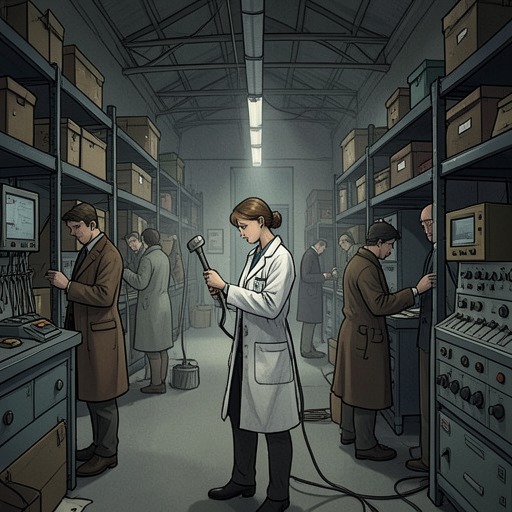
The Smithsonian Institution comprises more than a dozen major museums on the National Mall, but the scale of its holdings far exceeds what those museums can exhibit. Only about two percent of the collection is on display at any one time; the other 98 percent is stored at the Smithsonian Museum Support Center. That imbalance gives the institution a double presence in the story: its public face is the familiar world of museums, while much of its material wealth lies in storage, outside visitors’ sight.
The stored collections range across cultural and natural history. Among the objects and specimens described are giant Buddhas, handwritten codices, poisoned darts from New Guinea, jewel-encrusted knives, a kayak made of baleen, plesiosaur skeletons, meteorites, a giant squid, and elephant skulls brought back from an African safari by Theodore Roosevelt. The variety makes the Smithsonian Museum Support Center more than a warehouse in the novel’s setting. It is a concentrated repository of material from many fields, and its scale helps explain how a scientific laboratory could exist deep within a museum-support facility without resembling a conventional public gallery.
Leadership and Public Programs
Peter Solomon heads the Smithsonian Institution as its secretary. The institution’s annual board gala is a private event intended to thank its most generous supporters, drawing members of the country’s cultural elite. In the year depicted, a keynote address was scheduled to precede the dinner in National Statuary Hall. When the invited speaker fell ill on the day of the event, Peter asked Robert Langdon to take her place, suggesting a lecture Langdon had previously delivered on the symbolism and Masonic history of the nation’s capital.
The episode places the institution at the intersection of scholarship, patronage, and public ceremony. The gala is designed for supporters rather than general museum visitors, while the replacement lecture turns an urgent staffing problem into an opportunity to present historical interpretation in a prominent civic setting. Its subject also carries a distinction important to the novel: Langdon discusses Masonic symbolism, but the Smithsonian Institution is the host of the occasion, not the source of the Masonic ideas being discussed.
The Smithsonian Museum Support Center and Research
The Smithsonian Museum Support Center is the setting for Katherine Solomon’s research. Peter introduced his sister to the facility three years before the main action, not simply to show her its collections but to help her establish a laboratory. He arranged for her to use SMSC Pod Five, an empty space built for a planned future relocation of artifacts from the basement of the National Museum of Natural History. The move was expected in about five years, leaving the pod available in the meantime. Peter told Katherine that he had built the laboratory with his own money and that the Smithsonian Institution’s role in advancing scientific knowledge made supporting her experiments consistent with his responsibilities as secretary.
The resulting laboratory, known as the Cube, occupies a remote part of the facility. Its windowless, shielded interior is divided into laboratory, control, mechanical, bathroom, and library areas. The equipment includes paired electroencephalographs, a femtosecond comb, a magneto-optical trap, and Random Event Generators. The contrast between this specialized installation and the surrounding collection storage makes the center a setting where objects preserved from the past sit alongside an attempt to investigate the limits of human thought.
The novel presents Katherine’s research as an ambitious inquiry into whether focused thought can affect physical matter. Her experiments range from changes in plant growth, fish movement, cell division, and chemical reactions to the formation of ice crystals; she reports that positive and negative thoughts correspond to different crystal patterns. Her work also concerns Random Event Generators and the possibility that shared human attention can influence their outputs. These are presented as Katherine’s findings within the story, not as an institutional statement by the Smithsonian Institution. The facility supplies the secluded space and advanced equipment for her work, while Peter’s personal support enables the particular laboratory to exist.
Narrative Significance
The Smithsonian Institution’s importance rests on the contrast between visibility and concealment. Its museums display a small fraction of its holdings, while the Smithsonian Museum Support Center houses the larger, unseen remainder; within that support center, the Cube further separates Katherine’s research from ordinary public access. The institution thus gives the novel a credible setting for knowledge that is simultaneously collected, protected, and still being pursued.
Its public and research functions also connect separate strands of the story. The gala places the institution within Washington’s world of donors, academic prestige, and civic venues, while Peter’s support for Katherine situates her work inside a scientific complex devoted to the preservation and study of material. The same institution can therefore host a public lecture on national symbolism and shelter a private laboratory investigating consciousness. That juxtaposition does not make the Smithsonian Institution itself a secret society; it makes the boundary between what is publicly presented and what remains out of view part of the setting’s narrative force.