Smithsonian Museum Support Center
The Lost SymbolThe Smithsonian Museum Support Center is a vast, tightly controlled storehouse for the Smithsonian Institution’s collections and a setting where concealed research, unusual artifacts, and a carefully engineered security system converge. Built beyond the public museum landscape of the National Mall, it holds the overwhelming majority of the Institution’s objects, while its remote fifth pod provides Katherine Solomon with a laboratory isolated enough for her Noetic Science experiments. That privacy makes the facility a refuge for her work—and, when Mal’akh enters under a false identity, a dangerous weakness to exploit.
Scale, Location, and Collections
Located at 4210 Silver Hill Road just outside Washington, District of Columbia, the center is a zigzag-shaped complex of five interconnected pods, each larger than a football field. Its bluish metal exterior gives little indication of the immense collection inside: the building covers six hundred thousand square feet and contains more than twelve miles of storage cabinets. The narrative describes it as one of the world’s largest and most technologically advanced museums, yet one of its least accessible. The public sees only a small share of the Smithsonian Institution’s holdings; about two percent can be displayed at any one time, leaving the other ninety-eight percent in storage here.
The stored objects range across human history and the natural world. Katherine encounters, among other things, giant Buddhas, handwritten codices, poisoned darts from New Guinea, jewel-encrusted knives, and a kayak made of baleen. The natural-history collections include plesiosaur skeletons, meteorites, elephant skulls, and a giant squid. In Wet Pod, the squid is kept in more than three thousand gallons of liquid ethanol; Trish Dunne identifies it as a female Architeuthis measuring over forty feet. The extraordinary range makes the center less a conventional gallery than a concealed landscape of preserved specimens and artifacts.
Security and the Hidden Research Space
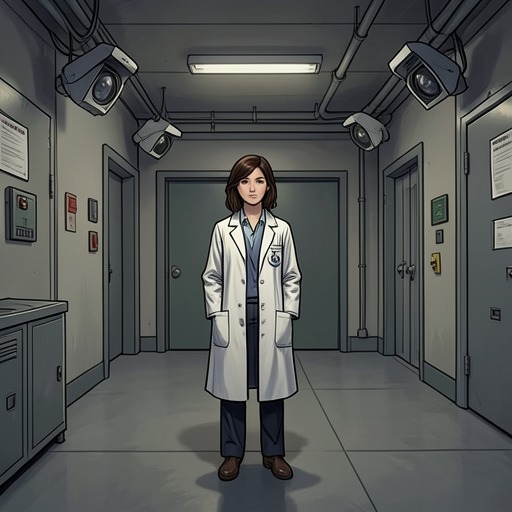
The building’s design is organized around preservation and controlled access. A dead zone—an inhospitable compartment between double walls—surrounds the complex, and the facility freezes its refuse to prevent insect infestations. Cameras monitor the main corridor continuously, while entry to rooms branching off it requires a key card and PIN. Trish describes the security as automated and recalls no theft, although the system’s dependence on authorized access later proves vulnerable to someone who can acquire or misuse an employee’s credentials.
Peter Solomon introduces his sister to the fifth pod three years before the main events. The pod is then unused, awaiting the eventual transfer of material from the basement of the National Museum of Natural History. Peter arranges for Katherine to have a dedicated laboratory there, drawing on his own money and on the center’s advanced research equipment. He recognizes that her proposed experiments need more than theoretical discussion: they require a working scientific facility.
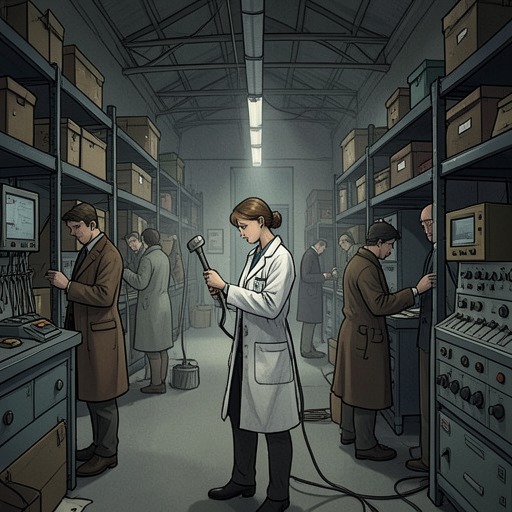
The pod’s isolation suits Katherine’s research. It is a sealed, energy-neutral environment designed to protect the artifacts within from solar radiation. Because her experiments seek to measure previously unknown energy fields, she needs to limit outside radiation and other forms of interference, including what she calls brain radiation or thought emissions. A university campus or hospital laboratory would not offer the quiet conditions she needs; an empty pod inside the Smithsonian Museum Support Center does. Her laboratory, nicknamed the Cube Laboratory, becomes both her workplace and a private sanctuary deep within the center.
The Crossing into Pod Five
Reaching the Cube Laboratory requires a passage through more than a hundred yards of near-total darkness. When Peter first brings Katherine to the pod, its door opens onto what seems an empty abyss. He invites her to follow him without a flashlight, and the door closes behind her. She finds her way through a guidance system he has left her to discover: a narrow carpet runner laid straight across the rough floor. In a later account of her own first visit, Trish describes following the same strip by feel after Katherine tells her to trust the route. The carpet turns the crossing into a practical test of attention and bodily orientation, not a complicated technological process.
For Katherine, the first passage becomes the beginning of a sustained relationship with the place. The dark corridor gives way to a laboratory equipped for work that, in the narrative, has begun to produce striking results. Katherine and Peter agree to keep the findings secret until their implications are better understood. By the time the story returns to the center, she believes her recent discoveries could change established ways of thinking across several fields. The isolation that protects the experiments therefore also protects information with consequences beyond the facility.
Mal’akh’s Infiltration and Katherine’s Escape
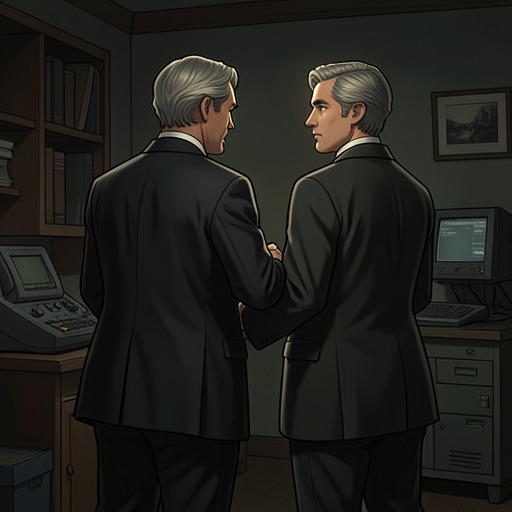
Mal’akh identifies the center as the place where both Katherine and her research can be found. After learning that her work is secured in one location, he uses Peter’s phone to impersonate her brother and persuade Katherine that Peter is on his way to the laboratory. He presents himself by phone as Dr. Christopher Abaddon, gives Katherine a plausible reason to invite him in, and directs her to provide the address. He then destroys Peter’s phone beneath the wheel of his limousine, making it unusable after it has served the deception.
The false invitation carries Mal’akh through the center’s ordinary security procedures. At the gate, a guard checks an identification card bearing the name Christopher Abaddon and a Kalorama Heights address. Trish meets the visitor in the lobby and escorts him through the building. He takes in the security cameras and asks about the stored collections, then stops at the window into Wet Pod to admire the squid. Trish opens the pod for him. Later, the guard reviewing the recordings sees Mal’akh emerge alone, with wet sleeves and a key card; Trish is no longer visible. The apparent tour has concealed the attack on Katherine’s assistant and given Mal’akh a route toward Pod Five.
When Langdon warns Katherine that she is in danger, she calls the security desk and learns from the recorded video that Mal’akh has already entered the fifth pod using Trish’s credentials. Katherine is crossing the dark space when the guard confirms the entry. She stops, turns off her phone’s light, and asks for help to be sent to her and for Trish to be checked on. The center’s darkness, normally a condition that protects Katherine’s work, now conceals the intruder from her as well as from anyone trying to reach her.
Mal’akh later returns to the pod after Katherine has escaped. He jams a dime into the exterior key panel, preventing the guard from readily using it, then uses Trish’s card and PIN to enter the brightly lit Cube Laboratory. He locates the data room containing two holographic storage units. Trish’s access card does not open that room, but a card taken from Katherine’s lab coat does. His objective is to destroy Katherine’s research and prevent its wider consequences; the laboratory’s separate security boundary presents an obstacle even after he has crossed the larger facility. The episode makes the center’s systems legible as both real safeguards and points of failure: cameras reveal what happened, while stolen credentials and the isolated pod give the intruder access.
Narrative Significance
The Smithsonian Museum Support Center brings together two kinds of secrecy. Its collection is hidden from public view because the Smithsonian Institution can display only a fraction of what it holds; Katherine’s results are deliberately withheld while she and Peter consider their implications. These forms of concealment are not the same as Mal’akh’s deception, but the plot makes them intersect inside a building designed to keep valuable things out of ordinary reach.
The physical arrangement shapes the action. A long monitored corridor, locked doors, Wet Pod, the dark crossing into Pod Five, and the Cube Laboratory’s separately secured data room form successive thresholds. Mal’akh exploits the trust attached to an invitation and the permissions attached to a key card, while Katherine and the guard rely on cameras and access records to understand what has already happened. The center is therefore more than a repository or backdrop: it is a working research institution whose architecture both enables Katherine’s experiments and determines the course of the threat against her.