Solid-Gold Capstone
The Lost SymbolThe Solid-Gold Capstone is both the missing top of the Stone Pyramid and the interpretive key that makes the pyramid readable. Peter Solomon gives it to Robert Langdon in a sealed package, describing it as a dangerous talisman; Langdon eventually discovers that its power is not supernatural but structural and symbolic. It completes the pyramid, and, as its legend or cipher key, helps turn an apparently obscure object into a map to a hidden place.
Inheritance and Custody
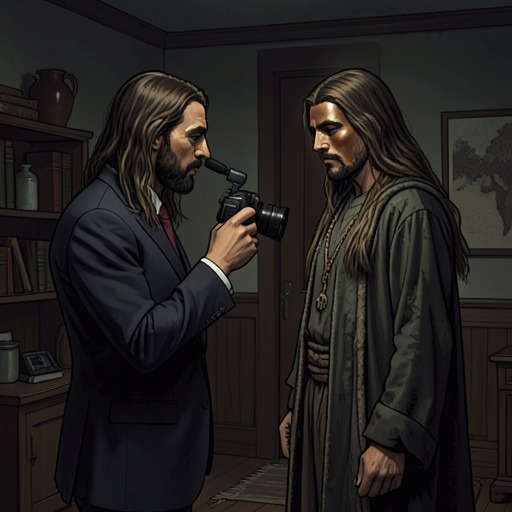
Peter entrusts the package to Langdon after explaining that he inherited it and no longer feels comfortable keeping it at home or in his office. Rather than place it in a safe-deposit box, where employees and paperwork would be involved, he chooses a trusted friend whom he believes can keep a secret. The handoff reflects how little Peter wants Langdon to know: he asks him to store the package safely and tell no one, while insisting that its contents may hold substantial power and could attract dangerous people.
The object arrives in an unassuming form. The package is a heavy cube-shaped box, about three inches square, wrapped in faded brown paper and tied with twine. An embossed wax seal bears a double-headed Phoenix with the number 33 on its chest, an emblem of Freemasonry’s highest degree. Langdon initially assumes Peter sealed it with his Masonic ring. Peter corrects him: the seal was made by his great-grandfather almost a century earlier. The ring, passed down from great-grandfather to grandfather to father and then to Peter, belongs to the same family history, but the package itself has remained unopened.
Peter’s explanation for preserving the seal is deliberately opaque: he says it is not yet time. He tells Langdon that his father described the contents as a talisman capable of bringing order from chaos, and warns that powerful people want to steal it. Langdon understands the phrase as a Masonic axiom but dismisses the idea that an object could literally confer such power. He accepts custody anyway. After placing the package in a wall safe, he forgets it until Peter’s assistant asks him to bring it to Washington. Langdon retrieves it and carries it in his shoulder bag, unaware that the small parcel will become central to the night’s pursuit.
Revelation as the Pyramid’s Missing Piece
The package’s contents become clear when an X-ray image shows a small pyramid enclosed in the cube. Langdon recognizes that the object is not a miniature pyramid in its own right, but the capstone for the truncated Stone Pyramid found in Peter Solomon’s Chamber of Reflection. The larger stone structure has a flat apex, a symbolic space awaiting the piece that would make it whole. The apparent mismatch in scale does not alter the relationship: the gold object completes the stone one as an apex completes a pyramid.
That recognition revises the meaning of Peter’s word talisman. Langdon recalls that, before the word acquired magical associations, it could mean an object that completes another and makes it whole. In that sense the capstone is a talisman without needing to be a magical instrument. Its function lies in completion: joined conceptually to the unfinished pyramid, it changes the meaning of the larger object from incomplete monument to completed symbolic form. The image on the X-ray, where the small pyramid shines brightly inside its enclosing cube, makes the hidden connection visible at the very moment Langdon understands it.
Key to the Map
The capstone matters not only because it completes the Stone Pyramid, but because it helps explain what that pyramid is for. Mal’akh tells Langdon that the Masonic Pyramid does not contain the Ancient Mysteries themselves. Instead, the pyramid points to the place where they are hidden. In this account, its encrypted engraving is a map, and the capstone is necessary to interpret it. Warren Bellamy later makes the relationship more precise by calling the capstone the pyramid’s legend: the key that tells a reader how to read the map. The distinction between treasure and directions is crucial. Peter did not entrust Langdon with the lost wisdom itself; he entrusted him with an object that helps disclose its hiding place.
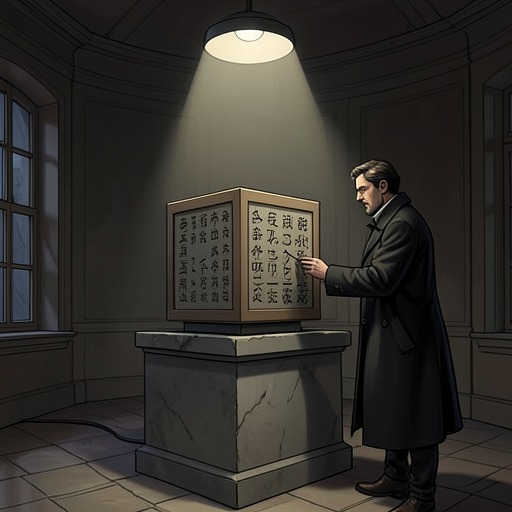
The puzzle unfolds in layers rather than yielding its meaning at a glance. Langdon first deciphers the engraved symbols on the Stone Pyramid using a basic Masonic substitution cipher, producing a grid of letters that seems meaningless. The existence of a key does not make the result immediately transparent; the first decipherment leads to another interpretive problem. Later, the base’s sixty-four symbols are connected to an order-eight magic square associated with Benjamin Franklin. Mal’akh realizes that the symbols must be rearranged according to the numbers in Franklin’s square. The capstone belongs to the broader system that makes the pyramid legible, while the inscriptions and their successive transformations supply the steps by which that system is applied.
Material Proof and Narrative Significance
Analysis by the CIA’s senior analyst Nola Kaye confirms that the capstone is pure gold, with a density of 19.3 grams per cubic centimeter. The scan also detects faint engraved text on its surface, although the X-ray image is too unclear for Nola to read the inscription at once. These findings replace Langdon’s speculation with physical evidence: the shining object is not merely gold-colored, and its surface carries information as well as symbolic value. Inoue Sato classifies images of both the capstone and the Stone Pyramid at the highest security level and orders Nola to report directly to her, establishing that the object has become an intelligence concern as well as a Masonic secret.
The capstone’s changing identity drives a repeated reversal in the story. It first appears to be a sealed heirloom, then a supposed magical talisman, then a miniature pyramid, and finally the missing component and reading key of a larger design. Each change comes from closer attention to its material form and its relation to another object: the seal connects it to inherited custody; the X-ray reveals the gold shape inside the cube; the flat summit of the Stone Pyramid gives that shape a place and purpose; and the pyramid’s cipher makes the key consequential. Its significance therefore rests not on an independently demonstrated supernatural power, but on its capacity to complete, connect, and direct interpretation. What Langdon once put away as an eccentric mystery becomes the small, indispensable piece through which an unfinished monument can point beyond itself.