Stone Pyramid
The Lost SymbolThe Stone Pyramid is a nine-inch granite object discovered behind a canvas in a concealed Chamber of Reflection beneath the United States Capitol. Though its modest size and flat top rule it out as the legendary Masonic Pyramid itself, an engraved cipher and a separate capstone reveal its real purpose: it is a key-bearing map to the supposed hiding place of the Ancient Mysteries. The object turns a story about secret wisdom into a problem of interpretation, where what a symbol appears to be matters less than how it must be read.
Concealed Form and Discovery
The pyramid comes into view when a candle flame flickers and the rear surface of the Chamber of Reflection seems to ripple. Robert Langdon realizes that the apparent wall is a canvas, billowing backward through an opening; he pulls it aside to expose a roughly three-foot-square gap in the masonry. The opening leads only a few feet into the wall, ending in a niche rather than another room. There, among the chamber’s furnishings, rests a single carved object.
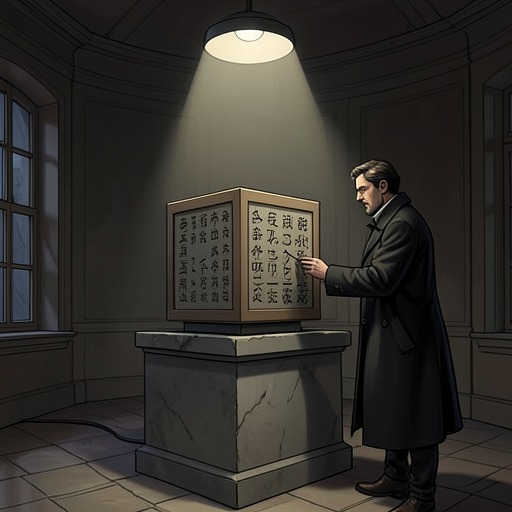
The object is made of solid granite, about nine inches tall, with four smooth, polished sides that catch the candlelight. Its top is flat. That detail makes its silhouette an Unfinished Pyramid rather than a complete pyramid: a familiar symbol of a human ascent that remains incomplete, with a capstone still to be placed. Robert Langdon therefore rejects Inoue Sato’s first association with the legendary Masonic Pyramid. The hidden find resembles a pyramid, but it does not match the legend’s enormous structure crowned with solid gold.
Inoue Sato nevertheless orders Trent Anderson to remove it from the niche for closer examination. Anderson has to reach awkwardly into the opening and lower the granite onto a wooden desk with a hard thud. The act shifts the object from a concealed feature of a private Masonic chamber into the hands of investigators. For Robert Langdon, the shrine-like setting makes this handling feel like the disturbance of a personal memorial, not simply the examination of evidence.
Inscription and the Map’s Purpose
When Inoue Sato turns the object around, its fourth side reveals sixteen precisely engraved characters. The inscription is a cipher, not a set of decorative icons, and its appearance makes the pyramid’s concealment newly consequential: the object contains a puzzle that its discoverers can attempt to read. Inoue Sato assumes Robert Langdon was brought to Washington, District of Columbia, because his expertise will let him decipher it. He recognizes the language as an old Masonic cipher, but initially resists reading an artifact that belongs to Peter Solomon.
The object’s significance changes when its captor explains the distinction between the pyramid and the treasure it is said to protect. The Ancient Mysteries are too vast to be written on a small stone object. Instead, the Stone Pyramid preserves the location where that wisdom is buried; in this sense it is a map, or a portal to the search for the hidden place. The distinction resolves an apparent contradiction: the object can be associated with the Masonic Pyramid legend without itself being the immense legendary structure. Its power lies in pointing beyond itself.
The map is also said to require a key. Warren Bellamy explains that the word legend can mean not only a story handed down but also the key that explains how to read a map. The separate capstone is that legend: it supplies the interpretive means by which the pyramid’s inscription can be understood. Thus the Stone Pyramid and capstone are not interchangeable pieces of treasure. One bears the encoded directions; the other makes those directions legible. Peter Solomon’s decision to keep them apart turns their separation into both a practical safeguard and a test of who can bring them together.
Cipher, Context, and Interpretation
The Masonic cipher is not formidable by conventional standards. Robert Langdon notes that students in his advanced symbology seminar could break it in about five minutes, and that he could do so in less than a minute with pencil and paper. Its simplicity clashes with the extravagant claims surrounding the pyramid: if almost anyone can read the inscription, then the difficulty must lie in understanding the clue, identifying the correct key, or knowing what the decoded message signifies. A code’s ease of transcription does not guarantee that its purpose is obvious.
The novel places that first cipher within a wider pattern of symbolic reading. Earlier, Robert Langdon turns Peter Solomon’s hand upside down to make a group of marks resolve into a consistent system; the change of orientation transforms how the signs can be interpreted. With the pyramid, too, he objects to treating a cipher as self-explanatory. Its sixteen symbols become part of a sequence of clues rather than a complete answer in themselves.
A later discussion connects the inscription’s four-by-four arrangement with the magic square in Albrecht Dürer’s Melencolia I. Robert Langdon explains that Dürer’s numbers produce the same total of thirty-four across rows, columns, diagonals, quadrants, center squares, and corners; the adjacent numbers 15 and 14 also indicate the year 1514. This example gives the grid a mathematical context and links the puzzle to the history of coded knowledge. It does not make the Stone Pyramid’s inscription mystical by itself; instead, it offers a structured way to consider how arrangement, number, and symbolic tradition might work together.
The later clue sequence extends that method. Robert Langdon identifies an eight-by-eight magic square, the order-eight square associated with Benjamin Franklin, as the key for rearranging the sixty-four symbols on the pyramid’s base. The symbols are not simply read in the order in which they appear: their sequence must be reorganized according to the numbers in the square. In this account, the promise of order from apparent chaos is not just a motto attached to Masonic symbolism; it describes the concrete operation required to make the grid yield meaning.
Custody, Secrecy, and Narrative Significance
Peter Solomon entrusts the separate capstone to Robert Langdon rather than keeping it within the Masonic circle. Warren Bellamy interprets that choice as deliberate: the pyramid had been targeted before, including by people who entered the brotherhood with unworthy motives, and keeping the key outside the organization reduces the risk that its secrets will be taken through its own ranks. The object therefore carries not only encoded information but also a dispute over who is entitled to possess and interpret it.
That dispute echoes Robert Langdon’s earlier classroom explanation of Freemasonry. He distinguishes a society with secrets from a secret society: Masonic rings, buildings, and meeting times are visible, while access to deeper knowledge depends on trust, hierarchy, and obligations of silence. The Stone Pyramid gives this distinction a physical form. It is hidden, but not because every aspect of its existence is unknowable; its concealed niche, engraved surface, separated capstone, and restricted meaning each mark a different boundary between seeing an object and being able to use it.
Warren Bellamy presses the point into an ethical conflict when he tells Robert Langdon that protecting the secret may require sacrificing Peter Solomon’s life. His claim that the brotherhood’s duty to preserve the Ancient Mysteries can supersede loyalty to an individual reveals how secrecy can create its own hierarchy of obligations. Robert Langdon resists treating the pyramid’s alleged importance as a sufficient reason to abandon Peter. The object’s custodianship is therefore not a neutral transfer of property: it places loyalty to a person against a duty to an inheritance imagined to belong to all humanity.
The Stone Pyramid’s smallness is central to its narrative force. It is neither the buried wisdom itself nor the monumental treasure imagined by those pursuing it. It is a compact instrument for finding something absent, and its meaning depends on orientation, ciphers, numerical patterns, a separate capstone, and competing accounts of who should be trusted. Each turn of the object—from hidden niche to engraved face, from artifact to map—revises what its discoverers think they have found.