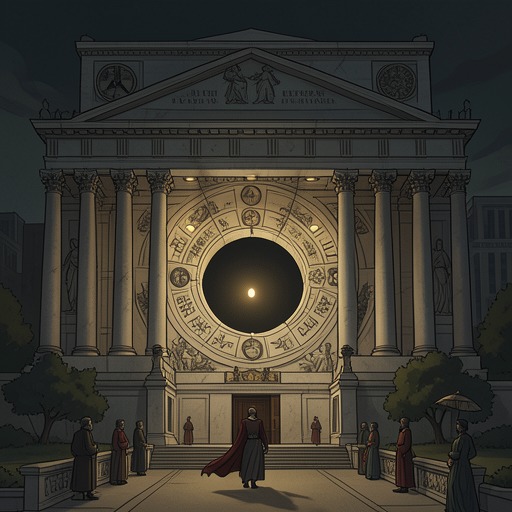
The Apotheosis of Washington
The Lost SymbolThe Apotheosis of Washington is the vast fresco overhead in the U.S. Capitol Dome, an image that joins the founding of the nation to the possibility of human spiritual transformation. Its scale and unusual mixture of divine figures, inventors, and technology make it more than a monumental decoration: in the closing scene, the fresco becomes both an object of close observation and a visual framework for ideas about the human mind and collective consciousness.
Setting and Composition
Created by Brumidi, the fresco occupies nearly five thousand square feet above the Capitol Rotunda. Its figures are fifteen feet tall, and the elevated circular catwalk gives Robert Langdon and Katherine Solomon an unusually close view of details normally far overhead. From there, the painted forms are not merely a distant ceiling image; they fill the space above the two characters as they walk beneath it.
A rainbow leads the eye from Benjamin Franklin, Fulton, and Morse, shown with technological inventions, toward George Washington ascending heavenward on a cloud. The scene places American scientific achievement and classical mythology in the same visual field. Katherine is struck by that conjunction: mythical gods appear alongside inventors and their creations, at the center of the nation’s Capitol. The fresco’s subject and placement make national identity, human ingenuity, and divine ascent parts of one composition.
The image also rewards a change in viewpoint. At first Langdon is preoccupied with the height and the precarious catwalk. Later, lying beside Katherine and looking up, he notices that the figures are arranged in two concentric rings, a circle within a circle. The discovery shifts the fresco from an impressive panorama into a legible pattern. Langdon recognizes in that arrangement a Circumpunct, a form that links the painted ceiling to the symbolic language he has encountered during the preceding events.
The Fresco as a Message
Katherine reads the Apotheosis as an expression of The Ancient Mysteries hovering over the Rotunda. In her interpretation, the image’s central ascent promises that humanity may develop toward spiritual maturity. The founding fathers, she argues, imagined America as a blank canvas on which the seeds of those mysteries could be sown. The fresco’s position above lawmakers, leaders, and presidents thus gives its imagery a continuing public presence: Washington’s ascent functions as a reminder of a future possibility, not simply a scene from the nation’s past.
That reading is grounded in the fresco’s fusion of technological invention and divine imagery. Katherine connects it to Noetic Science, describing the study of human thought as an old inquiry pursued through new scientific means. The inventors painted beside Minerva become especially resonant in this account: modern instruments and inventions may help people investigate ideas that ancient traditions already explored. The painting does not itself explain that theory, but its juxtaposition of gods and technology gives Katherine a visible counterpart for it.
Katherine extends the connection through texts and traditions concerned with the mind. She invokes the Vedas on the flow of mind energy, the Pistis Sophia on universal consciousness, the Zohar on mind spirit, and Shamanic texts that she associates with Einstein’s idea of remote influence. She also argues that biblical parables can be read as a study of the human mind. Her interpretation of the body as a temple leads to the Temple of the Mind: the sacred structure, in this account, is something people must build inwardly by learning to use the power latent within them.
Shared Thought and the Image of Many
The fresco frames Katherine’s claim that thought gains power when minds share it. She explains that, according to her research, the effect grows exponentially rather than simply doubling as minds work together. Prayer groups, healing circles, collective singing, and communal worship serve as examples in her account. She also points to communication technologies such as Twitter, Google, and Wikipedia as means of linking minds into an increasingly connected network. Her argument turns the fresco’s many figures into a useful visual analogy: human development is collective as well as individual.
Langdon responds with hesitation rather than immediate agreement. Katherine asks him to reconsider what seems impossible as a change of perspective, comparing resistance to new ideas with earlier disbelief in a round Earth and opposition to heliocentricity. The fresco supplies a setting in which that disagreement can unfold: its image of ascent suggests transformation, while Langdon’s skepticism keeps the promised transformation from becoming an established fact. Katherine presents a reading of the image and of human consciousness; the scene preserves Langdon’s uncertainty even as he listens.
Recognition and Final Meaning
Katherine asks Langdon to lie on his back and look at the ceiling in the open-minded way he remembers gazing at stars from a canoe as a child. The gesture changes his view of the fresco. Once prone beneath it, he perceives the concentric rings and recognizes their relationship to the Circumpunct. The pattern then leads into their discussion of minds gathered as one. As Langdon thinks about Plato, Jung, and the notion of a world mind, he connects Katherine’s account to the plural Hebrew word Elohim. Katherine confirms that the word is plural; the conversation moves from the plurality of minds to the possibility of a collective conception of God.
The fresco’s painted inscription, E pluribus unum, meaning out of many, one, becomes the scene’s final synthesis. Langdon sees the words as he drifts toward sleep beneath the dome. Their placement joins the fresco’s national symbolism to Katherine’s account of interconnected consciousness: unity can emerge from plurality without erasing it. The Apotheosis of Washington therefore closes the story not by proving a scientific claim, but by bringing its central images—human ascent, the gathered many, and an unfinished possibility of spiritual maturity—together in a single ceiling above the Capitol Rotunda.