The Masonic Lost Word
The Lost SymbolThe Masonic Lost Word is the fabled key to the Ancient Mysteries: in the legend recounted in the novel, an encoded word buried deep underground will unlock ancient wisdom at a crisis point in human history. Its importance lies both in what it promises and in the conflict between literal and symbolic readings of that promise. Mal’akh treats the Word as a hidden object to be found and inscribed on his body; Robert Langdon argues that it is a metaphor for wisdom, not a magic password.## Legend and Promised Function The legend presents the Word as the missing key to knowledge that ancient adepts concealed in symbols, myths, and allegories so that the unworthy could not misuse it. The knowledge is said to remain dispersed through mythology, art, and occult texts, while the ability to interpret it has been lost. In this account, the Word is not merely one more item of secret information: it is the means by which the larger body of concealed wisdom might become intelligible to everyone.
A student’s online account of the legend describes the Word as a password left behind by the sages. It is supposedly buried underground, waiting for a pivotal moment when humanity can no longer survive without the truth and wisdom of the ages. Its eventual discovery would herald a new era of enlightenment. Peter Solomon recognizes the term verbum significatium when the student reads it aloud, and treats the prophecy as worth considering rather than dismissing it as nonsense. His response gives the legend a place within the novel’s serious discussion of spiritual possibility, but does not establish that every detail of the account is literal fact.
Solomon links the anticipated enlightenment to recurring traditions across cultures. Hindus call the promised era the Krita Age; astrologers call it the Age of Aquarius; Jewish tradition speaks of the Coming of the Messiah; theosophy calls it the New Age; and cosmologists associate it with Harmonic Convergence. One student names December 21, 2012, as a predicted date, which Solomon acknowledges as a belief tied to Mayan mathematics rather than a certainty. He frames these parallels as evidence of a widespread human hope for apotheosis: a transformation in which human minds reach their fuller potential. In his account, the possibility of shared wisdom matters more than agreement on a single religious name or doctrine.
Solomon also invokes Avrah KaDabra, an Aramaic expression he explains as meaning that creation occurs through speech. The familiar magical word abracadabra, in this telling, preserves a trace of an older mystical idea: words can be understood as acts of creation, not simply as labels. This example helps explain why the Lost Word exerts such imaginative force. If speech can create, then recovering the right word seems capable of changing not only what people know but what they can become.## Secrecy, Knowledge, and Interpretation The legend’s structure echoes the novel’s account of Freemasonry as a society with secrets rather than a secret society. Robert Langdon explains that membership, visible symbols, and public meeting places coexist with information disclosed only within a hierarchy and under obligations of secrecy. The distinction matters: secrecy can mark a boundary around entrusted knowledge without proving the conspiratorial claims outsiders attach to it. The Lost Word belongs to that charged boundary between guarded teaching and public rumor.
Langdon’s skepticism toward extravagant claims about Washington’s hidden symbolism supplies a counterpoint. He tells students that drawing enough intersecting lines on a street map can produce striking shapes, and demonstrates that supposed Masonic patterns can also be found on a map of Detroit. Yet he does not deny that Washington contains genuine historical symbolism or that concealed traditions have existed. His distinction is between an interpretation supported by a consistent system and a pattern imposed on evidence after the fact. The Lost Word raises the same problem on a larger scale: a hidden message may be meaningful, but the desire to find one can make every fragment seem like proof.
The novel connects the legend to the historical secrecy surrounding the Ancient Mysteries. Langdon recalls accounts in which secret wisdom passed from the Mystery Schools of early Egypt into Renaissance Europe and later into the circle associated with the Royal Society of London, nicknamed the Invisible College. He also recalls the 1936 discovery of Isaac Newton’s private papers, which revealed his intense interest in alchemy and mystical knowledge, and a letter urging Robert Boyle to maintain silence about what they had learned. These examples do not prove the existence of a single buried Word. They do, however, make secrecy and restricted transmission part of the novel’s historical atmosphere, giving the legend an apparent lineage without settling its truth.
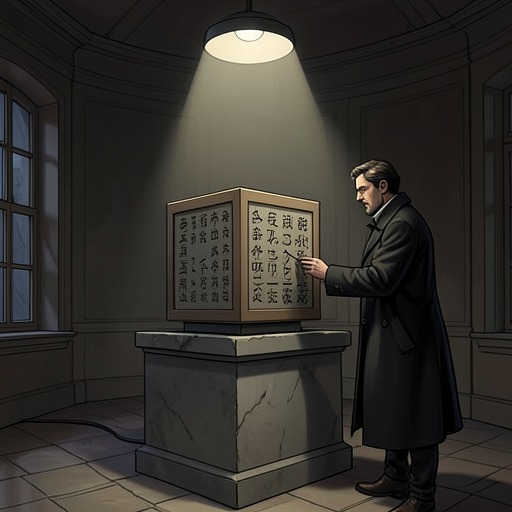
The distinction between an actual password and a symbolic promise becomes crucial when Langdon encounters a room covered with texts, maps, symbols, and notes assembled by Mal’akh. Among lists of sacred words and ceremonial incantations, Langdon recognizes a recurring preoccupation: Mal’akh is searching for the verbum significatium, the Lost Word. The collage turns the legend into evidence of a particular person’s objective. At the same time, it reveals how a search organized around a desired answer can draw disparate materials into one apparent pattern.## Mal’akh’s Literal Pursuit Mal’akh believes the Lost Word is physically recoverable in Washington. After solving the pyramid’s encoded directions, he concludes that it points beneath the House of the Temple, also known as Heredom. The remaining symbols, he believes, will show him how to locate the Word there. He arrives at the Temple Room with Peter Solomon captive, convinced that Solomon’s knowledge and position as Worshipful Master can help complete the search.
For Mal’akh, finding the Word is bound to a bodily ritual. Langdon infers from the materials in Mal’akh’s basement and the untattooed flesh on his head that Mal’akh intends to inscribe the recovered Word on the top of his scalp. Langdon understands this as preparation for a transformation: Mal’akh expects possession of the Word to unlock the Ancient Mysteries and make him ritually complete. The search therefore ties abstract knowledge to the body, turning a legend about enlightenment into a program of self-adornment and sacrifice.
Peter’s captivity gives that program immediate stakes. Mal’akh believes Katherine is dying and uses her supposed peril to make Peter cooperate; Langdon recognizes that, if Peter believes he can save her by finding the Word, he may accept any answer that appears to offer hope. The search is thus not simply a contest of scholarship. Mal’akh’s literal faith in the legend makes it a means of coercion, while Peter’s love for his family threatens to make him act on that faith even if the promised Word cannot be found.
Metaphor and Resolution
Langdon tells Inoue Sato that the Lost Word is one of Freemasonry’s enduring symbols: an arcane word that humanity can no longer decipher and whose power is said to become clear only to the enlightened. His explanation shifts the emphasis from possession to understanding. The Word’s significance lies in the promise that the Ancient Mysteries may become comprehensible, not necessarily in a single magical utterance waiting in a vault. When Langdon insists that there is no actual Word, he is challenging Mal’akh’s material interpretation, not denying that the legend carries meaning.
That contrast gives the concept its narrative force. For Mal’akh, hidden wisdom is a destination: locate it, claim it, and mark the body with it. For Langdon, the search itself demands interpretation, patience, and a willingness to distinguish symbol from literal instruction. The Lost Word gathers several of the novel’s recurring questions into one object of pursuit: who is entitled to knowledge, how secrecy protects or distorts it, and whether enlightenment can be obtained as a possession. The final revelation identifies the buried Word with the Bible concealed in the Washington Monument Cornerstone, redirecting the quest from an unknown magical password toward a familiar sacred text. The revelation preserves the language of discovery while changing what discovery means: the promised Word is not an unprecedented incantation but a book already legible as scripture, whose significance depends on how its wisdom is understood.