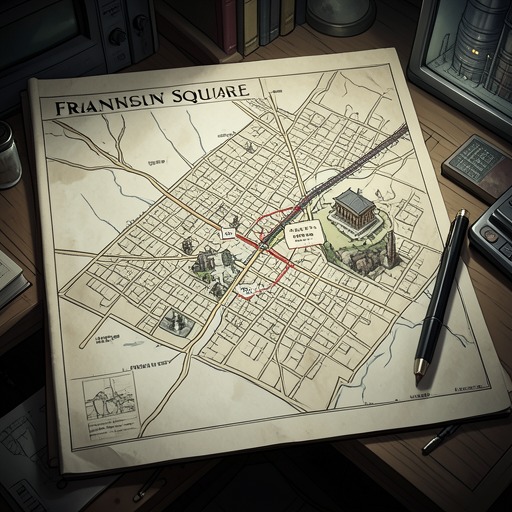
The Pyramid Reveals Eight Franklin Square
The Lost SymbolThe Pyramid Reveals Eight Franklin Square is the moment when a chain of symbolic clues becomes a specific Washington address. In a kitchen at Cathedral College, Katherine Solomon uses the relationship between a Masonic degree, an angle, and temperature to activate a concealed message on the golden capstone. The revelation turns the pyramid from an enigmatic object into a practical lead for Robert Langdon and Katherine as they try to negotiate Peter Solomon’s release.
From Symbolic Clue to Experiment
Langdon and Katherine arrive at the kitchen carrying the granite pyramid and its gold capstone. Katherine has concluded that the pyramid can be transformed through simple science, but she has not yet explained the method. Rather than seek specialized laboratory equipment, she asks Langdon to put the pyramid on the kitchen island and fills an enormous pasta pot with hot tap water. She removes the strainer insert, turns on the gas burner, and prepares to lower the object into the boiling water.
Her proposal grows from the inscription on Peter Solomon’s ring: “All is revealed at the thirty-third degree.” Earlier, Langdon and Katherine had understood “degree” as a Masonic rank, then recognized that rotating the ring by thirty-three degrees of arc transformed a cube and exposed a cross. Katherine now proposes a third meaning: a measure of temperature. The progression matters because the inscription has not changed; their understanding of its key word has. A phrase that appeared to point toward Masonic status or geometry becomes an instruction for a physical test.
The Thirty-Third Degree
Katherine’s reasoning draws on the importance of the number thirty-three in mystical traditions, including its place as the highest degree in Freemasonry. She recalls that Isaac Newton, who studied alchemy and numerology, devised a temperature scale based on natural phenomena. On that scale, melting ice was assigned the starting point, while boiling water corresponded to thirty-three degrees. The inscription, Katherine argues, directs them not toward water at thirty-three degrees on a familiar modern scale, but toward the temperature associated with boiling on Newton’s system.
Langdon initially objects that thirty-three degrees is nearly freezing and asks whether the pyramid belongs in a freezer. Katherine’s explanation resolves the apparent contradiction: the clue depends on which scale is being used. Boiling water is the operative temperature, and the pot becomes an improvised means of applying it. The exchange turns the puzzle’s ambiguity into a testable hypothesis. Instead of treating the inscription as a purely symbolic statement, they use its multiple meanings to determine what to do with the object in front of them.
A Message Appears
Katherine lowers the gold-capped granite pyramid into the strainer and submerges it in the bubbling water. She believes that a hidden thermal marker may respond as the object heats. She explains that different substances incandesce at specific temperatures and that early alchemists used organic phosphors as thermal markers. Langdon remains uncertain that such a technique could have been incorporated into a nineteenth-century pyramid, but Katherine is watching the water closely for a change.
When she notices something, Katherine runs to the switch and turns off the kitchen lights and exhaust fan. In the darkness, the distinction between an ordinary engraved surface and a heat-responsive mark becomes visible: beneath the water, a section of the capstone begins to glow, and letters emerge as the water heats. Katherine turns off the gas, allowing the turbulence to subside. The text comes into focus under the calm surface. The revelation is not produced by breaking the capstone open or by decoding another set of symbols; heat makes concealed writing legible.
The Address and Its Consequences
The glowing message reads “Eight Franklin Square.” Langdon recognizes it as a street address, though he does not know what is located there. He reads the rest of the text on the capstone: “The secret hides within The Order.” The pyramid has therefore supplied both a destination and a further interpretive clue. The address is unusually precise, but its significance remains unresolved: Langdon wonders whether an Order is based there and whether the location conceals an entrance to a deep spiral staircase. At this point, the pair do not know whether anything is actually buried at the address.
What they do know is that they have deciphered the pyramid and gained information they believe can be used to negotiate Peter’s release. The urgency is underscored by Langdon’s Mickey Mouse watch: they have less than ten minutes to spare. Katherine tells him to make the call, and he hesitates, insisting that he will not give up the information until Peter is safe. When he dials, however, the expected contact does not answer. A woman identifies herself as Officer Paige Montgomery with Preferred Security and says someone there is asking for Langdon. The discovery thus achieves its immediate purpose as a bargaining lead, but the call does not proceed as Langdon expects.
The Pyramid as a Working Map
The event converts the pyramid’s reputation into action. Colin Galloway had told Langdon that it was a real map pointing to a real location; the glowing address now gives that claim a concrete form. The transformation also gathers several kinds of knowledge into one procedure: Masonic symbolism supplies the phrase, the word “degree” links rank and angle to temperature, Newton’s system explains the number, and the capstone’s hidden material responds to heat. No single clue suffices on its own. The address appears only when interpretation leads to a carefully chosen physical experiment.
The discovery also echoes an earlier piece of background in the novel: a 1991 CIA document contains cryptic references to an ancient portal, an unknown underground location, and the phrase “It’s buried out there somewhere.” The newly revealed address does not, by itself, establish the document’s location or explain its references. It does, however, sharpen the novel’s recurring connection between concealed knowledge, hidden places, and the act of reading clues correctly. At Eight Franklin Square, the pyramid has not yet revealed what lies at its destination; it has changed the search from a broad mystery into a specific next step.