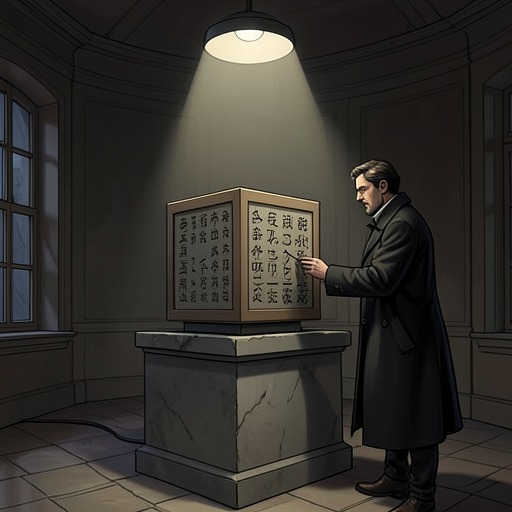
The assembled Masonic Pyramid
The Lost SymbolThe assembled Masonic Pyramid is the stone pyramid joined to its long-separated capstone, a union that turns two guarded pieces into a layered map. The capstone supplies the key for reading the pyramid, but its message does not immediately reveal a location; deciphering the base demands another, more elaborate operation. For Dean Colin Galloway, the completed object also marks a change in the guardians’ role: the Mysteries are moving out of the inner circles and toward the light.
The Separate Pieces and Their Reunion
For generations, the pyramid and capstone had been kept apart. Peter Solomon entrusted Robert Langdon with the sealed package containing the capstone, while Warren Bellamy urged him not to open it. The separation was not merely practical: it preserved a secret that the object could disclose only when its pieces were brought together.
Katherine Solomon chose to break that safeguard because her brother’s life was at stake. She argued that the capstone was needed to decipher the pyramid and that no hidden treasure could take priority over rescuing Peter. She yanked the twine, and the brittle wax seal broke. Her decision moved the object from protected inheritance into active use, despite the warnings from both Bellamy and Peter.
At Dean Colin Galloway’s office, Langdon placed the stone pyramid before him, then removed the capstone from its box. Galloway examined both by touch, tracing the engraved side, smooth base, truncated top, and the capstone’s inscription. He aligned the capstone atop the pyramid by feel, pausing as if in prayer before running his palms over the joined object. The assembly was at once a physical act and a reverent recognition of a union that had been deferred for generations.
The Capstone as a Reading Key
Warren Bellamy explained the relationship between the pieces through the language of maps: a map’s legend tells its reader how to interpret the marks, and the capstone serves as the legend to the pyramid. The pyramid is therefore not simply an imposing stone monument, but a system of instructions whose signs cannot be read correctly without the matching piece. Bellamy described the combined artifact as a map to the hiding place of the lost wisdom of the ages.
The capstone’s inscription, “The secret hides within The Order,” initially seemed to send Langdon toward a Masonic organization or another secret society. The first cipher on the pyramid appeared straightforward: its symbols could be decoded with a substitution key made from four grids, two plain and two dotted, in which each letter occupied a distinctive enclosure. Yet the resulting phrase, Jeova Sanctus Unus, identified a meaning rather than the geographic destination Peter’s captor sought. The apparent simplicity of the first code concealed a deeper layer.
The Layers of Decipherment
The next step connected the pyramid’s letter grid to Dürer’s Four-by-Four Magic Square. Katherine Solomon recognized the numbered arrangement from Albrecht Dürer’s engraving: each row, column, and diagonal sums to thirty-four, as do additional groupings in the square. Langdon noted the conspicuous placement of 15 and 14 together in the bottom row, a reference to the year 1514. He transcribed the numbered pattern alongside the letters from the pyramid, turning the square into a tool for reading rather than an isolated mathematical curiosity.
The distinction between a figurative message and a physical map remained central. Galloway rejected Langdon’s conclusion that the decoded phrase made the pyramid only metaphorical. He insisted that it pointed to a real location and that the decipherment was incomplete. In this reading, each solved layer is not the answer but an instruction toward the next: the capstone explains how to begin, while the assembled object preserves further meaning in its base.
That further layer depends on an order-eight magic square. Mal’akh later understood Langdon’s explanation that the sixty-four symbols on the pyramid’s base had to be rearranged according to the numbers in Benjamin Franklin’s eight-by-eight square. The phrase on the capstone thus becomes a clue to the method: “The Order” refers not simply to a group but to the order-eight square. The reorganization of the symbols is a separate operation from the earlier substitution cipher, extending the pyramid’s map through a second system of encoding.
Custodianship and Significance
Galloway experienced the joined pieces as the culmination of a long custodial history. As his hands moved over the assembled pyramid, he reflected that he had never expected to witness the moment when the separated parts were reunited. He also found significance in the fact that two people outside Freemasonry had assembled it: to him, the Mysteries were moving beyond the inner circles that had kept them in darkness.
Galloway did not claim to know precisely where the pyramid pointed. He believed, however, that a great spiritual treasure lay buried somewhere and could act as a catalyst for transformation. The assembled pyramid therefore carries both a practical promise and a contested one: it offers a method for locating something real, while its guardians interpret that discovery as part of a wider passage from concealed knowledge to enlightenment. Its completion changes the keepers’ task from keeping the pieces apart to guiding others through what they reveal.