Turner Simkins
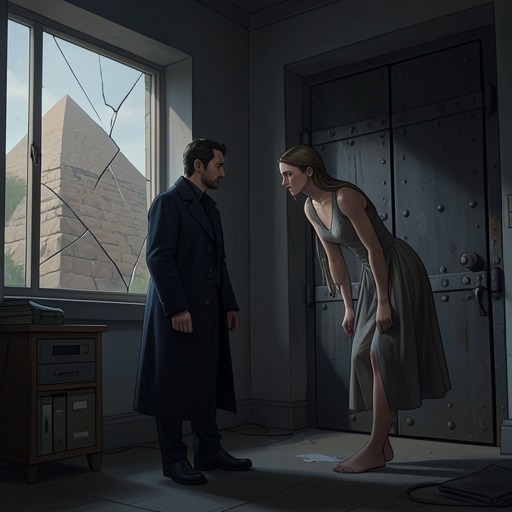
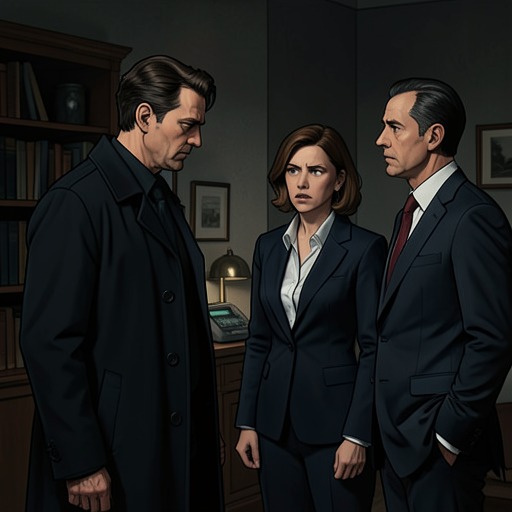
The Lost SymbolTurner Simkins is a Central Intelligence Agency field agent who leads teams in the pursuit of Robert Langdon and Katherine Solomon. His role changes as the operation’s assumptions fail: he first treats the pair as fugitives to be caught, then works alongside Langdon when their knowledge is needed, and finally drives Peter Solomon and Langdon toward a destination Peter keeps secret. Simkins is characterized less through private history than through the practical decisions he makes under pressure, and through his willingness to act on orders even as the mission’s purpose becomes uncertain.
Identity and Operational Role
Simkins commands field agents during the Central Intelligence Agency’s search for Langdon and Katherine. He is a hands-on leader: he enters buildings with his team, assesses routes and evidence, directs pursuit, and reports developments to Inoue Sato. His methods rely on coordinated surveillance and specialized equipment, but the story repeatedly shows that technology cannot guarantee the outcome he expects.
The contrast between Simkins’s operational confidence and the mystery surrounding the mission becomes clearest as the search widens. He follows Sato’s instructions and organizes teams around the information she provides, while the reasons for the agency’s interest in the Masonic Pyramid and the people carrying it remain only partly clear to him. At Franklin Square, for example, he learns that the Almas Shrine Temple is connected to the Masons, but initially knows little about the building or the order associated with it. His competence is practical rather than encyclopedic: he can deploy a team quickly, but depends on others to interpret the historical and symbolic clues.
Pursuit Through the Library and the Streets
At the Library of Congress, Simkins leads a four-person team into the Main Reading Room after agents use Key4 to open its doors. The team first searches in darkness with night-vision equipment and then uses thermal imaging to trace recent heat left by the two men who had occupied a desk. The technology reveals evidence of where the fugitives have been, including fingerprints on a keypad and warmth around an exit, but the trail leads onward rather than resolving the chase.
In the library’s underground stacks, Simkins expects the fugitives to be at a disadvantage. Motion-activated lights switch on along their route, illuminating a path through the shelves. He and his team follow it and spot Warren Bellamy, who is running behind Langdon. Simkins orders Bellamy to stop; when he continues, an agent uses a nonlethal restraint that brings him down. The team discovers that Bellamy is alone: Langdon has escaped farther into the stacks. Simkins’s capture is therefore a partial success, and the empty aisle ahead exposes the gap between a clear trail and a complete apprehension.
Later, an intercepted report from taxi driver Omar Amirana gives Simkins another opportunity to locate the fugitives. He speaks directly with Omar, confirms that Langdon and Katherine are in the cab, asks about Langdon’s leather bag, and instructs the driver to slow down while the field team moves into position. The exchange shows Simkins managing an uncertain encounter through concise questions and controlled directions. The supplied scenes do not establish that this particular plan results in their capture; the larger pursuit continues.
Interceptions and the Search for the Fugitives
At the George Washington Masonic Memorial, Simkins approaches King Street Station with an armed team, intending to intercept Langdon and Katherine as they travel by train. He calculates the likely arrival time from the Blue Line’s approximate interval and orders his agents to clear the southbound platform. The operation is built on timing and prediction, but it depends on knowing which train the fugitives will take and where they will emerge.
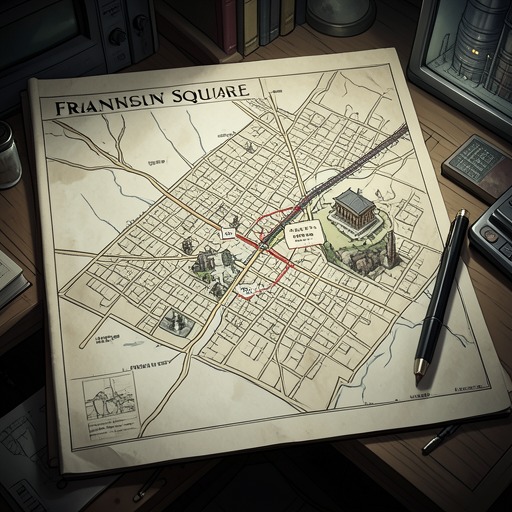
At Franklin Square, Simkins helps stage a second interception. After a helicopter touches down at One Franklin Square, he and the agents escort Bellamy into the park and position him as bait while they conceal themselves nearby. Sato warns Simkins to watch the entrance of the Almas Shrine Temple, whose identity as a Masonic-associated institution could allow the target to bypass the planned rendezvous. Simkins acknowledges the risk and keeps the building under observation. When Langdon fails to arrive within the expected time, and Sato reports that agent Hartmann has not checked in from Kalorama Heights, the operation is called off. Simkins gathers his team and withdraws; the planned trap has yielded neither the target nor an explanation for Hartmann’s absence.
The team’s subsequent search of Mal’akh’s mansion turns the missing agent into a confirmed loss. Simkins’s team breaks into the darkened house and finds Hartmann dead in the foyer. A security guard is also found dead in the dining room. Simkins organizes a search of the floors and basement, but the house is deserted, and neither Langdon, Katherine, nor Peter is there. He reports the result to Sato: if the three are still alive, Mal’akh has taken them away. The search gives the agency a grim account of what happened at the house, but no immediate lead to its captives.
From Pursuer to Guide
At the House of the Temple, Simkins’s role changes from pursuing Langdon to helping him reach the room where Mal’akh and Peter are likely to be. Driving a commandeered Lexus SUV, Simkins follows Langdon’s precise instructions through the surrounding streets. Rather than turning toward the building’s public entrance, he continues along S Street, turns at Fifteenth Street, and takes a barely visible unpaved access road behind the building. Langdon identifies a van near the rear entrance and explains that the Temple Room sits at the building’s summit beneath a skylight. Simkins relays this information to Sato, who is waiting in a helicopter, and her response is to take the aircraft up. The episode makes Simkins an operational link between Langdon’s knowledge of the building and Sato’s command of the response.
Inside, Simkins stays close to Langdon as they move through the building’s main atrium and ascend the marble staircase toward the Temple Room. The exchange is a reversal of their earlier relationship: the agent who had directed teams to catch Langdon now follows his directions because those directions are essential to reaching the target. Simkins provides the armed support and mobility of the field operation; Langdon supplies the interpretation of the site and its hidden route.
Final Assignment and Narrative Significance
After the crisis at the House of the Temple, Peter tells Langdon that he has solved the riddle of the Lost Word and offers to show him where it is buried. Simkins drives the Escalade carrying Peter and Langdon. Before they leave, Peter gives Langdon a traditional Masonic blindfold and asks him not to see where they are going. Simkins continues to serve as driver while Peter controls the revelation: he takes the two men through a security checkpoint and into a restricted facility, then waits outside as Peter and Langdon proceed alone.
This final journey differs sharply from Simkins’s earlier operations. The car is no longer simply a means of closing distance on fugitives; it carries a trusted passenger toward a disclosure that Peter deliberately withholds from Langdon until the last moment. Simkins does not explain the destination or take part in what Peter reveals. His presence instead makes the transition possible, joining the institutional resources of the agency to Peter’s private decision to share the secret. Across the novel, Simkins’s changing function—pursuer, search leader, tactical support, and discreet driver—embodies the limits of force when the decisive knowledge belongs to someone else.