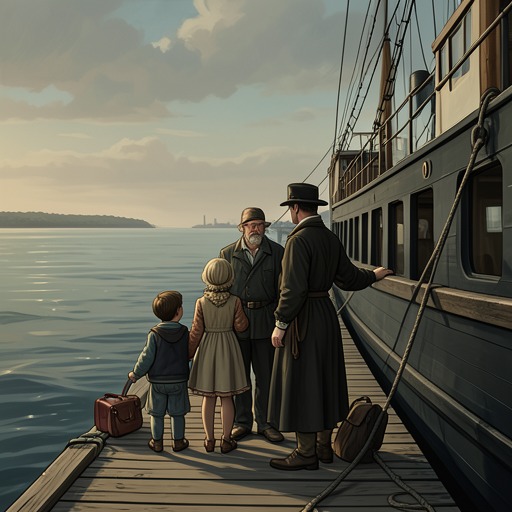
Despair
The LoverDespair is the recurring maternal condition at the center of the family’s emotional and social existence. It is not presented as a private sadness with a clear cause, but as a force that repeatedly overtakes The Narrator’s mother, alters the household’s behavior, and becomes formative for The Narrator, The Elder Brother, and Paulo. Poverty, impending death, failed hopes, and the humiliations imposed by society all surround it, yet the narrative refuses to reduce it to any single explanation. Its deepest consequence is that the children learn to live inside their mother’s despair until shame, fear, violence, and love become inseparable.
A Daily and Unnamed Condition
Despair appears in the family’s life with startling regularity. The Narrator recalls a photograph of her mother in a courtyard house by the Small Lake in Hanoi, standing among her children with a drawn face, an untidy dress, and a drowsy expression. The children’s disorder in the photograph reveals what the image cannot directly record: there were periods when their mother suddenly became unable to wash them, dress them, or even feed them. This condition did not remain constant. Sometimes it lasted; sometimes it disappeared with darkness. But its recurrence was certain, and its suddenness made it more frightening than a stable illness would have been.
The Narrator cannot identify the practical thoughts that precipitated these collapses. Her mother may have been facing the imminent death of her husband, who was already gravely ill; she may have feared that she shared his illness; she may have been overwhelmed by doubts about her marriage, her children, or the whole structure of the life surrounding her. The uncertainty matters. Despair is experienced as an event with recognizable effects but without an accessible explanation. At a particular moment each day, it could make its appearance, followed by an inability to continue, an inability to sleep, mere moodiness, or a movement toward deathlike passivity.
The same state could also produce its apparent opposite. When her despair lifted, The Narrator’s mother might buy houses, move the family, or give freely and impulsively. She accepted the house by the Small Lake even though the family did not need it and The Narrator’s father was near death. She could also buy the flat-brimmed hat, the Gold Lamé High Heels, or whatever else one of the children wanted. These gestures are not evidence that the despair has ended. They are another expression of its instability: generosity becomes a sudden command over circumstances that otherwise feel unmanageable, while sleep, silence, and withdrawal represent surrender to the same pressure.
Poverty, Social Pressure, and Failed Futures
The family’s material conditions intensify the mother’s despair without fully explaining it. The children are poor, ashamed, and forced to sell their furniture, but The Narrator insists that they are not starving. They have a houseboy and food; at times even cooked storks and baby crocodiles can be refused as a luxury. This distinction prevents poverty from becoming a convenient total explanation. The family’s suffering comes from deprivation, social humiliation, colonial limitations, and the mother’s repeated collapse, not from hunger alone.
Her efforts to plan the children’s futures reveal how despair coexists with strenuous, often futile responsibility. The Narrator is sent to a state boarding school in Saigon, eats and sleeps there, and attends the French high school because her mother insists that a daughter must receive a secondary education and eventually earn a degree in mathematics. For the sons, the mother devises improvised routes forward. Paulo is repeatedly enrolled in bookkeeping courses through the Universal Correspondence School, but each attempt lasts only a few days before the family’s move forces it to begin again elsewhere. The effort continues for ten years and achieves little; Paulo eventually becomes an accountant’s clerk in Saigon.
The Elder Brother’s departure for France similarly arises from the absence of a technical school in the colonies. He remains away for several years to study, but does not persist. The mother appears to understand that his education is failing, yet she has no better means of removing him from the other children. His absence temporarily protects those left behind from his violence, while also confirming that the family’s plans are makeshift structures built to occupy the future rather than secure it. The mother keeps planning because planning is one of the few forms of resistance available to her, even when the plans repeatedly collapse.
Despair as Inheritance
The children do not merely observe their mother’s despair; they are shaped by it. The Narrator says that, as a child, her dreams were never of Christmas trees but of her mother, alternately destroyed by poverty, distraught and muttering in the wilderness, searching for food, or endlessly recounting her innocence, savings, and hopes. Maternal unhappiness takes the place of the imaginative future normally associated with childhood. The mother’s inner catastrophe becomes the child’s primary symbolic world.
The family’s response is a closed system of shame and silence. The children do not greet one another, exchange thanks, or converse. They do not even look at one another, because looking implies interest and therefore submission. Their unity is not based on tenderness or shared purpose but on a common shame at having to live. All three are bound to their mother, whom they regard as both loving and destroyed by society; their love for her is intense precisely because they have witnessed what the world has done to her. They consequently hate life and themselves from within the same structure that keeps them attached to her.
The Narrator later judges her mother harshly for failing to conceal the truth of her condition from the children. She calls her careless, muddle-headed, and irresponsible, imagining that she might have separated The Elder Brother from the younger children or hidden what had become her essential fate. Yet the judgment immediately encounters impossibility. How could the mother make her face, eyes, voice, and love lie about the life she was actually living? Silence might have destroyed her, just as continuing to live damages the children. Despair therefore passes between generations not as a deliberate lesson but as an atmosphere that cannot be concealed.
Violence and the Family’s Closed Circuit
The mother’s despair is inseparable from the violence that surrounds the children. The Elder Brother’s hostility is described as cold, insulting, and constant. His first impulse is to kill, dominate, erase, hunt, and make others suffer, while The Narrator identifies herself as the one person who makes him afraid. Paulo remains terrified of him and of the possibility that The Narrator will be killed. The family’s emotional life is thus organized around anticipations of harm rather than mutual reassurance.
When The Narrator’s relationship with The Lover from Cholon is suspected, the mother’s panic turns physical. She enters the girl’s room, beats her, searches her clothing for evidence, and publicly brands her a prostitute. Her actions arise from fear of disgrace and from her conviction that she must somehow prevent the family from being driven further into desperation. Outside the locked room, The Elder Brother supports the mother’s demand to discover the truth while secretly wanting the beating to continue toward serious harm. Paulo, by contrast, cries out for the mother to stop and hides in the garden because he fears that The Narrator will be killed. The scene divides the household into competing responses to despair: coercion, predatory control, protective fear, and concealment.
The brothers’ conflicts repeat the same structure. Fights erupt because The Elder Brother orders Paulo out of the way and attacks him. They fight without speaking, accompanied by breathing, groans, and the sound of blows, while their mother answers with shrieks. Both possess the capacity for murderous anger, but their positions differ: The Elder Brother cannot tolerate any limit on his power to do evil, whereas Paulo cannot bear to watch helplessly. Their only common bond is their mother, and especially their sister. Despair does not dissolve the family; it traps its members in a violent dependence on one another.
Recognition, Fear, and Narrative Meaning
The Narrator’s later fear of madness shows that maternal despair has become a permanent anticipatory burden. As an adult, she remains afraid that a particular state of her mother will worsen until the mother must be separated from her children. She believes that she, rather than her brothers, would have to recognize when that moment arrived, because they would be unable to judge it. Responsibility is therefore transferred to the daughter, who has escaped the household psychologically and eventually physically but remains its watcher.
This fear is dramatized in a childhood memory from Vinh Long. During an evening blackout, the eight-year-old Narrator runs down a deserted avenue and believes that a very tall, thin, barefoot local madwoman is pursuing her. She is certain that if the woman touches her, she too will enter a condition worse than death: madness. The memory later returns beside the recollection of her mother sitting on the terrace of the house in rue Testard. For one terrifying instant, The Narrator can no longer recognize the woman as her mother; the identity occupying her mother’s place seems to have vanished, leaving an image with nothing living inside it. Her cry restores the scene, but not her security. The fear of despair is therefore also the fear of substitution, disappearance, and the loss of the person beneath the familiar maternal form.
The narrative’s retrospective structure gives despair its full significance. The Narrator has written extensively about her family, yet admits that while they were alive she skirted around the central facts instead of confronting them. Despair is consequently both the subject of memory and the reason memory has been delayed. Its repetition across photographs, childhood scenes, family violence, and adult fear resembles a wound that can be approached only indirectly. Writing does not erase the condition, but it converts the household’s mute atmosphere into an intelligible pattern: a mother’s collapse, a society’s pressure, children’s shame, and a family’s love are revealed as parts of one inherited and unresolved catastrophe.