Indian Ocean
The LoverThe Indian Ocean is the most expansive and emotionally charged waterway in The Lover: part of the route carrying the family from Indochina toward France, it enlarges a colonial voyage into a space of separation, danger, recollection, and belated recognition. On this ocean, the girl’s memory of The Lover from Cholon is recovered through music, while the death of a seventeen-year-old passenger and the spectacle of her younger brother’s affair place private feeling beside irreversible loss.
Maritime Setting and the Colonial Route
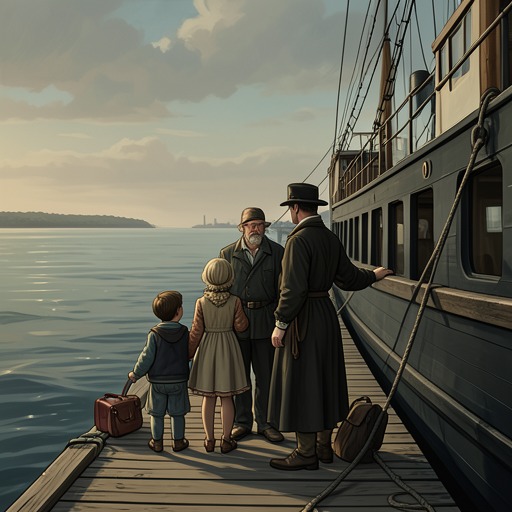
The Indian Ocean appears within a long sea passage linking Indochina to France. The liners travel through the China Sea, the Red Sea, the Indian Ocean, and the Suez Canal; their route is measured not only by geography but by the gradual removal of the travelers from the land they know. The voyage lasts twenty-four days, and the ships function like floating towns, containing streets, bars, cafés, libraries, drawing rooms, meetings, lovers, weddings, and deaths. The ocean is therefore both a physical interval and a temporary society formed by chance, one that is understood to be accidental and consequently capable of producing encounters that remain unforgettable.
The ocean also marks the transition from the colonial world to France. Before the departure, the family’s movement is tied to the Saigon River and to the shipping installations on the Mekong’s bend known as the Saigon River. Once the liner leaves, the familiar network of rivers, cities, family obligations, and forbidden intimacy gives way to a route whose scale exceeds individual control. The Indian Ocean, with its distance between landfalls, makes separation material: the farther the vessel proceeds, the less easily the past can be re-entered or repaired.
Vastness, Calm, and Threat
The Indian Ocean is remembered as the most distant and most immense part of the crossing. It reaches toward the South Pole and contains the longest open-water distance between landfalls, between Ceylon and Somalia. Yet its danger is not presented only through storms. At times the sea is so calm, and the weather so fair and mild, that the crossing feels like travel over something other than water. The passengers escape the heat of their cabins, open the lounges, gangways, and portholes, and sleep on deck. This calm does not make the ocean safe; it suspends ordinary expectations and gives the sea an almost unreal amplitude.
That instability between serenity and catastrophe governs the memories attached to the ocean. During one nighttime crossing, a young man leaves a card game in the first-class bar without speaking, runs across the deck, and throws himself into the sea. The vessel is traveling at full speed, and even after it is stopped, the body cannot be found. The ocean absorbs the act without leaving a recoverable trace, turning a sudden private decision into an absence shared by everyone on board.
Music, Suicide, and Recovered Love
A second remembered night on the same route transforms the Indian Ocean into an inward landscape. Music suddenly bursts from the lounge on the main deck: a Chopin waltz the girl knows intimately because she had tried for months to learn it, without ever managing to play it properly. The music spreads across the dark ship beneath a brilliantly lit sky, carrying an authority the girl cannot interpret. Its force is so immediate that she rises as though she might kill herself too and throw herself into the sea.
The impulse does not culminate in death. Instead, the music opens a passage into recognition. Thinking of The Lover from Cholon, the girl begins to suspect that she loved him more deeply than she had understood. The affair had concealed the feeling from her, as water disappears into sand; only the music, cast across the ocean, makes the lost love visible again. The Indian Ocean thus becomes the medium through which memory returns—not as a stable recollection, but as an emotional discovery produced by distance, sound, and the proximity of death.
Family Intimacy and Separation
The same night also holds a clandestine scene involving the girl’s younger brother. She sees him on deck with a married woman, recognizes her, and watches them kiss. During the final days of the voyage they spend their days in their cabin and emerge only at night, while the younger brother looks at his mother and sister as though he no longer knows them. Their mother becomes grim, silent, and jealous; the girl is at once happy for him and afraid of what his attachment may bring.
The ocean therefore gathers several forms of separation into one setting. The girl fears that her younger brother will abandon the family for the woman, although he returns to them on reaching France. The Lover from Cholon, meanwhile, remains behind in the emotional and social world from which the girl is departing. The family’s movement across the Indian Ocean is not a simple passage toward freedom or arrival: it carries concealed affairs, maternal distress, threatened loyalties, and the knowledge that some attachments cannot survive the change of continent.
Narrative and Thematic Significance
The Indian Ocean’s significance lies in the way it joins physical scale to narrative uncertainty. The remembered suicide is itself unstable in the narrator’s account: she cannot quite determine whether it occurred on that voyage or another, and later relocates the story to Sadec, where the dead passenger becomes the seventeen-year-old son of the district officer, a boy she had known from high school in Saigon. The missing body, the absent farewell letter, the dawn decision to abandon the search, and the empty sea make the ocean a place where facts persist through gaps rather than certainty.
Its vastness also anticipates the work’s larger movement from lived event to writing. The Indian Ocean separates Indochina from France, but it also gives the narrator the distance from which lost desire, family violence, and death can be rearranged into literature. Years later, after the war, marriages, children, divorces, and books, The Lover from Cholon calls her in Paris and tells her that he still loves her and will love her until death. The ocean remains behind that telephone reunion as the original expanse of their separation: the water that once carried her away becomes the silent measure of everything that endured after departure.