Madness
The LoverMadness is one of the governing states of the family’s life: it belongs most visibly to the mother, but it also circulates through her children as fear, violence, silence, and an inability to separate love from harm. The Narrator eventually recognizes that her mother’s condition is not a temporary illness but a way of being that has structured the household from birth, while the family’s closed world allows the condition to become both intimate and contagious. Madness therefore names not only the mother’s behavior, but the destructive system created around her despair.
The Mother’s Condition
The Narrator first sees her mother’s madness clearly at the last house on the Loire, after the mother has finally abandoned her continual movement from place to place. The recognition is retrospective and absolute: the mother has always had access to this madness, as have Dô and The Elder Brother, while The Narrator had previously failed to see it. The condition is described as something present from birth and in the blood, not as an illness that arrives from outside. For the mother, it resembles health. Her madness coexists with the qualities that make her socially attractive: she maintains old friendships, forms new ones, draws people around her, and is admired for her lively intelligence, cheerfulness, and inexhaustible poise. The contradiction is central. Madness does not erase her sociability; it operates beside it, hidden by the very energy that makes her appear capable.
The mother’s despair is inseparable from the life imposed on her. Society has reduced her to desperation, and her children understand themselves as the children of that reduction. Yet the mother cannot conceal what has happened to her. She does not successfully preserve a reassuring family image or protect her sons and daughter through silence. The Narrator judges her as careless, confused, and irresponsible, but also recognizes that she cannot lie about her essential fate. Her inability to hide her despair exposes the children to it, and all three love her intensely because she cannot falsify herself. Madness thus becomes both a wound and a form of terrible candor.
Madness as Family Violence
At the time of the affair with The Lover from Cholon, the mother’s condition becomes an active force of surveillance and punishment. She senses that her daughter has changed without knowing exactly what has happened. The Narrator appears slower, absent-minded, and strangely detached, as though she has become a spectator even of her mother’s unhappiness. The mother interprets this change through the social danger facing a girl who may never marry or secure a place in society. Her fear of disgrace turns the daughter’s private life into a public emergency.
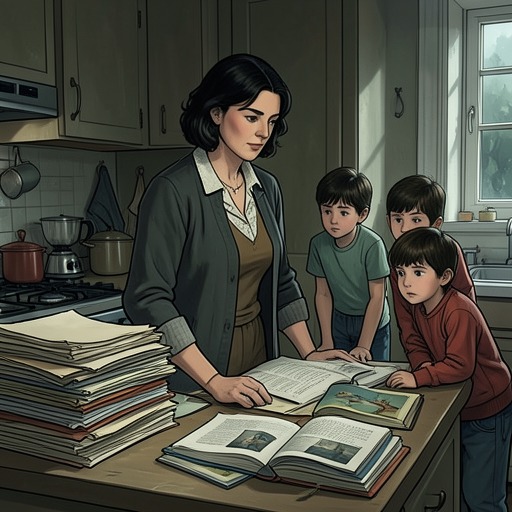
During her attacks, the mother locks The Narrator in her room, strikes her, undresses her, smells her body and underwear, searches for stains, and claims that she can detect the Chinese man’s presence. She shouts that her daughter is a prostitute, disgraced, and worse than a bitch, while simultaneously weeping and asking what else she can do. The violence is not presented as a simple expression of hatred. It is driven by terror of social abandonment, and the mother imagines expulsion as the only possible way to save the household from contamination. Her madness converts maternal protection into physical examination, accusation, and public humiliation.
The scene also reveals how the family distributes responsibility for the crisis. The Elder Brother tells the mother that she is right to beat the girl and urges her to discover the truth in order to save both daughter and mother from despair. Paulo, by contrast, tells the mother to leave The Narrator alone, then hides in the garden because he fears that she may be killed and that The Elder Brother may intervene. The Narrator lies to calm the mother, denying that anything has happened and insulting The Lover from Cholon as weak and ugly. Behind the locked door, The Elder Brother listens and wants the beating to continue toward the edge of harm. Madness here is not merely an individual eruption: it is maintained, resisted, witnessed, and intensified by the family’s shifting alliances.
Fear, Identity, and the Supernatural Edge
The Narrator’s fear of madness begins in childhood, before she can understand it as a family condition. In Vinh Long, during an electrical failure, an eight-year-old girl runs through a deserted avenue and believes that a very tall, thin, barefoot woman is pursuing her. The woman is the local lunatic, laughing, shouting in an unknown language, and playing with the child. The Narrator’s deepest terror is not that she will be caught or killed, but that a touch will make her enter a condition worse than death: madness itself. For several days she cannot speak about what happened. The episode gives madness a bodily and almost contagious form, as though it could pass through contact before it can be named in language.
That childhood fear returns late in life as anxiety over the mother’s worsening state. The Narrator believes that she, rather than her brothers, will have to recognize the moment when the mother must be separated from her children, because The Elder Brother and Paulo would be unable to judge the danger. The responsibility is paradoxical: the daughter who has left the family becomes the one who must remain capable of distinguishing the mother from the madness surrounding her. Her fear is therefore also a burden of witness.
A final recognition scene turns this burden into a crisis of identity. A few months before the family’s last separation in Saigon, on the terrace of the house in the rue Testard, The Narrator looks at her mother and suddenly can no longer recognize her. The figure seated in the mother’s place seems blank, youthful, beautiful, and privately happy, gazing toward a point in the garden where nothing visible is occurring. Dô does not appear to notice the substitution. The terror lies not in the mother’s altered beauty, but in the disappearance of the irreplaceable identity that had inhabited her image. No one has replaced her, yet she is absent from herself. The Narrator cries out, fully conscious and nevertheless driven into madness for an instant, trying to break the frozen scene and bring recognition back.
Violence, Inheritance, and Social Structure
The family’s madness is inseparable from its recurring violence. When the children are small, The Elder Brother and Paulo fight regularly, often without an identifiable immediate cause beyond The Elder Brother’s command that the younger boy get out of the way. Their fights are wordless physical contests marked by breath, groans, and the dull impact of blows, while the mother accompanies them with screams. Both brothers possess the same capacity for black, murderous anger, but their positions differ. The Elder Brother cannot bear being prevented from doing evil or ruling over life; Paulo cannot bear having to watch helplessly as the elder brother becomes terrifying. The mother’s madness forms the atmosphere in which these opposed impulses develop.
The Narrator’s own murderous wish shows how deeply the family structure has entered her imagination. She wants to kill The Elder Brother, defeat him once, remove from the mother the son who possesses her love, and protect Paulo from the elder brother’s power. The wish is at once revenge, rescue, and a demand for maternal recognition. The Elder Brother appears as a living law imposed over Paulo’s existence, casting a black veil over his life and filling each day with fear. The Narrator does not present this desire as a detached criminal intention; she places it inside the family’s closed circuit of domination, where every attempt to protect one person risks reproducing the violence of another.
The silence surrounding the violence makes the system more durable. There are no greetings, celebrations, conversations, funerals, or shared rituals. The family is described as stone, deeply petrified and impenetrable. Its members do not look at one another because looking would imply curiosity, interest, or submission. They are united not by communication but by shame, by the sense that ordinary community is degrading, and by hatred of the life that has reduced their mother to despair. Madness therefore has a social form: it is nourished by isolation, pride, fear, and the family’s refusal of language.
Narrative Meaning and Recurrence
The Narrator’s explanations of her altered face resist easy diagnoses. Others attribute it to excessive childhood sunlight or poverty, but she rejects both explanations: the children were ashamed and poor, yet they were not hungry, had a houseboy, and sometimes even refused food, including cooked storks and baby crocodiles. She locates the decisive cause in something that happened when she was eighteen, especially in the nocturnal fear of herself, of God, and of death. The account does not provide a neat event that would settle the matter. Instead, it preserves a gap around the origin of the face and around the transformation of experience into madness.
The imagery of the madwoman expands beyond one person. The Narrator says that the beggar woman who frightened her inhabits the whole town, the rice fields, the roads bordering Siam, and the banks of the Mekong; wherever the woman began, she eventually ends in Calcutta. The mother is present beside this wandering figure, tending a foot eaten by maggots and covered with flies. Madness, poverty, maternal care, and death become interwoven images rather than separate categories. The little girl carried through the story is eventually to be given away, while the abandoned woman under the trees will live longest and die inside a house in a lace dress, where she will be mourned. The passage makes madness part of a larger landscape of dispossession, in which children are carried, abandoned, or absorbed into stories of maternal failure.
The Narrator has written repeatedly about the family while avoiding its most difficult truths. Her later naming of the mother’s madness changes the status of the earlier scenes: the mother’s attacks, the brothers’ fights, the childhood pursuit, and the terror on the terrace become connected manifestations of one inherited and socially shaped condition. Yet the narrative does not reduce the mother to madness. Her friends, vitality, intelligence, love, despair, and violence remain present together. Madness is consequently both an explanation and a limit: it clarifies the family’s destructive patterns while preserving the irreducible mystery of a person who can appear cheerful, loving, socially persuasive, and terrifyingly absent from herself.