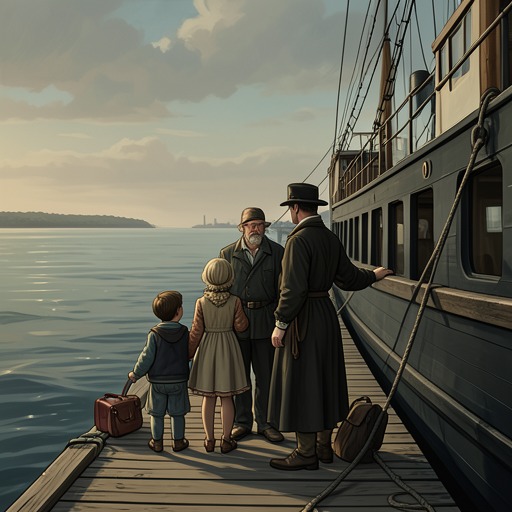
Messageries Maritimes
The LoverMessageries Maritimes was the French shipping line that linked Indochina to France in the world remembered by The Narrator. Its liners were not merely transport: they were floating towns, colonial infrastructure, and theaters of departure in which education, class, race, erotic attachment, grief, and the possibility of a new literary life converged. The line gives physical form to the passage from the Mekong world to France, while its slow voyages make separation visible as an extended human ordeal rather than a simple change of location.
Colonial Route and Historical Setting
Messageries Maritimes operated along the maritime route connecting Indochina with France at a time when large parts of the continents still lacked roads and railways. The liners traveled up the Saigon River with their engines off, drawn by tugs toward port installations on the bend of the Mekong known as the Saigon River. Once berthed, passengers were symbolically in France: they could dine and dance there, although such pleasures were too expensive for the Narrator’s mother and held no practical purpose for her. The route therefore joined a colonial possession to the metropolitan country while preserving sharp differences in wealth, access, and social position. The shipping line belongs to the final period of the great mailboats, just before the expansion of air travel began to deprive people of long sea journeys. The Narrator presents this transition as a change in the scale and meaning of movement. Earlier travelers crossed the sea at a natural, human speed, living through delays, waiting for wind or fair weather, and accepting the possibility of shipwreck, heat, and death. Messageries Maritimes thus represents both the reach of colonial modernity and a vanishing form of travel whose duration allowed departure to become an experience in itself.
Ships as Floating Societies
The voyage lasted twenty-four days. The liners were described as towns with streets, bars, cafes, libraries, drawing rooms, meetings, lovers, weddings, and deaths. Their passengers formed temporary societies, accidental communities that everyone knew to be contingent and therefore found tolerable, sometimes even unforgettable. For many women, and for some men, the voyage outward to the colony was the real adventure of their lives; the Narrator’s mother remembered such journeys, together with her children’s infancy, as the happiest days of her life. This shipboard world suspended ordinary social arrangements without abolishing them. People met strangers in an enclosed society created by the vessel, yet the very knowledge that the community would end gave its encounters a special freedom. The liner became a passage between fixed identities: between colony and metropole, childhood and adulthood, family duty and individual desire, and the life already known and the life that writing might later construct. Its enclosed sociability made movement feel intimate, while its route exposed every passenger to the larger geography of empire.
The Departure from Saigon
Messageries Maritimes becomes decisive at the moment of the Narrator’s departure from Indochina. The ship’s departure followed a ritual of repeated farewells. Three long, extraordinarily loud blasts from the siren were heard throughout the town; tugs drew the vessel into the middle of the river, then released it and returned to harbor. The ship sounded its farewell again, its mournful calls making not only those who were parting but also onlookers and people with no particular person in mind weep. Under its own steam, the vessel moved slowly toward the sea until its outline disappeared around the curve of the earth. The Chinese man from Cholon remained in the black limousine with its white-liveried driver, positioned apart from the Messageries Maritimes car park. The girl recognized the car and understood that he was watching her. She leaned on the rails as she had earlier leaned on the rails of the Mekong ferry, looking toward the motionless shape until the car, the harbor, and finally the land vanished. Her tears were concealed because he was Chinese and she believed that one ought not to weep publicly for such a lover. The ship therefore carries not only a passenger but a forbidden history whose emotional force cannot be acknowledged within the family or colonial order.
The Ocean Crossing and Its Dangers
After leaving the harbor, the ship entered a sequence of vast maritime spaces: the China Sea, the Red Sea, the Indian Ocean, and the Suez Canal, followed above all by the ocean itself. The ocean is the farthest and most expansive part of the journey, with the longest interval between landfalls, including the passage between Ceylon and Somalia. In calm weather the crossing could seem like travel over something other than water; the lounges, gangways, and portholes opened, and passengers escaped their hot cabins to sleep on deck. The vessel alternated between enclosure and exposure, routine and immensity. The line’s floating community also contained death. During an ocean crossing, a young man playing cards in the first-class bar suddenly laid down his cards, left without speaking, ran across the deck, and threw himself into the sea. Although the ship was stopped, traveling at full speed before the attempt, his body could not be found. The Narrator is uncertain whether the suicide occurred on that voyage or another, and later locates the remembered story elsewhere, in Sadec, where she had known the district officer’s seventeen-year-old son from high school. Nothing was found in his cabin, including no farewell letter. At dawn the ship resumed its course, and the empty sea and the decision to abandon the search became the worst part of the story. Messageries Maritimes thus carries an event whose disappearance is inseparable from its route: the ship continues, while the missing body remains beyond recovery.
Separation, Memory, and Literary Afterlife
For the girl, the ship’s first farewell marks the physical separation from the Chinese lover from Cholon, but the separation had begun before the vessel moved. Once her departure date was fixed, his body could no longer respond to hers; he became sexually impotent, saying that he was dead, while his gentleness remained intact. They decided not to see one another, yet he continued waiting outside the high school in his black car, his head turned away in humiliation. The ship makes this private change public and irreversible by placing it within a civic spectacle of sirens, tugs, spectators, waving handkerchiefs, and receding land. The voyage also becomes a structure through which memory is later organized. The absent photograph of the first ferry crossing acquires its force precisely because no one recognized the importance of the moment while it was occurring. By contrast, the Messageries Maritimes departure is surrounded by witnesses and ritual, yet the decisive intimacy remains inaccessible: the girl and her lover can see one another only as distant shapes, and their grief must remain concealed. The documented departure and the impossible photograph form opposing media of memory, one public and audible, the other absent and imagined. Years later, after the war, marriages, children, divorces, and books, the former lover came to Paris with his wife and telephoned the Narrator. His voice immediately restored the earlier connection; he said he had wanted only to hear her voice, then told her that he still loved her and would love her until death. The shipping line had carried her away from Indochina, but it had not completed the emotional journey. The telephone reverses the direction of the voyage without undoing its consequences: the former lovers meet again through sound, after the sea passage has become memory and the girl has become a writer.
Narrative and Cultural Significance
Messageries Maritimes embodies the book’s central tension between mobility and exclusion. Its ships enable movement across an imperial geography, but the people who move are not socially equal: the white girl’s passage toward France, the Chinese lover’s inability to be seen with her, and the mother’s restricted access to colonial pleasures all reveal that transportation does not dissolve racial and class boundaries. The same infrastructure that connects worlds also sorts who may travel, how they may appear, and what relationships can survive public recognition. The line also supports the Narrator’s larger transformation into an artist. The passage from Indochina to France becomes the route by which a girl leaves the colonial setting and enters the life from which books will later be written. In the broader literary frame, the lover’s body, the Mekong crossing, the black limousine, the ship, and the ocean are converted into forms that can circulate beyond their original place. Messageries Maritimes is therefore both a historical organization and a narrative machine: it transports bodies across the map, stretches farewell across twenty-four days, preserves accidents and deaths within recollection, and supplies the crossing through which private experience becomes world literature.