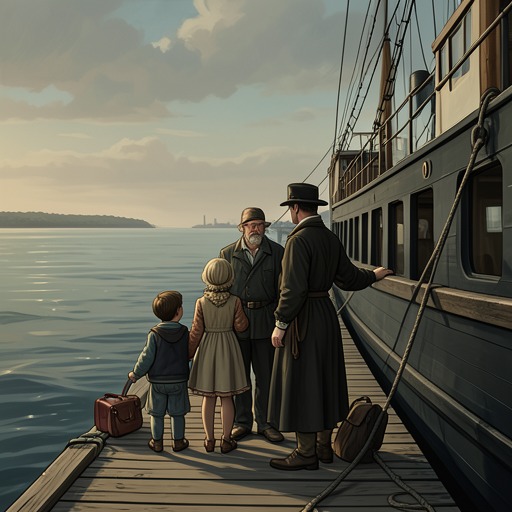
Paulo
The LoverPaulo, the Narrator’s younger brother, is the family’s most vulnerable member and the figure most completely trapped beneath The Elder Brother’s violence. His life is shaped by fear, interrupted education, dependence, and silence; his death in December 1942, during the Japanese occupation, becomes the event that ends the Narrator’s attachment to the family and transforms Paulo from an endangered child into the center of a larger meditation on grief, mortality, and immortality.
Identity and Family Position
Paulo grows up in a household ruled by the conflicting forces of his mother’s desperate care and The Elder Brother’s destructive authority. The Narrator describes The Elder Brother as a “black veil” cast over Paulo’s life: a living law whose presence fills every day with fear. The Narrator’s imagined wish to kill The Elder Brother is therefore presented not only as revenge for maternal favoritism but also as an attempt to rescue Paulo from a life already being occupied and suppressed by another man’s power.
Paulo is the younger son whom the mother tries repeatedly to place within an ordinary future. His education is conducted through the Universal Correspondence School, with bookkeeping courses taken at every level, year after year. The effort is unstable because the family abandons the school whenever the mother is posted elsewhere, beginning again in each new place. After ten years, the schooling has achieved little: Paulo becomes an accountant’s clerk in Saigon. The failed educational plan reveals both his limited opportunities in the colonies and the mother’s persistent habit of constructing makeshift futures for her children when more ambitious possibilities have disappeared.
Life Under Violence and Fear
The violence between the brothers begins when they are very young and recurs without any apparent cause beyond The Elder Brother’s command that Paulo get out of the way. Their fights are wordless physical assaults, marked by breathing, groans, and the dull impact of blows, while the mother accompanies them with shrieks. Both brothers possess a capacity for murderous anger, but their positions are unequal. The Elder Brother wants to exercise power freely and to dominate evil wherever he encounters it; Paulo cannot bear to watch helplessly what The Elder Brother is capable of doing.
The household therefore makes Paulo afraid not only during moments of open combat but as a continuous condition of life. When the Narrator’s relationship with The Lover from Cholon is suspected, Paulo hears their mother’s violence and shouts for her to leave the girl alone. He then hides in the garden because he fears that the Narrator will be killed, and because he is always afraid of The Elder Brother, whom the family experiences as a stranger within its own walls. His fear briefly calms the mother, showing how his vulnerability can still interrupt the family’s cycle of violence even though he cannot overcome its source.
The Narrator also tells The Lover from Cholon that The Elder Brother’s cold and insulting violence exists regardless of circumstance, and that his first impulse is to kill, erase, dominate, scorn, hunt, and make others suffer. Yet The Narrator adds that The Elder Brother is afraid of one person: the Narrator herself. Paulo has no comparable protection. In the family’s system of fear, the Narrator can sometimes confront or unsettle The Elder Brother, while Paulo remains the person most exposed to his authority and most unable to answer it.
The Sadec Meal and the Logic of Exclusion
One of the clearest images of Paulo’s subordination occurs during a meal in Sadec, when the brothers are seventeen or eighteen. The Elder Brother watches Paulo and the Narrator eat, puts down his fork, and tells Paulo that he must be careful not to eat too much. He insists that the large pieces of meat belong to him and that Paulo must remember this. When the Narrator asks why, The Elder Brother offers no reason beyond the assertion that this is simply how things are.
Paulo does not answer. He sits very pale while The Elder Brother waits for him to speak, his clenched fists poised to strike. The Narrator responds with a wish for The Elder Brother’s death, and neither she nor Paulo can continue eating. The scene turns food into an instrument of hierarchy: even at the family table, Paulo’s right to nourishment is treated as something that can be granted or withdrawn by force. His silence is not consent but the bodily expression of a terror that has learned resistance may provoke immediate harm.
The episode also clarifies why the Narrator later understands Paulo’s life as having been overwhelmed by The Elder Brother. The violence is not confined to spectacular fights. It enters the distribution of meat, the arrangement of bodies around a table, and the expectation that Paulo must remain silent while another person defines his place.
Separation, Death, and Aftermath
The Narrator leaves Saigon after graduating from high school in 1931 and is separated from Paulo for ten years. During that period, Paulo writes only once. His letter is conventional, carefully copied in neat handwriting without mistakes, and assures the Narrator that everyone is well and that the school is successful. He mentions having an apartment and a car, identifies the make, and says he has taken up tennis again. He does not mention the war or The Elder Brother. The letter’s polished reassurance conceals rather than resolves the family’s history, and its silence about the central sources of suffering makes the distance between the siblings feel both geographical and emotional.
Paulo dies in three days of bronchial pneumonia; his heart gives out. The death occurs in December 1942, during the Japanese occupation. For the Narrator, this is the day on which everything ends. She leaves her mother, stops asking questions about their childhood, and experiences her mother as having died symbolically with Paulo. The Elder Brother too becomes inseparable from the death in her perception: Paulo is understood as having died because of the long domination imposed upon him.
The Narrator later recalls receiving a telegram from Saigon, though she cannot remember its exact wording. She is unsure whether it said that Paulo was dead or used the phrase “Recalled to God.” The uncertainty belongs to the trauma of the news: first the death is incomprehensible, then pain arrives from every direction and overwhelms her identity. She distinguishes it from the earlier loss of a stillborn child, whom she had never known, and says that Paulo’s death produces a desire to kill herself. The delayed, fragmented memory of the telegram makes the event less a stable report than an aftershock that continues to alter the meaning of her life.
Memory, Immortality, and Narrative Role
After Paulo’s death, the Narrator imagines that everything must die after him and through him, as though his death initiates a chain reaction. She sees his body as having harbored immortality during the twenty-seven years of his life without knowing its name. Once that body is dead, the immortality it contained is also lost to the world, which continues without recognizing what has disappeared. Paulo is thus transformed from the family’s frightened, uneducated, scarcely articulate younger son into the bearer of a value that the living failed to perceive.
This transformation does not erase his concrete vulnerability. The Narrator emphasizes that Paulo was uneducated, struggled to speak, could scarcely read or write, and sometimes seemed unable even to understand or express suffering. His immortality is therefore not the result of public achievement, eloquence, or social power. It is attached to the irreducible fact of his existence and to the intensity of the love he inspires after death. The contrast gives the idea its force: the person whom the family and its social world treated as weak becomes, in memory, the figure through whom the Narrator understands the limits of mortality.
The Narrator calls her love for Paulo a mystery. She had been separated from him for ten years and had hardly thought about him when he died, yet she feels that she had loved him forever and that nothing new could happen to that love. His death therefore reveals an attachment that had existed beneath conscious attention. The loss does not simply recall a relationship; it discovers one retrospectively, converting absence into knowledge.
Paulo’s narrative role is finally inseparable from the act of writing. While the family is alive, the Narrator circles around its members and avoids confronting what they have done to one another. After Paulo’s death, memory becomes both unbearable and unavoidable. His death breaks the family bond in lived time, but it also provides the central image through which the Narrator can understand inherited violence, maternal despair, and her own desire to die. Paulo remains silent within the family, yet his death becomes the event that makes the family’s silence legible.