Suez Canal
The LoverThe Suez Canal appears as one segment of the sea voyage that carried passengers between Indochina and France. Its importance lies less in a scene set beside the canal than in the way the remembered route gathers distant seas, colonial infrastructure, departure, and loss into one continuous passage: the canal marks a transition within a journey that is already separating people from their former lives.
Place in the Maritime Route
The narrator recalls that liners traveled through the China Sea, the Red Sea, the Indian Ocean, the Suez Canal, and then onward across the ocean. The voyage belonged to the era when ships were among the principal means of connecting distant parts of the world. The vessels of the Messageries Maritimes linked Indochina to France, and a crossing lasted twenty-four days. The Suez Canal therefore belongs to a route that joined a colonial outpost to the metropolitan country through a sequence of named waters and ports.
The route is presented as both mechanical and socially expansive. The liners were described as towns, containing streets, bars, cafés, libraries, drawing rooms, meetings, lovers, weddings, and deaths. The canal is consequently not an isolated geographical curiosity but part of a mobile society assembled temporarily aboard ship. Its passage helps transform distance into an organized itinerary while preserving the emotional scale of an immense separation.
Passage, Departure, and Separation
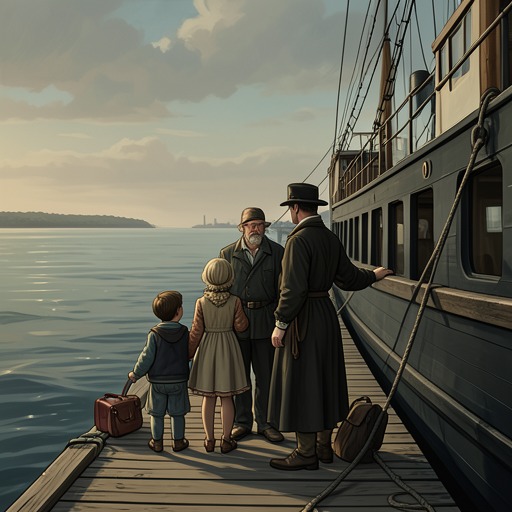
The Suez Canal stands within the voyage that follows the lovers’ separation. Before the ship leaves, the Chinese man from Cholon watches from his long black car, while the girl leans on the rail and looks back toward him. The harbor and land gradually disappear. The subsequent movement through the canal and across the seas gives physical form to a parting that cannot be reversed by simply returning to the original place.
This maritime sequence also contrasts with the earlier crossing of the Mekong River. The ferry between Vinh Long and Sadec is a local passage through the great plain of mud and rice, whereas the ocean liner carries passengers between Indochina and France. The Mekong crossing introduces the girl to the Chinese man from Cholon and becomes an origin point for the affair; the Suez Canal belongs to the later route away from that world. Together, the crossings create a chain of thresholds, moving from a regional landscape into an international system of colonial travel.
The Route and Its Human Consequences
Although the canal itself receives only brief mention, the voyage around it carries consequences that extend far beyond navigation. The girl leaves behind the Chinese man from Cholon, while the route places her within the world to which she will return as a writer. The journey thus connects erotic memory with literary memory: the geography of travel becomes part of the material through which a life is later reconstructed.
The voyage also contains an episode of sudden death. During an ocean crossing, a seventeen-year-old passenger left a card game, ran across the deck, and threw himself into the sea. The ship stopped, but his body was not found. The narrator’s recollection is uncertain about whether the suicide occurred on that particular voyage, yet the image remains attached to the remembered journey: the ship continues at dawn across an empty sea after the search is abandoned. The Suez Canal consequently belongs to a route marked not only by movement and connection but also by disappearance.
Narrative Significance
In the retrospective structure of the book, the Suez Canal is named while the narrator reconstructs an earlier world from a later vantage point. The route is not presented as a detached travel itinerary. It gathers the colonial relationship between Indochina and France, the long distance separating the lovers, the social world temporarily created aboard ship, and the possibility that a journey may contain both departure and death.
The canal’s significance is therefore threshold-like. It divides stages of travel without resolving the emotional passage between them. The lovers can be separated by the movement of a ship, yet memory later crosses the same distances: years after the war, after marriages, children, divorces, and books, the former lover from Cholon telephones from Paris and says that he still loves her. The canal remains part of the intervening geography, a link within the route that carried them apart and within the transnational world through which their memory eventually returns.