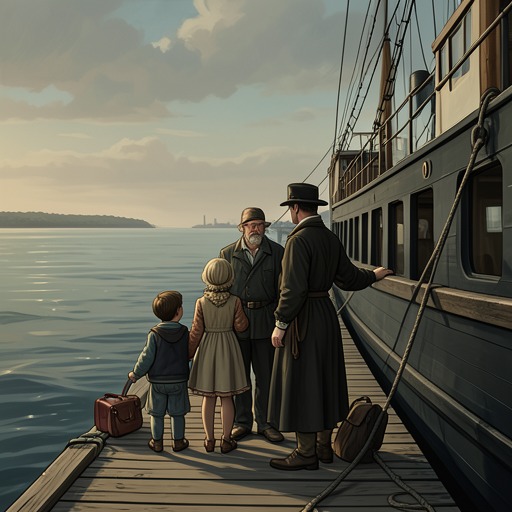
The Family’s Departure from Indochina for France
The LoverThe Family’s Departure from Indochina for France is both a physical voyage and the central threshold of the narrator’s formation. After the failure of the mother’s land by the dike and the death of the younger brother, the family leaves the colonial landscape for France. The departure ends the household’s already damaged existence in Indochina, separates the narrator from the Chinese lover from Cholon, and begins the long transformation by which the girl who crossed the Mekong becomes the woman who writes about that crossing, the family, and the lost lover.
Causes and Historical Background
The departure follows the collapse of the mother’s hopes for the land by the dike. She had tried to establish a productive life in the colony, but the lower part of the property was lost, the remaining patches were worked by servants, and the bungalow deteriorated under endless rain. The family’s economic failure made the land impossible as a future, while the mother’s repeated confrontations with officials, the land registrar, and the law left her without a practical means of recovery. The property remained as a ruinous emotional center rather than a viable home: the servants cared for the bungalow, polished its furniture, opened its doors by day, and shut them against stray dogs and smugglers at night.
The mother’s last visit to the dike gives the departure the character of a farewell ritual. A year and a half after the narrator’s meeting with the wealthy Chinese man on the ferry, the mother takes the family back to France, intending to sell the furniture and look once more toward the mountain and the green and yellow sky above the forest. The departure therefore does not simply answer poverty. It closes the mother’s relationship with the landscape in which she had invested her labor, hopes, and failure. She will later return to Indochina and retire in Saigon, but the dike and its mountain will never again be part of her life.
The family’s history is also marked by death. During the Japanese occupation, the younger brother dies in three days of bronchial pneumonia, his heart giving out. The narrator identifies that death as the day on which she left her mother. She describes the mother, and also the elder brother, as having died for her emotionally at the same moment. The family’s departure thus occurs after a private catastrophe that has already destroyed ordinary attachment, even before the geographical separation is completed.
The Voyage from Indochina to France
The route begins through the waterways that connect the colony to the sea. Liners travel up the Saigon River with their engines off, drawn by tugs toward the port installations in the bend of the Mekong at the latitude of Saigon. Once berthed, the ships create a temporary version of France: passengers can dine and dance there, though such pleasures are too expensive for the mother. The route is served by the ships of the Messageries Maritimes, which function as the great maritime link between Indochina and France at a time when large parts of the continents still lack roads and railways.
The voyage lasts twenty-four days. The liner is described as a floating town, containing streets, bars, cafes, libraries, drawing rooms, meetings, lovers, weddings, and deaths. Its passengers form temporary societies whose chance character makes them both fragile and, at times, unforgettable. For the mother, such journeys, together with the children’s infancy, had been the happiest days of her life. That remembered happiness intensifies the irony of the present departure: the same maritime world that once represented adventure and promise now carries the family away from the place where those hopes have failed.
The departure belongs to an older scale of movement, before air travel made ocean crossings faster and less ceremonious. The ships are among the last mailboats of their kind, and the journey is measured through delays, weather, distance, and waiting. The route passes the China Sea, the Red Sea, the Indian Ocean, and the Suez Canal before reaching France. The ocean is the greatest interval between landfalls, an expanse that makes separation material and visible rather than instantaneous. The family does not merely change countries; it spends nearly a month inhabiting the distance between one life and another.
The Scene of Farewell
The ship’s departure turns the family’s migration into a public spectacle of mourning. Three long blasts from the siren are heard across the town. Tugs draw the vessel toward the middle of the river, release their cables, and return to harbor. The ship sounds its farewell again, with wails so terrible and mysteriously sad that not only the departing passengers but also onlookers and people with no particular person to farewell are moved to tears. The vessel proceeds slowly under its own steam until its outline is swallowed by the curve of the earth.
For the narrator, the decisive emotional moment comes when the gangway is hauled up and the tugs begin pulling the ship away from land. She cries without allowing her mother or younger brother to see her sadness, because the lover is Chinese and she believes that one should not weep for such a lover. Her silence repeats the family’s habitual refusal to display feeling. The loss is therefore both intimate and concealed: she is leaving the man she loves while preserving the appearance that nothing has happened.
The Chinese lover remains visible only through his car. His long black automobile, with its white-uniformed driver, stands apart from the Messageries Maritimes car park. He is a nearly indistinct figure in the back seat, motionless and overwhelmed. The narrator leans on the rail as she had on the first day, when she met him on the ferry crossing the Mekong. She knows that he is watching her and continues looking toward the black car even after she can no longer see him clearly. Finally the car disappears, then the harbor, and then the land itself. The sequence turns physical distance into an image of emotional erasure without making the attachment disappear.
Consequences for the Family and the Lover
The departure permanently rearranges the family. The mother remains in Saigon from 1932 until 1949, partly because she says she must stay near the younger brother’s grave, before eventually returning to France. Reunion with the narrator comes too late: when they meet again, the narrator’s son is already two years old, and both recognize at first sight that there is nothing left to reunite. The mother later lives and dies in Loir-et-Cher, in a sham Louis XIV chateau, with Dô, while continuing to sacrifice her resources for the elder brother.
In France, the mother’s efforts remain desperate and economically unstable. She buys a property near Amboise for the elder brother; he cuts down its woods and loses the money in one night at a baccarat club in Paris. At the chateau, she installs electric incubators in the main drawing room and produces six hundred chicks, but an error with the infrared rays leaves them unable to eat, so they starve. These later failures echo the failed land by the dike and show that the departure has not delivered the family into security. It has transferred the mother’s struggle to another country without resolving its underlying pattern.
The mother eventually founds the Nouvelle Ecole Française. The school earns enough to help the narrator with her studies and support the elder brother for as long as the mother lives. This institution becomes an unexpected consequence of displacement: the failed colonial developer becomes the founder of a school, and the family’s survival is sustained not by the land but by education. Yet even this achievement remains bound to maternal sacrifice and to the elder brother’s dependency rather than to a stable family renewal.
For the lover, the departure produces a physical and erotic collapse before it produces any later reconciliation. Once the date of the narrator’s departure is fixed, he loses his sexual potency. He tells her that he can no longer make love and that he feels dead, while his gentleness remains intact. They decide not to see one another, but the decision fails; every evening he waits outside the high school in his black car, turning his head away in humiliation. The separation therefore begins before the ship sails, as anticipation changes the body and makes the coming loss present in advance.
Long-Term Meaning and Return
The family’s departure does not end the relationship between the narrator and the Chinese lover; it gives that relationship its lasting form as memory. Years after the war, after marriages, children, divorces, and books, the former lover comes to Paris with his wife and telephones the narrator. She recognizes him immediately by his voice. He says that he only wanted to hear her voice, then tells her that he still loves her and will love her until death. The call reverses the finality of the harbor scene without cancelling it. The lovers cannot recover their shared life, but the voice crosses the distance that the ship once established.
The departure also becomes the route by which the narrator enters writing. The evidence of the voyage is repeatedly reorganized through recollection: the ferry crossing, the black car, the harbor, the ship’s siren, and the disappearance of land are not merely remembered facts but the materials through which a self is made. The narrator’s movement from Indochina to France parallels the movement from lived experience to literary form. The girl leaves the colony, while the future writer returns to it through language.
In this sense, the event is both an ending and a beginning. It ends the mother’s colonial project, the narrator’s daily access to the lover, and the family’s shared existence in Indochina. It begins the narrator’s French life, the later work of writing, and the transnational circulation of the story between Indochina, France, Paris, cinema, and readers elsewhere. The departure is decisive not because it resolves the past, but because it makes the past permanently unavailable and therefore permanently writable.