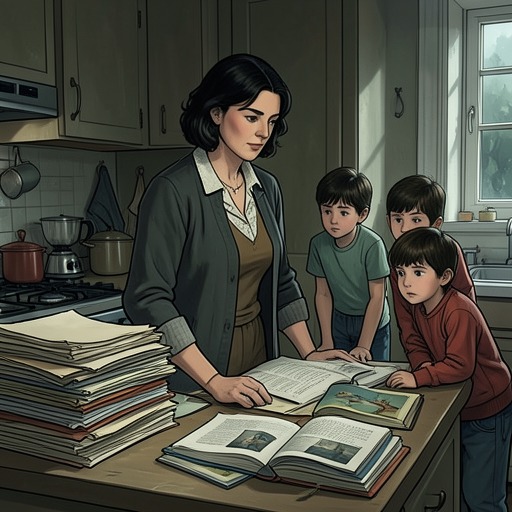
The failed purchase of the land by the dike
The LoverThe failed purchase of the land by the dike is not merely a bad investment but the material center of the family’s ruin. The mother buys land in the hope of securing a future for her children, yet the land proves unusable and the money is lost. What remains is a bungalow, a damaged agricultural scheme, unpaid labor, and a family organized around waiting. The failure converts the colonial landscape into a source of debt and despondency, while forcing education, migration, theft, and the daughter’s relationship with the wealthy Chinese man from Cholon into the same desperate struggle for survival.
Purchase and Family Circumstances
The purchase takes place while the family’s prospects are already being managed through improvised plans. The mother is a teacher who insists that The Narrator attend high school in Saigon and pursue a degree in mathematics, while trying to construct futures for the sons through education. The younger brother is repeatedly enrolled in the Universal Correspondence School for bookkeeping, although each course lasts only a few days before the family’s next move interrupts it. The Elder Brother is sent to France for technical training, partly because there is no technical school in the colonies and partly because his absence removes him from the other children. During those years, the mother buys the land by the dike, making the investment part of a larger attempt to hold the family together by giving each child a possible economic role.
The decision is also made against a background of poverty without literal starvation. The family is white, ashamed of its poverty, and forced to sell furniture, but it still has a houseboy and food. Even the strange food available to them, including storks and baby crocodiles, is cooked and served in the household. This distinction matters: the family’s crisis is not represented as simple hunger but as the collapse of property, planning, and social security. The mother’s purchase becomes a gamble by someone who has too few resources to absorb failure.
The Land and Its Failure
The land is repeatedly described as a wilderness and a waste. Its lower portion is lost permanently, while servants cultivate patches on the higher ground and keep the paddy for themselves. They remain without wages, using the sturdy straw huts the mother had built, and continue to care for the bungalow as though the family belonged to their own household. Their work preserves a remnant of order, but it cannot restore the investment or reverse the loss. The economic failure therefore does not end in a single dramatic foreclosure; it persists through diminished cultivation, unpaid labor, and the slow decay of the property.
The bungalow becomes the visible monument to that failed scheme. Its cheap crockery remains in place, its roof disintegrates under endless rain, and its furniture is kept polished. The doors are opened each day to let wind pass through and dry the wood, then closed each night against stray dogs and smugglers from the mountains. The building is maintained even as the land can no longer sustain the family. This contrast gives the failure its peculiar duration: the property is neither fully abandoned nor successfully inhabited, but preserved as an empty shape while the people attached to it grow inert.
Waiting, Despair, and Family Consequences
The failed land purchase becomes inseparable from the mother’s recurring despair. The Narrator associates the mother’s daily despondency with the house she bought, the father’s approaching death, and the practical burdens that she could not escape. At unpredictable moments the despair makes it impossible for her to continue, sleep, wash, dress, or feed the children; at other moments it leads to impulsive purchases, removals, or acts of extravagant generosity. The land is one of the “wildernesses” surrounding her: the sons seem incapable of producing a future, and the salt land has consumed the family’s money.
The children inherit the consequences in different forms. The younger brother is pushed toward bookkeeping but becomes an accountant’s clerk in Saigon, while the Elder Brother’s education and later conduct remain bound to the family’s destructive economy. The Narrator understands that she may be the only child capable of turning attention into money. The mother’s failure thus transforms the daughter’s developing body and social visibility into a possible financial resource. The family’s future is no longer secured by land; it is imagined through whatever each child might earn, surrender, or extract.
The Property as a Scene of Stagnation
When The Narrator recalls returning to the property with her mother and younger brother, the family is already too old for the adventures that once filled the place. They no longer bathe in the river, hunt black panther in the marshes, enter the forest, or visit villages in the pepper plantations. The landscape has grown around them, and the children themselves have become strange and sluggish. They watch the forest, wait, and weep. The failed purchase has altered not only their finances but their relation to time: the family remains physically present while the anticipated future recedes.
This stagnation is environmental as well as psychological. Rain rots the roof, the lower land is irretrievably lost, and cultivation survives only in scattered higher patches. The property’s damage accumulates gradually rather than arriving as one spectacular disaster. The family’s poverty is therefore embedded in a landscape whose agricultural promise has failed them, while those with the least power—the servants who continue working without wages—absorb part of the cost. The dike land is both a private miscalculation and a colonial economic condition in which labor and land cannot guarantee security.
Departure and Afterlife of the Failure
The failed purchase eventually helps determine the family’s departure from Indochina. About a year and a half after The Narrator meets the wealthy man on the ferry, the mother takes the children back to France and sells the furniture. Before leaving, she returns once more to the dike, sits on the bungalow’s veranda, and looks toward the mountains of Siam and the forest beneath the setting sun. It is a final act of attachment to a place that has already ceased to offer a future. She will never see that mountain and sky again, even when later changes of mind bring her back to Indochina and eventually to retirement in Saigon.
The loss does not disappear after the family leaves. The mother later opens the Nouvelle Ecole Française, a French-language school that earns enough to support The Narrator’s studies and provide for The Elder Brother for as long as she lives. This later enterprise contrasts sharply with the land purchase: education, once interrupted and improvised, becomes the means of generating income, while the agricultural investment remains associated with waste and exhaustion. In the family’s larger history, the failed land is the abandoned promise behind every subsequent attempt to make a future elsewhere.
Narrative and Thematic Significance
The Narrator corrects an earlier version of the story by insisting that the meeting with the rich man in the black limousine did not occur in a bar at Réam. It happened on the ferry, two or three years after the family had left the land by the dike. The correction places the failed purchase directly behind the encounter, making the ferry a threshold between one failed economic world and another form of exchange. The daughter’s account of having no money, of the dikes, and of the mother’s approaching death shows that the relationship with the wealthy man cannot be separated from the family’s financial collapse.
The Elder Brother’s later thefts make the same history more brutal. He steals from the household, from the servants, and from his mother in order to smoke opium and gamble. The family’s house is sold to pay his debts, while a property near Amboise bought with ten years of savings is mortgaged in one night. These later losses repeat the logic of the failed land purchase: property is acquired as protection, then consumed by the family member whom the mother cannot stop supporting. The dike land therefore becomes the first major form of a recurring economic tragedy, in which maternal sacrifice is converted into debt and the family’s resources are drawn toward destruction rather than renewal.