The suicide of the seventeen-year-old passenger
The LoverThe suicide of the seventeen-year-old passenger is an episode remembered around a sea voyage from Indochina toward France. Its decisive significance lies not only in the disappearance of a young man into the ocean, but in the way the event destabilizes memory and awakens the Narrator to the emotional truth of her relationship with The Lover from Cholon. A stranger’s death becomes a threshold through which love, separation, and the possibility of death itself are suddenly perceived together.
Circumstances and Uncertainty
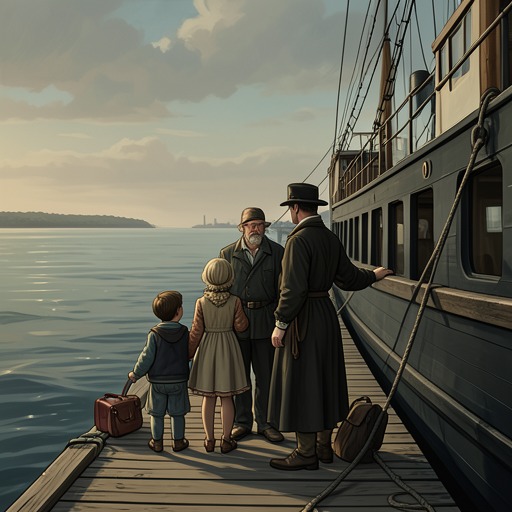
The death occurs during a crossing of the Indian Ocean, although the Narrator initially cannot determine whether it happened on that voyage or another. She first remembers the setting as a late night on the boat: people are playing cards in the first-class bar, and a young man among them silently puts down his cards, leaves the room, runs across the deck, and throws himself into the sea. The ship is traveling at full speed. Even after it is stopped, the body cannot be found.
The memory then corrects and relocates itself. As the Narrator writes the episode down, she no longer sees the boat as the primary scene; instead, she remembers being told about it in Sadec. The dead passenger was the son of the district officer there, someone she had known from the high school in Saigon. This recognition gives the suicide a disturbing intimacy. He is not an anonymous passenger but a familiar young man, remembered as dark, tall, gentle-faced, and wearing horn-rimmed glasses. His age remains fixed in her memory as seventeen, an age whose youth makes the death terrifying.
The Act and Its Aftermath
No farewell letter is found in the passenger’s cabin, and no explanation is supplied for his decision. The boat resumes its course at dawn. The search is abandoned, leaving the empty sea and the sunrise as the event’s practical aftermath. The most unbearable fact is not a discovered body but the continuation of ordinary travel: the vessel goes on, and the passengers must proceed while the missing boy remains beneath or beyond the ocean.
The Narrator identifies the resumption of the voyage as the worst part. The ship’s movement converts suicide into an irreversible separation, one that cannot be repaired by testimony or evidence. The absence of a body and the absence of a letter preserve the death as an unanswered rupture. What remains is the stark sequence of night, disappearance, dawn, and the decision to stop searching.
The Music and the Reversal of Feeling
On another night during the same route, the memory of the suicide returns through music. A Chopin waltz suddenly bursts from the lounge on the main deck beneath a brilliantly lit sky. The Narrator knows the piece personally because she had tried for months to learn it and had never managed to play it properly; that failure had helped persuade her mother to let her abandon the piano. The familiar music is therefore bound to an earlier history of effort, frustration, and release.
In the darkened ship, however, the waltz becomes strange and commanding. It spreads across the boat like an injunction whose meaning cannot be understood, or like an order from God whose purpose remains inscrutable. The girl rises as though she might kill herself in turn by throwing herself into the sea. The remembered death thus changes from an external report into a bodily possibility confronting the Narrator herself. The value at stake shifts from the apparent continuity of life to the terrifying nearness of death.
The impulse does not culminate in another suicide. Instead, it produces recognition. The Narrator weeps because she suddenly wonders whether she had loved The Lover from Cholon with a love she had not recognized at the time. The affair had absorbed and concealed that feeling, as water disappears into sand; the music brings it back to the surface. The passenger’s death therefore functions as a displaced revelation: through the thought of dying, the Narrator discovers the depth of a love she had previously experienced without fully seeing.
Separation, Love, and Narrative Meaning
The suicide is embedded in the larger movement of departure. Before the voyage, The Lover from Cholon continues to meet the Narrator in the apartment in Cholon even after the date of her departure has been fixed. His body has lost its potency, and he tells her that he can no longer make love to her. They agree that they should stop seeing each other, but the separation proves impossible; every evening he waits outside the high school in his black car, his head turned away in humiliation.
When the ship finally leaves, its long blasts and slow movement through the river make separation public and monumental. The Narrator weeps unseen because The Lover from Cholon is Chinese and, within the racial and social order surrounding her, he is not regarded as the kind of lover for whom a white girl should openly grieve. The ocean suicide echoes this enforced silence. Both deaths involve a departure that cannot be reversed, while both are surrounded by observers who cannot fully enter the suffering of the person who has gone.
The later recollection of the suicide also prepares the Narrator’s understanding of loss. During the same voyage, music makes her see The Lover from Cholon anew, just as death later allows her to perceive the continuing presence of her younger brother. The event belongs to a chain in which disappearance is not simple erasure. The dead and the departed become more fully legible after they can no longer be reached, and memory converts an uncompleted farewell into a lasting image.
Threshold and Mortality
The episode occupies a series of thresholds: the ship leaves land, crosses the ocean, loses a passenger, resumes its course, and carries the Narrator toward France. The voyage is already a movement away from family, colonial childhood, and The Lover from Cholon; the suicide intensifies that movement by placing an irreversible death inside the passage itself. The sea is at once a route to another life and a space into which a life can vanish without explanation.
The Narrator’s uncertainty about whether she witnessed the death or learned of it later is essential to its force. The event is not presented as a stable report with a recoverable cause. It is reconstructed through competing locations, impressions, and temporal layers, and its meaning emerges only when the memory encounters the Chopin waltz and the thought of The Lover from Cholon. The suicide consequently belongs as much to the structure of remembrance as to the chronology of the voyage: it is a gap that generates recognition.
The later telephone call from Paris, years after the war and after marriages, children, divorces, and books, confirms how thoroughly the old separation has persisted. The Lover from Cholon phones merely to hear the Narrator’s voice and tells her that he still loves her and will love her until death. Against that declaration, the seventeen-year-old passenger’s disappearance remains the voyage’s silent counterpoint: one voice survives across decades, while the boy leaves no letter and no body. Together, the two episodes make death and memory inseparable from the Narrator’s belated knowledge of love.