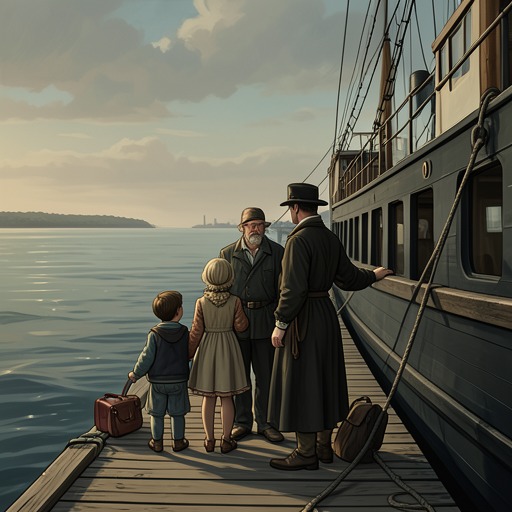
The voyage from Indochina to France
The LoverThe voyage from Indochina to France is both a literal departure and the central threshold of the Narrator’s formation. Beginning after the family’s final withdrawal from the land by the dike, it removes the Narrator from the Mekong world where poverty, colonial hierarchy, family conflict, and her affair with the Lover from Cholon have become inseparable. The passage does not resolve those entanglements. Instead, its slow movement across rivers, seas, and canals preserves them as memory, grief, and the material of future writing.
Causes and Background
The voyage follows the collapse of the Mother’s hopes for the land by the dike. A year and a half after the Narrator meets the wealthy Chinese man on the ferry, the Mother takes the family back to France, sells the furniture, and makes one final visit to the dike. She looks toward Siam and toward the mountain and the green and yellow sky above the forest, knowing that she will never see them again in the same way. Her departure is therefore not a triumphant return but the abandonment of a failed colonial project and of a landscape that has defined the family’s misery.
The journey also follows the Narrator’s separation from the Lover from Cholon. Their affair has lasted a year and a half, but both understand from the beginning that they can have no future together. The racial and social order of Indochina makes their relationship impossible: the Narrator is a very young white girl from a poor French family, while the Lover from Cholon belongs to a wealthy Chinese family whose fortune comes from working-class housing in the colony. Their separation is thus produced not only by distance but by colonial racial hierarchy, family authority, and the Chinese-white marriage taboo.
The voyage belongs to an older world of travel in which ships connected Indochina to France across immense distances. The liners moved up the Saigon River with their engines off, drawn by tugs toward the port installations at the bend of the Mekong. Once berthed, they offered a temporary France where passengers could dine and dance, although such pleasures were too expensive for the Mother. The Messageries Maritimes ships are presented as among the last great mailboats, linking places that still lacked roads and railways and making distance a lived duration rather than a brief interval.
Departure from Indochina
The departure is staged as a public ritual of sound, delay, and disappearance. When the ship is due to sail, it gives three very long blasts on its siren, loud enough to be heard throughout the town. Tugs pull the vessel toward the middle of the river, cast off their cables, and return to the harbor. The ship then sounds another farewell before moving under its own power. Its outline advances slowly toward the sea until the curve of the earth swallows it; on a clear day, the Narrator imagines, one can watch it gradually sink from sight.
The same departure is experienced privately by the Narrator and the Lover from Cholon. She weeps when the gangway is raised and the tugs begin towing the ship away, but she hides her tears because he is Chinese and she is not supposed to grieve publicly for such a lover. His long black car, with its white-liveried driver, stands apart from the Messageries Maritimes car park. She recognizes him in the back, motionless and overcome. Leaning on the rails as she once leaned on the ferry, she looks toward the barely visible shape even after she can no longer see him. Finally the black car disappears, followed by the harbor and the land.
The emotional restraint of the scene repeats the family’s established silence. The Narrator does not allow her Mother or younger brother to see her sadness, just as intimate matters remain unspoken within the family. The ship therefore carries away not an openly acknowledged love but a concealed one, made more painful by the rule that it must not be named or mourned.
The Twenty-Four-Day Passage
The voyage lasts twenty-four days, long enough for the ship to become a temporary society. Its streets, bars, cafés, libraries, drawing rooms, meetings, lovers, weddings, and deaths create a floating world formed by chance. These accidental communities are tolerable precisely because everyone knows they are temporary. For the Mother, such voyages, together with the children’s infancy, had been the happiest days of her life; for the Narrator, the same form of travel becomes the setting in which departure, memory, and loss are held open over time.
The route expands the family’s departure into a geography of empire and world circulation. The vessel passes the China Sea, the Red Sea, the Indian Ocean, and the Suez Canal. At one point, the absence of vibration reveals that the ship is moving through the sand of the canal. Above all, the ocean creates the greatest distance between landfalls, especially between Ceylon and Somalia. When the weather is calm, passengers leave their hot cabins to sleep on deck, and the whole ship opens through lounges, gangways, and portholes. The voyage alternates between confinement and release, between the intense proximity of shipboard life and the immense emptiness surrounding it.
This movement is also a passage from one historical order to another. The liners are described as among the last mailboats in the world, while the first airlines are beginning to replace such sea journeys. The voyage thus preserves a disappearing form of human movement, one governed by wind, waiting, shipwreck, sun, and death. Its slowness gives separation a physical measure and prevents the emotional consequences of departure from being quickly evaded.
Consequences and Aftermath
The voyage makes the separation from the Lover from Cholon irreversible, but it does not end their attachment. Even before departure, the fixed date of the Narrator’s leaving has already altered the Lover’s body. He loses his sexual potency, saying that his body no longer wants the body that is about to go away. He describes himself as dead, while remaining gentle and apologetic. They decide not to see each other again, yet he continues to wait outside the high school each evening in his black car, his head turned away in humiliation. The ship’s departure therefore completes a separation that had begun internally before either lover reached the harbor.
For the Narrator, leaving Indochina produces both escape and loss. France offers a new location, but the voyage does not free her from the colonial family history she carries with her. The ferry crossing on the Mekong, the black limousine, the Cholon apartment, the city’s shouted Chinese voices, and the Lover’s car at the harbor remain bound together in recollection. The later telephone call from Paris confirms that time and distance have not erased the relationship. Years after the war, after marriages, children, divorces, and books, the Lover from Cholon phones the Narrator in Paris. She recognizes him immediately by his voice. He says he wanted only to hear her voice, tells her that he has heard she writes books, and says that he still loves her and will love her until death.
That later call reverses the apparent finality of the voyage without undoing its consequences. The lovers do not reunite physically; instead, the voice crosses the distance that the ship once established. The passage from Indochina to France therefore ends not in restored domestic life but in a delayed auditory return, where the lost relationship reappears through speech and memory.
Narrative and Historical Significance
The voyage functions as a threshold between identities rather than a simple change of location. Before it, the Narrator is a fifteen-year-old girl moving through colonial Indochina, divided between the poverty of her family and the wealth of the Lover from Cholon. After it, the experience can be recollected by the woman who becomes a writer. The journey does not provide a clean transformation, because the Narrator’s old world continues to organize her later consciousness; it gives her the distance from which that world can be made into literature.
Its significance is intensified by the novel’s unstable relation to memory. The voyage is narrated through images that are recalled, revised, and connected to other scenes of crossing, including the first meeting on the Mekong ferry. The ship’s route becomes a material counterpart to writing itself: a long movement through fragments of place, sensation, historical violence, and emotional aftermath. The Narrator’s departure from Indochina is thus also the beginning of her return to it through language. The sea carries her away from the Lover and the family, but it preserves the conditions under which she can later write them down.