Universal Correspondence School
The LoverUniversal Correspondence School appears as a recurring educational institution in the family history of the Narrator. Its courses are ordered for the younger brother, whom the mother attempts to train through bookkeeping lessons while the family moves from one colonial posting to another. The school therefore represents both her determination to manufacture a future for her children and the precarious conditions that repeatedly defeat that determination.
Place in the Family’s Educational Plan
Universal Correspondence School is introduced alongside the mother’s insistence that the Narrator attend high school and eventually earn a degree in mathematics. Education is treated as the practical foundation of a planned future: what had once been sufficient for the mother is no longer sufficient for her daughter, while the sons require other, more makeshift routes into employment. The correspondence school belongs to this differentiated family strategy, offering the younger brother a course of study when the available colonial institutions cannot provide a stable technical education.
The mother’s plans are not presented as detached ambitions. They are her way of filling the uncertain time ahead with projects for the children. When grand futures for the sons become impossible, she substitutes workable ones, and the correspondence lessons become part of that effort. The school’s presence in the narrative is consequently inseparable from maternal hope, improvisation, and desperation.
Courses, Interruptions, and Repetition
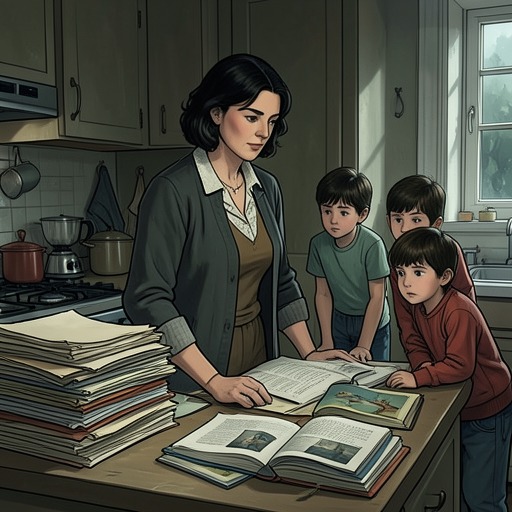
The younger brother studies bookkeeping through Universal Correspondence School, taking every year and every level offered. The arrangement is repeatedly interrupted whenever the mother receives a new posting. The family abandons the school after only a few days—three days, never four—and begins again at the next destination. This cycle continues for ten years.
The repetition gives the institution a distinctive narrative function. It is not a completed educational path but a ritual of restarting, a formal promise that never becomes durable progress. Each new posting breaks the continuity that the mother is trying to create, so the school’s curriculum remains suspended between intention and achievement. The lessons travel with the family, but the family’s unstable circumstances prevent them from becoming a settled life.
Outcome for the Younger Brother
The mother’s sustained effort ultimately produces only a limited result. The younger brother becomes an accountant’s clerk in Saigon, but the correspondence education is explicitly judged unsuccessful: after ten years, “It wasn’t any good.” The school has provided neither the advancement nor the secure transformation the mother had imagined. His eventual clerical position is therefore both an outcome and a measure of the plan’s narrowness.
This failure contrasts with the elder brother’s departure for France to study at a technical school. Because there is no technical school in the colonies, the elder brother is sent away, and the mother’s purchase of land occurs while he is absent. The younger brother, by contrast, remains within the family’s unstable colonial circuit and receives a portable but repeatedly broken education. Universal Correspondence School thus marks the unequal educational futures available to the brothers, even within the same household.
Colonial Modernity and Narrative Significance
The school embodies a form of modern education that is mobile in theory but fragile in practice. It offers standardized courses and levels across a territory where the family cannot rely on permanent institutions, yet its very portability exposes the limits of that modern promise. The school can send lessons across distance; it cannot prevent postings, family dislocation, poverty, or the absence of technical schools from shaping the children’s prospects.
Its story also sharpens the portrait of the mother’s planning. She continues the bookkeeping program for a decade despite its interruptions, not because the evidence suggests that it works, but because planning is one of the few forms of resistance available to her. The correspondence school becomes a material sign of a future repeatedly begun and repeatedly lost, linking domestic duty, colonial educational scarcity, and the family’s broader history of failed attempts to secure itself.